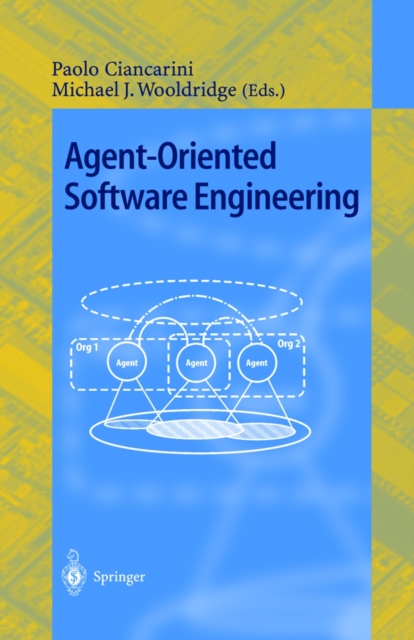
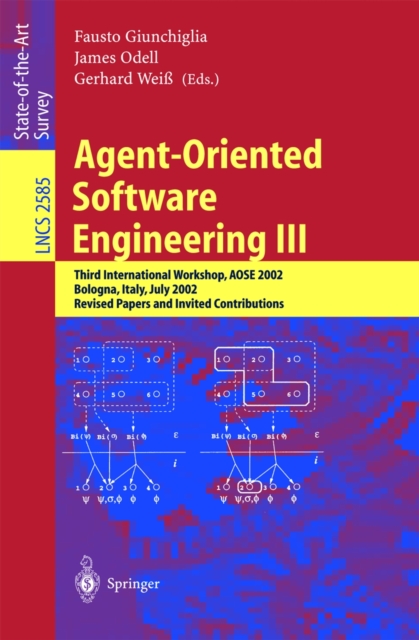
One of the most important reasons for the current intensity of interest in agent technology is that the concept of an agent, as an autonomous system capable of interacting with other agents in order to satisfy its design objectives, is a natural one for software designers.
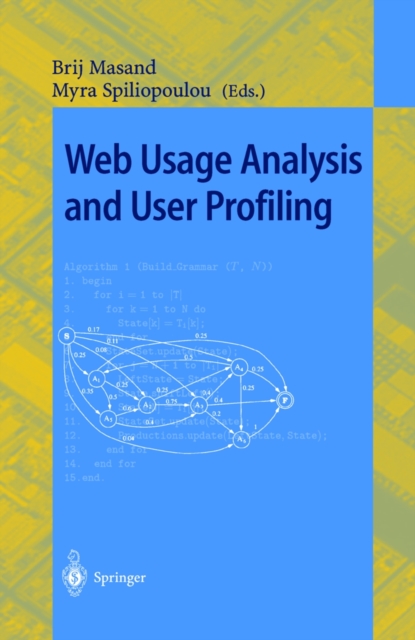
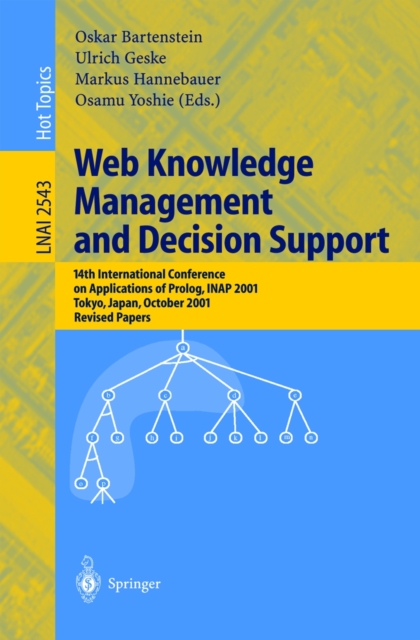
After the advent of data mining and its successful application on conventional data, Web-related information has been an appropriate and increasingly popular target of knowledge discovery.
This book constitutes the joint refereed proceedings of the 8th International Workshop on Structural and Syntactic Pattern Recognition and the 3rd International Workshop on Statistical Techniques in Pattern Recognition, SSPR 2000 and SPR 2000, held in Alicante, Spain in August/September 2000.
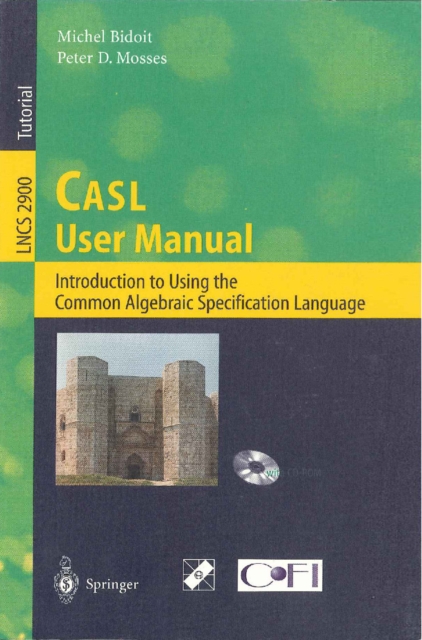
CASL, the Common Algebraic Specification Language, was designed by the members of CoFI, the Common Framework Initiative for algebraic specification and development, and is a general-purpose language for practical use in software development for specifying both requirements and design.
The proceedings of ECML/PKDD2003 are published in two volumes: the P- ceedings of the 14th European Conference on Machine Learning (LNAI 2837) and the Proceedings of the 7th European Conference on Principles and Practice of Knowledge Discovery in Databases (LNAI 2838).
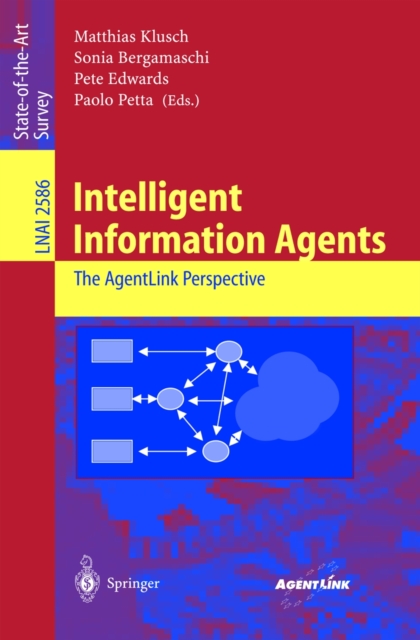
This book presents 10 chapters on various aspects of intelligent information agents contributed by members of the respective AgentLink special interest group.
The 20 revised full papers presented in this book together with 4 section surveys were carefully reviewed and selected from the papers contributed to the 14th International Conference on Applications of Prolog, INAP 2001, held in Tokyo, Japan, in October 2002.
This book constitutes the refereed proceedings of the Second International Conference on COTS-Based Software Systems, ICCBSS 2003, held in Ottawa, Canada in February 2003.
The growth of the Internet and the availability of powerful computers and hi- speed networks as low-cost commodity components are changing the way we do computing.
During the last decade of the twentieth century, computer vision made considerable progress towards the consolidation of its fundaments, in particular regarding the treatment of geometry for the evaluation of stereo image pairs and of multi-view image recordings.
The widespread interest this book has found among professors, scientists and stu- dents working in a variety of fields has made a new edition necessary.
Many difficult scientific discovery tasks can only be solved in interactive ways, by combining intelligent computing techniques with intuitive and adaptive user interfaces.
By presenting state-of-the-art results in logical reasoning and formal methods in the context of artificial intelligence and AI applications, this book commemorates the 60th birthday of Jorg H.
The series of ISCIS (International Symposium on Computer and Information Sciences) symposia have been held each year since 1986, mostly in Turkey and occasionally abroad.
This book constitutes the proceedings of the International Symposium on Neural N- works (ISNN 2004) held in Dalian, Liaoning, China duringAugust 19-21, 2004.
Web engineering is a new discipline that addresses the pressing need for syst- atic and tool-supported approaches for the development, maintenance and te- ing of Web applications.
Interactive Digital Storytelling has evolved as a prospering research topic banding together formerly disjointed disciplines stemming from the arts and humanities as well as computer science.
Since 1995, when the SPIN workshop series was instigated, SPIN workshops have been held on an annual basis in Montr' eal (1995), New Brunswick (1996), Enschede (1997), Paris (1998), Trento (1999), Toulouse (1999), Stanford (2000), Toronto (2001), Grenoble (2002) and Portland (2003).
CASL, the Common Algebraic Specification Language, was designed by the members of CoFI, the Common Framework Initiative for algebraic specification and development, and is a general-purpose language for practical use in software development for specifying both requirements and design.
The ongoing migration of computing and information access from the desktop and te- phone to mobile computing devices such as PDAs, tablet PCs, and next-generation (3G) phones poses critical challenges for research on information access.
Advances in networking technology have revitalized the investigation of agent technologyasapromisingparadigmforengineeringcomplexdistributedsoftware systems.
This book constitutes the thoroughly refereed post-proceedings of the 6th International Conference on Artificial Evolution, EA 2003, held in Marseilles, France in October 2003.
The4thWorkshoponInformationSecurityApplications(WISA2003)wassp- sored by the following Korean organizations and government bodies: the Korea Institute of Information Security and Cryptology (KIISC), the Electronics and TelecommunicationsResearchInstitute(ETRI),andtheMinistryofInformation and Communication (MIC).
The LNCS journal Transactions on Computational Science reflects recent developments in the field of Computational Science, conceiving the field not as a mere ancillary science but rather as an innovative approach supporting many other scientific disciplines.