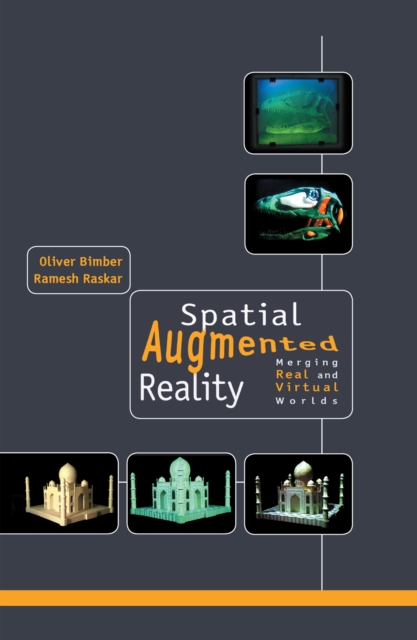
Like virtual reality, augmented reality is becoming an emerging platform in new application areas for museums, edutainment, home entertainment, research, industry, and the art communities using novel approaches which have taken augmented reality beyond traditional eye-worn or hand-held displays.
Visual perception is a complex process requiring interaction between the receptors in the eye that sense the stimulus and the neural system and the brain that are responsible for communicating and interpreting the sensed visual information.
The rapid advancement of digital multimedia technologies has not only revolutionized the production and distribution of audiovisual content, but also created the need to efficiently analyze TV programs to enable applications for content managers and consumers.
Used by companies, organizations, and even individuals to promote recognition of their brand, logos can also act as a valuable means of identifying the source of a document.
With the exponential increase in computing power and broad proliferation of digital cameras, super-resolution imaging is poised to become the next "e;killer app.
From the streets of London toA subway stations in New York City, hundreds of thousands of surveillance cameras ubiquitously collect hundreds of thousands of videos, often running 24/7.
In the development of digital multimedia, the importance and impact of image processing and mathematical morphology are well documented in areas ranging from automated vision detection and inspection to object recognition, image analysis and pattern recognition.
Avoiding heavy mathematics and lengthy programming details, Digital Image Processing: An Algorithmic Approach with MATLAB(R) presents an easy methodology for learning the fundamentals of image processing.
Providing a thorough introduction to the field of soft computing techniques, Intelligent Systems: Modeling, Optimization, and Control covers every major technique in artificial intelligence in a clear and practical style.
There are many books on neural networks, some of which cover computational intelligence, but none that incorporate both feature extraction and computational intelligence, as Supervised and Unsupervised Pattern Recognition does.
Image Processing with MATLAB: Applications in Medicine and Biology explains complex, theory-laden topics in image processing through examples and MATLAB algorithms.
The book analyzes the use of smart medical devices that use artificial intelligence and machine learning to analyze medical images, detect diseases, and assist in diagnosis.
The last half century has seen the development of many biological or physical t- ories that have explicitly or implicitly involved medial descriptions of objects and other spatial entities in our world.
Computational methodologies of signal processing and imaging analysis, namely considering 2D and 3D images, are commonly used in different applications of the human society.
In the early 1990s, the establishment of the Internet brought forth a revolutionary viewpoint of information storage, distribution, and processing: the World Wide Web is becoming an enormous and expanding distributed digital library.
Integrated Image and Graphics Technologies attempts to enhance the access points to both introductory and advanced material in this area, and to facilitate the reader with a comprehensive reference for the study of integrated technologies, systems of image and graphics conveniently and effectively.
The main intention of this book is to give an impression of the state of the art in energy-aware task-scheduling-related issues for very dynamic emb- ded real-time processing applications.
Mathematical Morphology is a speciality in Image Processing and Analysis, which considers images as geometrical objects, to be analyzed through their interactions with other geometrical objects.
In the development of digital multimedia, the importance and impact of image processing and mathematical morphology are well documented in areas ranging from automated vision detection and inspection to object recognition, image analysis and pattern recognition.
With the exponential increase in computing power and broad proliferation of digital cameras, super-resolution imaging is poised to become the next "e;killer app.
As multimedia applications have become part of contemporary daily life, numerous paradigm-shifting technologies in multimedia processing have emerged over the last decade.
Color Image Processing: Methods and Applications embraces two decades of extraordinary growth in the technologies and applications for color image processing.
There are many books on neural networks, some of which cover computational intelligence, but none that incorporate both feature extraction and computational intelligence, as Supervised and Unsupervised Pattern Recognition does.
Providing a thorough introduction to the field of soft computing techniques, Intelligent Systems: Modeling, Optimization, and Control covers every major technique in artificial intelligence in a clear and practical style.
Visual perception is a complex process requiring interaction between the receptors in the eye that sense the stimulus and the neural system and the brain that are responsible for communicating and interpreting the sensed visual information.
Multimedia Security: Watermarking, Steganography, and Forensics outlines essential principles, technical information, and expert insights on multimedia security technology used to prove that content is authentic and has not been altered.
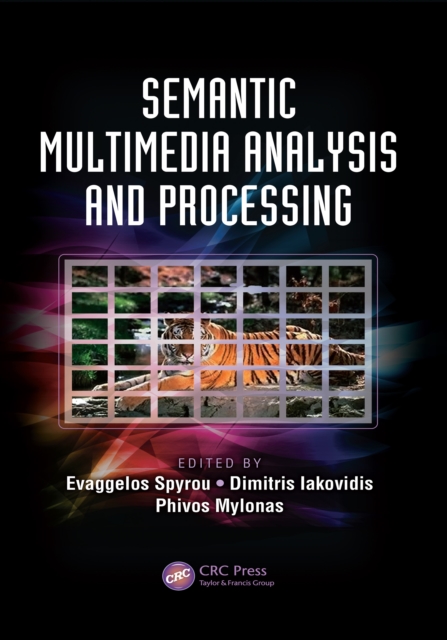
Broad in scope, Semantic Multimedia Analysis and Processing provides a complete reference of techniques, algorithms, and solutions for the design and the implementation of contemporary multimedia systems.