In Humanity & Machines: A Guide to Our Collaborative Future with AI, discover how artificial intelligence reshapes every aspect of our world from business and healthcare to ethics and national security.
Recognizing the vast potential in analyzing big data through machine learning (ML) and artificial intelligence (AI) technologies, companies are acknowledging these technologies as essential for maintaining relevance.
National security decisions pose a paradox: they are among the most consequential a government can make, but are generally the least transparent to the democratic public.
Vision language models (VLMs) combine computer vision and natural language processing to create powerful systems that can interpret, generate, and respond in multimodal contexts.
This book offers a complete and forward-looking discussion of how artificial intelligence and advanced analytics are changing modern business decision-making.
"e;AI Musings by AI"e; is a thought-provoking compilation curated, edited, and prefaced by The author in 2025, drawing from six months of interactions with five leading AI systems: Grok, DeepSeek, Claude, Gemini, and ChatGPT.
This book is composed of selected papers from two very important conferences, IWIFSGN'2024—Twenty Second International Workshop on Intuitionistic Fuzzy Sets and Generalized Nets held in Warsaw, Poland, on October 18, 2024, and BOS/SOR 2024, National Conference on Operational and Systems Research, held in Warsaw, Poland, on October, 17–18, 2024.
This book explores the emerging paradigm of Agentic AI, where Large Language Models (LLMs) and Reinforcement Learning (RL) converge to create intelligent, autonomous, and adaptive systems.
Communication Skills for Generative AI: A Practical Guide for Humans is the first comprehensive book to treat communication with generative AI as a distinct human competence-analogous to digital literacy, media literacy, or academic writing skills.
This book presents additional papers included in the proceedings of the 8th International Conference of Reliable Information and Communication Technology 2025 (IRICT 2025) held at the Faculty of Sciences Ain Chock Casablanca, Hassan II University (Morocco) on November 25–26, 2025.
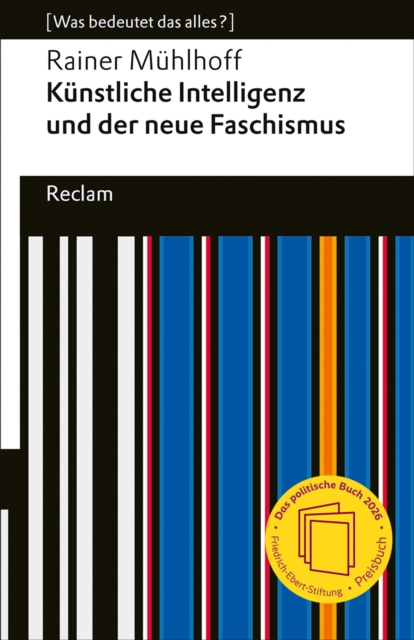
KI und AGI (Artificial General Intelligence), ihr menschenverachtendes Weltbild und unsere ZukunftElon Musk und Donald Trump kündigen massenhaft Verwaltungsmitarbeitern, um einen KI-Staat zu errichten.
The International Conference on Smart Technologies & Education (STE) brings together a global community of researchers, educators, and innovators at the intersection of emerging technologies and engineering education.
The four-volume set, LNAI 16597-16600 constitutes the proceedings of the 30th Pacific-Asia Conference on Knowledge Discovery and Data Mining, PAKDD 2026, held in Hong Kong, China, during June 9–12, 2026.
This book thoroughly covers the prospective use cases, intelligent technologies, layered architectures for RIS-assisted UAV communications, research findings, experimental discoveries, and standardizations .
This book constitutes the proceedings of the 5th International Conference on Artificial Intelligence Logic and Applications, AILA 2025, held in Xi'an, China, during August 16–17, 2025.
This book constitutes the proceedings of the 5th International Conference on Artificial Intelligence Logic and Applications, AILA 2025, held in Xi'an, China, during August 16–17, 2025.
The four-volume set, LNAI 16597-16600 constitutes the proceedings of the 30th Pacific-Asia Conference on Knowledge Discovery and Data Mining, PAKDD 2026, held in Hong Kong, China, during June 9–12, 2026.
The four-volume set, LNAI 16597-16600 constitutes the proceedings of the 30th Pacific-Asia Conference on Knowledge Discovery and Data Mining, PAKDD 2026, held in Hong Kong, China, during June 9–12, 2026.
This book constitutes the refereed post-conference proceedings of the 14th International Conference on Nature of Computing and Pattern Recognition, ICCPR 2025, held in Beijing, China, during October 24–26, 2025The 81 full papers presented in this volume were carefully reviewed and selected from 205 submissions.
The four-volume set, LNAI 16597-16600 constitutes the proceedings of the 30th Pacific-Asia Conference on Knowledge Discovery and Data Mining, PAKDD 2026, held in Hong Kong, China, during June 9–12, 2026.
This book constitutes the refereed proceedings of the 18th JSAI International Symposium on Artificial Intelligence, JSAI-isAI 2026, held in Gunma, Japan, during June 7–9, 2026.
New-generation Artificial Intelligence (AI) is a strategic technology that exhibits strong spillover and driving effects, leading this round of technological revolution and industrial transformation.
New-generation Artificial Intelligence (AI) is a strategic technology that exhibits strong spillover and driving effects, leading this round of technological revolution and industrial transformation.
This volumes constitute the proceedings of the Workshops KGMA, SemiBDMA, MADM, AIEDM and STBDM which were held in conjunction with APWeb-WAIM 2025 which took place in Shenyang, China, during August 28–30, 2025.
Start using AI with confidence, master prompting, generate content, automate tasks, and apply AI safely in daily life and work, even with zero technical backgroundKey FeaturesBuild effective prompts using clarity, context, and structured frameworksApply AI for writing, visuals, planning, and everyday productivity tasksUse AI responsibly with guidance on privacy, bias, and professional boundariesBook DescriptionArtificial intelligence is no longer limited to specialists.
This book highlights the intersection of quantum computing and blockchain technology, addressing the urgent need for enhanced security measures in a post-quantum world.
This book highlights the intersection of quantum computing and blockchain technology, addressing the urgent need for enhanced security measures in a post-quantum world.
This book constitutes the refereed post-conference proceedings of the 14th International Conference on Nature of Computing and Pattern Recognition, ICCPR 2025, held in Beijing, China, during October 24–26, 2025The 81 full papers presented in this volume were carefully reviewed and selected from 205 submissions.
This volumes constitute the proceedings of the Workshops KGMA, SemiBDMA, MADM, AIEDM and STBDM which were held in conjunction with APWeb-WAIM 2025 which took place in Shenyang, China, during August 28–30, 2025.
This book constitutes the refereed proceedings of the 18th JSAI International Symposium on Artificial Intelligence, JSAI-isAI 2026, held in Gunma, Japan, during June 7–9, 2026.
This book constitutes the proceedings of the 24th International Conference on Security and Management, SAM 2025, the 24th International Conference on Wireless Networks, ICWN 2025, and the 23rd International Conference on Software Engineering Research and Practice, SERP 2025.
The four-volume set, LNAI 16597-16600 constitutes the proceedings of the 30th Pacific-Asia Conference on Knowledge Discovery and Data Mining, PAKDD 2026, held in Hong Kong, China, during June 9–12, 2026.