This book constitutes the refereed proceedings of the 13th International Conference on Systems Simulation, Asia Simulation 2013, held in Singapore, in November 2013.
This book constitutes the thoroughly refereed proceedings of the 7th International Conference on Software and Data Technologies, ICSOFT 2012, held in Rome, Italy, in July 2012.
This book constitutes the thoroughly refereed post-workshop proceedings of the International Workshop on Clinical Image-based Procedures: From Planning to Intervention, CLIP 2012, held in Nice, France, in conjunction with the 15th International Conference on Medical Image Computing and Computer-Assisted Intervention, MICCAI 2012.
The LNCS journal Transactions on Large-Scale Data- and Knowledge-Centered Systems focuses on data management, knowledge discovery, and knowledge processing, which are core and hot topics in computer science.
The LNCS journal Transactions on Large-Scale Data- and Knowledge-Centered Systems focuses on data management, knowledge discovery, and knowledge processing, which are core and hot topics in computer science.
This book constitutes the refereed proceedings of the First International Conference on Model and Data Engineering, MEDI 2011, held in Obidos, Portugal, in September 2011.
Control of Robot Manipulators in Joint Space addresses robot control in depth, treating a range of model-based controllers in detail: proportional derivative; proportional integral derivative; computed torque and some adaptive variants.
Rapid Modelling and Quick Response presents new research developments in the fields of rapid modelling and quick response linked with performance improvements (based on lead time reduction, etc.
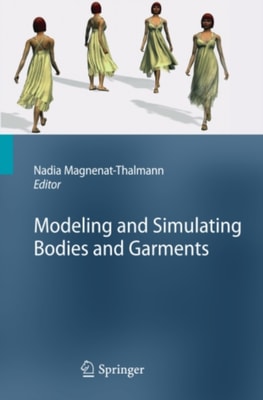
This book contains the research on modeling bodies, cloth and character based adaptation performed during the last 3 years at MIRALab at the University of Geneva.
An apparently appropriate control scheme for PEM fuel cells may actually lead to an inoperable plant when it is connected to other unit operations in a process with recycle streams and energy integration.
Many designers, policy makers, teachers, and other practitioners are beginning to understand the usefulness of using digital games beyond entertainment.
Art and Technology of Entertainment Computing and Communication takes a blue sky research perspective on the field of interactive media for entertainment computing.
Evolutionary algorithms are becoming increasingly attractive across various disciplines, such as operations research, computer science, industrial engineering, electrical engineering, social science and economics.
John Vince explains a wide range of mathematical techniques and problem-solving strategies associated with computer games, computer animation, virtual reality, CAD, and other areas of computer graphics.
Nowadays, engineering systems are of ever-increasing complexity and must be c- sidered asmultidisciplinary systems composed of interacting subsystems or system components from different engineering disciplines.
A Perspective on Two Decades of Rapid Modeling It is an honor for me to be asked to write a foreword to the Proceedings of the 1st Rapid Modeling Conference.
"e;Design Rules for Actuators in Active Mechanical Systems"e; deals with the formulation of model-based design rules to be used in the conception of optimized mechatronic and adaptronic systems.
Recent trends in the fashion market (including an impressive increase in the number of new collections, product assortments and variants, and the emerging mass-customization model) dictate the need for a new approach.
Research into the 3D Physiological Human is a very active field focusing on the creation of patient-specific computer models for personalised healthcare.
Implicit objects have gained increasing importance in geometric modeling, visualisation, animation, and computer graphics, because their geometric properties provide a good alternative to traditional parametric objects.
The advent of powerful processing technologies and the advances in software development tools have drastically changed the approach and implementation of computational research in fundamental properties of living systems through simulating and synthesizing biological entities and processes in artificial media.
Simulation Methods for Reliability and Availability of Complex Systems discusses the use of computer simulation-based techniques and algorithms to determine reliability and availability (R and A) levels in complex systems.
"e;Simulation-based Case Studies in Logistics"e; presents an intensive learning course on the application of simulation as a decision support tool to tackle complex logistic problems.
Spotlight on Modern Transformer Design introduces a novel approach to transformer design using artificial intelligence (AI) techniques in combination with finite element method (FEM).
Identification of Continuous-time Models from Sampled Data presents an up-to-date view of this active area of research, describing recent methods and software tools and offering new results in areas such as: time and frequency domain optimal statistical approaches to identification; parametric identification for linear, nonlinear and stochastic systems; identification using instrumental variable, subspace and data compression methods; closed-loop and robust identification; and continuous-time modeling from non-uniformly sampled data and for systems with delay.
Following on from Rob Davis' successful introductory book, ARIS Design Platform: Getting Started with BPM, Rob now covers in detail some of the more advanced concepts of using ARIS Business Architect.
Cognition, Communication and Interaction examines the theoretical and methodological research issues that underlie the design and use of interactive technology.
Presenting the latest developments and research results on fault diagnosis approaches using computational intelligence methodologies, this book opens with a review of the state-of-the-art before focusing on various theoretical aspects of computational intelligence methodologies applied to real-world fault diagnosis problems.
Overview Modelling and simulation is a tool that provides support for the planning, design, and evaluation of systems as well as the evaluation of strategies for system transformation and change.
At the end of the 1980s, Professor August-Wilhelm Scheer developed ARIS as a meta-model for organisational modelling and to provide a procedural model for recording, analysis and optimisation of business processes and their implemen- tion in software systems.
There has been a growing interest in crowd simulation particularly in the commercial sector where it is used in security, defence, entertainment and the movie industry.