This book is aimed to help instructional designers, science game designers, science faculty, lab designers, and content developers in designing interactive learning experiences using emerging technologies and cyberlearning.
This book traces the techniques that have enabled the development of data-driven personas and how they can be leveraged as tools for empathizing and understanding users.
Attention Deficit Hyperactivity Disorder (ADHD) is the most prevalent childhood psychiatric condition, with estimates of more than 5% of children affected worldwide, and has a profound public health, personal, and family impact.
This book traces the techniques that have enabled the development of data-driven personas and how they can be leveraged as tools for empathizing and understanding users.
This book organizes entity resolution (ER) into four generations based on the challenges posed by "e;the four Vs,"e; Veracity, Volume, Variety, and Velocity.
Attention Deficit Hyperactivity Disorder (ADHD) is the most prevalent childhood psychiatric condition, with estimates of more than 5% of children affected worldwide, and has a profound public health, personal, and family impact.
Peer-to-peer exchange is a type of sharing that involves the transfer of valued resources, such as goods and services, among members of a local community and/or between parties who have not met before the exchange encounter.
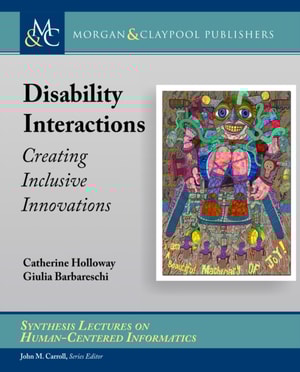
Disability interactions (DIX) is a new approach to combining cross-disciplinary methods and theories from Human Computer Interaction (HCI), disability studies, assistive technology, and social development to co-create new technologies, experiences, and ways of working with disabled people.
Query reformulation refers to a process of translating a source query-a request for information in some high-level logic-based language-into a target plan that abides by certain interface restrictions.
Assistive Technology Design for Intelligence Augmentation presents a series of frameworks, perspectives, and design guidelines drawn from disciplines spanning urban design, artificial intelligence, sociology, and new forms of collaborative work, as well as the author's experience in designing systems for people with cognitive disabilities.
Assistive Technology Design for Intelligence Augmentation presents a series of frameworks, perspectives, and design guidelines drawn from disciplines spanning urban design, artificial intelligence, sociology, and new forms of collaborative work, as well as the author's experience in designing systems for people with cognitive disabilities.
Human-Computer Interaction (HCI) addresses problems of interaction design: understanding user needs to inform design, delivering novel designs that meet user needs, and evaluating new and existing designs to determine their success in meeting user needs.
This book discusses semantic interaction, a user interaction methodology for visual analytic applications that more closely couples the visual reasoning processes of people with the computation.
Because circular objects are projected to ellipses in images, ellipse fitting is a first step for 3-D analysis of circular objects in computer vision applications.
Social media platforms are the latest manifestation in a series of sociotechnical innovations designed to enhance civic engagement, political participation, and global activism.
Unlock the power of creating your own multiplayer virtual world and explore infinite possibilities by following practical examples on building, designing, and implementing various featuresKey FeaturesCreate your own Metaverse from scratch with detailed and practical instructionsUse Firebase tools to create a distinctive and feature-rich virtual worldCompile and distribute the finished project to various platformsPurchase of the print or Kindle book includes a free PDF eBookBook DescriptionBuild Your Own Metaverse with Unity is a practical guide for developers with step-by-step explanations, practical examples, and screenshots to guide them through essential concepts.