Since user study design has been widely applied in search interactions and information retrieval (IR) systems evaluation studies, a deep reflection and meta-evaluation of interactive IR (IIR) user studies is critical for sharpening the instruments of IIR research and improving the reliability and validity of the conclusions drawn from IIR user studies.
With spatial technologies ranging from mapping software to the use of location-based services, spatial knowledge is often acquired and communicated through geographic information technologies.
Many data-intensive applications that use machine learning or artificial intelligence techniques depend on humans providing the initial dataset, enabling algorithms to process the rest or for other humans to evaluate the performance of such algorithms.
At the 2016 IEEE VIS Conference in Baltimore, Maryland, a panel of experts from the Scientific Visualization (SciVis) community gathered to discuss why the SciVis component of the conference had been shrinking significantly for over a decade.
The huge success of personal computing technologies has brought astonishing benefits to individuals, families, communities, businesses, and government, transforming human life, largely for the better.
Linked Data (LD) is a well-established standard for publishing and managing structured information on the Web, gathering and bridging together knowledge from different scientific and commercial domains.
Many people find statistics confusing, and perhaps even more confusing given recent publicity about problems with traditional p-values and alternative statistical techniques including confidence intervals and Bayesian statistics.
This book introduces the concept of worth for design teams, relates it to experiences and outcomes, and describes how to focus on worth when researching and expressing design opportunities for generous worth.
Many people find statistics confusing, and perhaps even more confusing given recent publicity about problems with traditional p-values and alternative statistical techniques including confidence intervals and Bayesian statistics.
Linked Data (LD) is a well-established standard for publishing and managing structured information on the Web, gathering and bridging together knowledge from different scientific and commercial domains.
The volume of natural language text data has been rapidly increasing over the past two decades, due to factors such as the growth of the Web, the low cost associated with publishing, and the progress on the digitization of printed texts.
With the rapid development of mobile Internet and smart personal devices in recent years, mobile search has gradually emerged as a key method with which users seek online information.
This book provides beginners in computer graphics and related fields a guide to the concepts, models, and technologies for realistic rendering of material appearance.
In geometry processing and shape analysis, several applications have been addressed through the properties of the Laplacian spectral kernels and distances, such as commute time, biharmonic, diffusion, and wave distances.
Chance, luck, and good fortune are the usual go-to descriptors of serendipity, a phenomenon aptly often coupled with famous anecdotes of accidental discoveries in engineering and science in modern history such as penicillin, Teflon, and Post-it notes.
The field of human information behavior runs the gamut of processes from the realization of a need or gap in understanding, to the search for information from one or more sources to fill that gap, to the use of that information to complete a task at hand or to satisfy a curiosity, as well as other behaviors such as avoiding information or finding information serendipitously.
Graphs naturally represent information ranging from links between web pages, to communication in email networks, to connections between neurons in our brains.
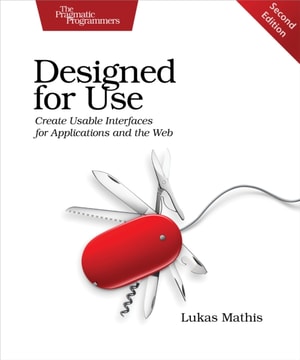
This book is for designers, developers, and product managers who are charged with what sometimes seems like an impossible task: making sure products work the way your users expect them to.
This book is for designers, developers, and product managers who are charged with what sometimes seems like an impossible task: making sure products work the way your users expect them to.
In smart cities, information and communication technologies are integrated to exchange real-time data between citizens, governments, and organizations.