This book discusses the main legal questions raised by free and open source software (FOSS) licenses and other alternative license models, such as Creative Commons.
This book constitutes the refereed proceedings of the 6th International Conference on E-Technologies, MCETECH 2015, held in Montreal, Canada, in May 2015.
The ever increasing use of computers, networks and the Internet has led to the need for regulation in the fields of cybercrime, cybersecurity and national security.
This book starts with an exercise, proposing a theoretical reflection on the technological path that, over time, has transformed the ways we produce, consume and manage intellectual content subject to copyright protection.
This book constitutes the thoroughly refereed post-conference proceedings of the 5th International ICST Conference on Digital Forensics and Cyber Crime, ICDF2C 2013, held in September 2013 in Moscow, Russia.
Gives the reader a detailed account of how cyber-security in Switzerland has evolved over the years, using official documents and a considerable amount of inside knowledge.
This work is an assessment of how to manage risk in property transactions in the context of the move from paper-based to electronic conveyancing (eConveyancing).
The views of leading researchers on the emerging topic of post-mortem digital legacy and posthumous interaction are explored in this book which combines the technical, cultural and legal aspects associated with this new branch of HCI.
This book stems from the CyberBRICS project, which is the first major attempt to produce a comparative analysis of Internet regulations in the BRICS countries - namely, Brazil, Russia, India, China, and South Africa.
This book constitutes the refereed proceedings of the 4th International Conference on HCI for Cybersecurity, Privacy and Trust, HCI-CPT 2022, held as part of the 23rd International Conference, HCI International 2022, which was held virtually in June/July 2022.
This book examines central aspects of the new technologies and the legal questions raised by them from both an international and an inter-disciplinary perspective.
This two-volume set LNCS 12918 - 12919 constitutes the refereed proceedings of the 23nd International Conference on Information and Communications Security, ICICS 2021, held in Chongqing, China, in September 2021.
The book analyzes the most relevant developments in the relation between contracts and technology, from automatically concluded contracts to today's revolutionary "e;smart contracts"e; developed through blockchain, which are beginning to and will increasingly disrupt many economic and social relations.
This book focuses on the legal regulation, mainly from an international law perspective, of autonomous artificial intelligence systems, of their creations, as well as of the interaction of human and artificial intelligence.
This book constitutes the refereed proceedings of the 25th Nordic Conference on Secure IT Systems, NordSec 2020, which was organized by Linkoping University, Sweden, and held online during November 23-24, 2020.
With the ongoing evolution of the digital society challenging the boundaries of the law, new questions are arising - and new answers being given - even now, almost three decades on from the digital revolution.
This book constitutes the refereed post-conference proceedings of the 19th International Conference on Information Security, ISSA 2020, which was supposed to be held in Pretoria, South Africa, in August 2020, but it was held virtually due to the COVID-19 pandemic.
This three volume book set constitutes the proceedings of the Third International Conference on Machine Learning for Cyber Security, ML4CS 2020, held in Xi'an, China in October 2020.
This book constitutes the refereed post-conference proceedings of the Second International Workshop on Model-Driven Simulation and Training Environments for Cybersecurity, MSTEC 2020, held in Guildford, UK, in September 2020 in conjunction with the 24th European Symposium on Research in Computer Security, ESORICS 2020.
This book constitutes the proceedings of the 7th International Workshop on Graphical Models for Security, GramSec 2020, which took place on June 22, 2020.
The information infrastructure - comprising computers, embedded devices, networks and software systems - is vital to operations in every sector: chemicals, commercial facilities, communications, critical manufacturing, dams, defense industrial base, emergency services, energy, financial services, food and agriculture, government facilities, healthcare and public health, information technology, nuclear reactors, materials and waste, transportation systems, and water and wastewater systems.
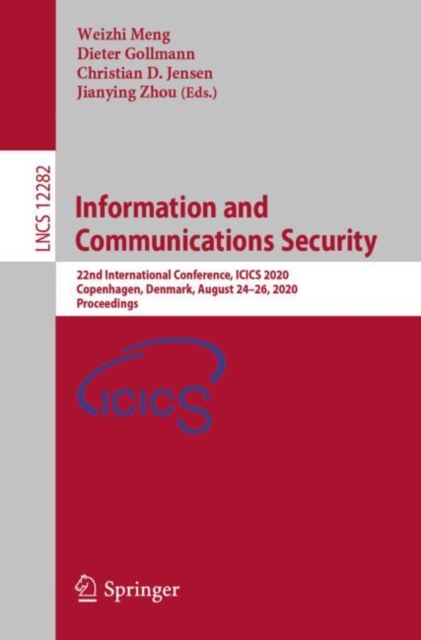
This book constitutes the refereed proceedings of the 22nd International Conference on Information and Communications Security, ICICS 2020, held in Copenhagen, Denmark*, in August 2020.
This book stems from the CyberBRICS project, which is the first major attempt to produce a comparative analysis of Internet regulations in the BRICS countries - namely, Brazil, Russia, India, China, and South Africa.