This book reviews the adequacy of information available for predicting and managing the environmental and human effects of oil and gas activities on Alaska's Outer Continental Shelf (OCS).
How can the United States meet demands for agricultural production while solving the broader range of environmental problems attributed to farming practices?
This book discusses the results of the transects program, which involves compilations of maps and cross sections showing geological, geophysical, and geochemical data and interpretations along 23 transects from the continental craton to the oceanic lithosphere around North America.
Aggressive, effective safety inspection programs are key elements to ensuring that oil- and gas-producing platform operations on the outer continental shelf are conducted in a safe and environmentally sound manner.
There is broad agreement in the scientific community that the solid earth beneath the Arctic Ocean basin contains answers to major unsolved problems in the earth sciences and that many of these pertain to questions that are of global scientific significance or pressing societal concern.
This volume explores and evaluates the development, multiple applications, and usefulness of four-dimensional (space and time) model assimilations of data in the atmospheric and oceanographic sciences and projects their applicability to the earth sciences as a whole.
EarthScope is a major science initiative in the solid-earth sciences and has been described as "e;a new earth science initiative that will dramatically advance our physical understanding of the North American continent by exploring its three-dimensional structure through time"e;.
In order to answer important questions about ecosystems and biodiversity, scientists can look to the past geological recordwhich includes fossils, sediment and ice cores, and tree rings.
Approximately 70 percent of the world's population is concentrated in the coastal borderlands, which geologists recognize to be the present continental margins.
The present mortality as a result of snow avalanches exceeds the average mortality caused by earthquakes as well as all other forms of slope failure combined.
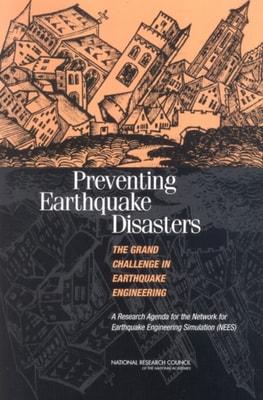
The Network for Earthquake Engineering Simulation (NEES), administered by the National Science Foundation (NSF), is scheduled to become operational in 2004.
The climate record for the past 100,000 years clearly indicates that the climate system has undergone periodicand often extremeshifts, sometimes in as little as a decade or less.
The destructive force of earthquakes has stimulated human inquiry since ancient times, yet the scientific study of earthquakes is a surprisingly recent endeavor.
This report assesses whether the Smithsonian Institution should continue to receive direct federal appropriations for its scientific research programs or if this funding should be transferred to a peer-reviewed program open to all researchers in another agency.
EarthScope is a major science initiative in the solid-earth sciences and has been described as "e;a new earth science initiative that will dramatically advance our physical understanding of the North American continent by exploring its three-dimensional structure through time"e;.
This report assesses whether the Smithsonian Institution should continue to receive direct federal appropriations for its scientific research programs or if this funding should be transferred to a peer-reviewed program open to all researchers in another agency.
The destructive force of earthquakes has stimulated human inquiry since ancient times, yet the scientific study of earthquakes is a surprisingly recent endeavor.
In order to answer important questions about ecosystems and biodiversity, scientists can look to the past geological recordwhich includes fossils, sediment and ice cores, and tree rings.
The Network for Earthquake Engineering Simulation (NEES), administered by the National Science Foundation (NSF), is scheduled to become operational in 2004.
During geologic spans of time, Earth's shifting tectonic plates, atmosphere, freezing water, thawing ice, flowing rivers, and evolving life have shaped Earth's surface features.
Safeguarding Mountain Social-Ecological Systems, Volume Two: Building Transformative Resilience in Mountain Regions Worldwide presents an overview of the relevant research in mountain regions worldwide, identifies existing challenges, and provides an understanding of the diversity of mountain ecosystems in different regions.
During geologic spans of time, Earth's shifting tectonic plates, atmosphere, freezing water, thawing ice, flowing rivers, and evolving life have shaped Earth's surface features.