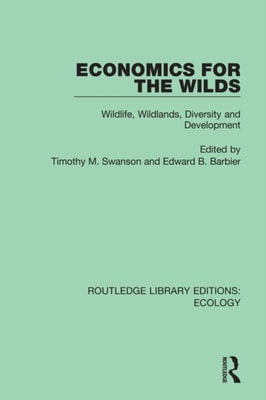
Originally published in 1992 Economics for the Wilds argues that an economics that properly values the resources of the wilds offers the best long-term security for their future.
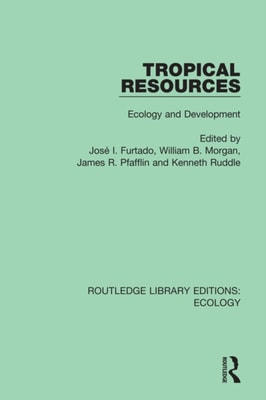
Originally published in 1990 Tropical Resources presents in-depth coverage of the extremely diverse tropical environments, the resources to be found within the region and their production, and ecological management.
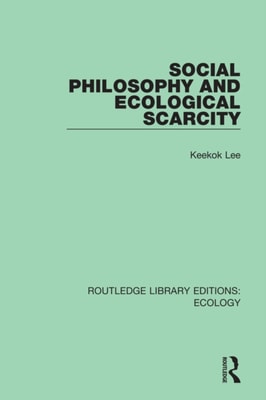
Originally published in 1989 Social Philosophy and Ecological Scarcity presents a systematic study of the implications of ecological scarcity for social philosophy.
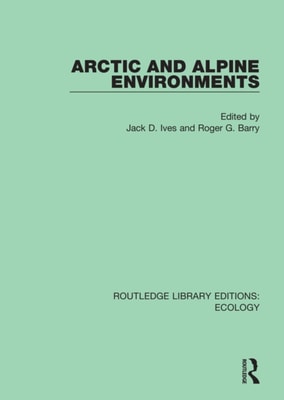
Originally published in 1974, Arctic and Alpine Environments examines, the relatively simple ecosystems of arctic and alpine lands that still occupy extensive areas little disturbed by modern technology.
Originally published in 1984, Themes in Biogeography presents a broad examination of biogeographical themes, extending across the field of plant and animal ecology and geography.
Originally published in 1982, Time Resources, Society and Ecology examines and seeks to examine the time dimension in terms of the ecology, technology, social organization and spatial structure of the human habitat.
Originally published in 1998, Southern Forested Wetlands is an up to date, one source compendium of current knowledge on the wetland ecology of America's southern forests.
Originally published in 1982, Time Resources, Society and Ecology examines and seeks to examine the time dimension in terms of the ecology, technology, social organization and spatial structure of the human habitat.
Originally published in 1984, Themes in Biogeography presents a broad examination of biogeographical themes, extending across the field of plant and animal ecology and geography.
Originally published in 1974, Arctic and Alpine Environments examines, the relatively simple ecosystems of arctic and alpine lands that still occupy extensive areas little disturbed by modern technology.
Originally published in 1989 Social Philosophy and Ecological Scarcity presents a systematic study of the implications of ecological scarcity for social philosophy.
Originally published in 1990 Tropical Resources presents in-depth coverage of the extremely diverse tropical environments, the resources to be found within the region and their production, and ecological management.
Originally published in 1992 Economics for the Wilds argues that an economics that properly values the resources of the wilds offers the best long-term security for their future.
Originally published in 2000, The Arctic provides a comprehensive overview of the region's rapidly changing physical and human dimensions, and demonstrates the importance of communication between natural scientists, social scientists, and local stakeholders in response to the tremendous challenges and opportunities facing the Arctic.
Diffuse pollution of water resources has a multi-disciplinary dimension and the measures to prevent and control it are closely inter-related to the development patterns and societal habits of the region.
The book examines concurrent green initiatives and their spillover effects on environmental conservation and management to reveal their impact on conservation effectiveness, drawing on a range of international case studies.
The book examines concurrent green initiatives and their spillover effects on environmental conservation and management to reveal their impact on conservation effectiveness, drawing on a range of international case studies.
This study, first published in 1985, aims to provide objective measures of the risks associated with various crops and livestock in the late nineteenth century and to examine two important issues in American economic history.
This book, first published in 1984, analyses the institutions and decision-making processes that determined agricultural production in the Soviet Union.
This book, first published in 1986, is a major reference work for the political discussions arising out of the 1985 Congress revisions of US food and farm laws.
This study, first published in 1985, aims to provide objective measures of the risks associated with various crops and livestock in the late nineteenth century and to examine two important issues in American economic history.