The recent financial crisis has awakened a renewed sensibility to ethics in business and management, and an increasing interest in a better understanding of how ethics and economics are intertwined.
Recent financial crises and instances of corporate malpractice have prompted many questions about how companies are run - and whether this tallies with how they should be run.
In the context of the financial and economic crisis, corporate governance and regulatory supervision failures, Laura Horn investigates one of the defining questions in social power relations in contemporary capitalism: who controls the modern corporation, and why.
Corporations in conflict zones and their provision of security are particularly relevant for understanding whether private actors are increasingly sources of governance contributions that regulate public goods.
Corporate strategy expert Prakash Sethi takes an in-depth look at global structures and how regulation works from a corporate perspective, providing case studies of several industries and governments who have begun implementing voluntary codes of conducts, including Equator Principles, ICMM, and The Kimberly Process.
Explores how companies engage in CSR activities, how their corporate identity determines the way in which they perceive the stakeholders and, as a result, engage in dialogue-based relations with them.
This book focuses on the concepts of social capital, corporate social responsibility, and economic development in relation to economic theory of institutions and behavioural economics.
Banking, Capital Markets and Corporate Governance explores the fragility of the banking system, corporate governance, and the increasing securitization of corporate finance.
The volume focuses on privatisation in transition countries, addressing issues ranging from corporate governance to the relationship between privatisation and the emergence of markets, from a multi-disciplinary perspective.
Bringing together a number of leading scholars and pioneering research, this volume explores the links between corporate governance and international business, and demonstrates how corporate governance influences the attractiveness of host countries to inward investors, as well as the internationalization strategies of MNEs themselves.
The International Security Programs Benchmark Report presents and analyzes the findings of a broad survey conducted by the Security Executive Council of corporate international security programs.
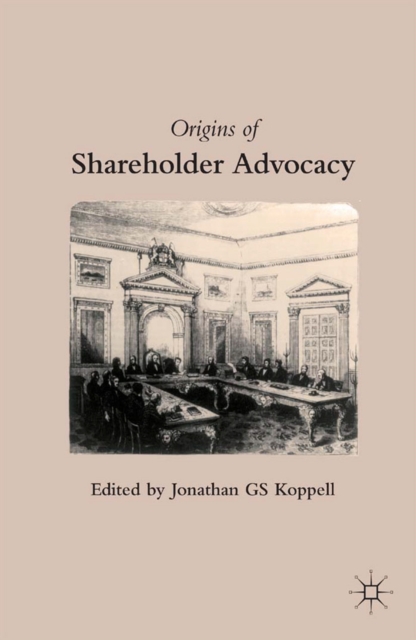
This volume deals with issues of widespread interest including, the origins of investor rights in different markets, the political, legal and economic conditions that determine levels of shareholder participation, and the implications of variation in investor rights.
Why stock-market short-termism is not causing severe damage to the American economy According to many political leaders, pundits, and corporate lawmakers, stock-market-driven short-termism - when corporations prioritize immediate results in the next quarter over their longer-term interests - is harming the American economy.
Why stock-market short-termism is not causing severe damage to the American economy According to many political leaders, pundits, and corporate lawmakers, stock-market-driven short-termism - when corporations prioritize immediate results in the next quarter over their longer-term interests - is harming the American economy.
The governance of the modern corporation is broadly understood as the mechanisms, relations, and processes for balancing the interests of stakeholders.
The governance of the modern corporation is broadly understood as the mechanisms, relations, and processes for balancing the interests of stakeholders.
The theory of symbolic management reveals a pervasive pattern of 'symbolic decoupling' - a separation between appearances and reality - at every level of the governance system.
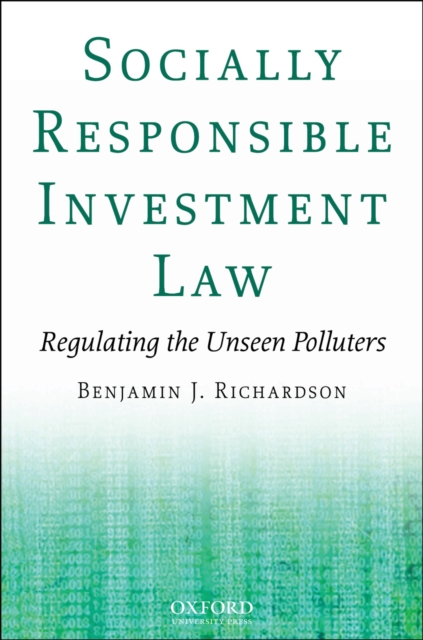
This book offers a guide, for companies, pension funds, asset managers, and other institutional investors, on how to commence the legal, governance, and financial strategies needed for effective climate mitigation and adaptation, and to help distribute the economic benefits of these actions to their stakeholders.
This book offers a guide, for companies, pension funds, asset managers, and other institutional investors, on how to commence the legal, governance, and financial strategies needed for effective climate mitigation and adaptation, and to help distribute the economic benefits of these actions to their stakeholders.
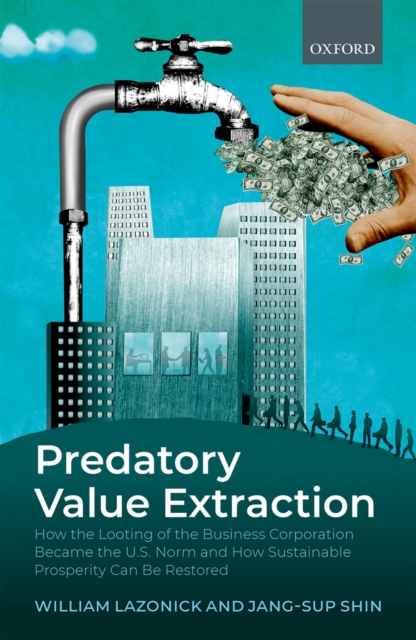
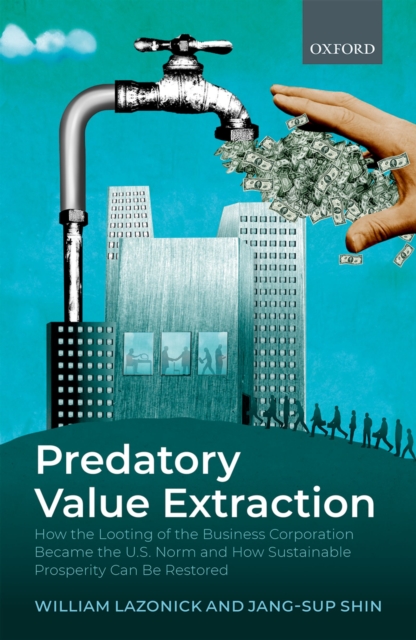
Predatory Value Extraction explains how an ideology of corporate resource allocation known as 'maximizing shareholder value' (MSV) that emerged in the 1980s came to dominate strategic thinking in business schools and corporate boardrooms in the United States.
Predatory Value Extraction explains how an ideology of corporate resource allocation known as 'maximizing shareholder value' (MSV) that emerged in the 1980s came to dominate strategic thinking in business schools and corporate boardrooms in the United States.
Corporate governance is a complex idea that is often inappropriately simplified as a cookbook of recommended measures to improve financial performance.
Corporate governance is a complex idea that is often inappropriately simplified as a cookbook of recommended measures to improve financial performance.
The theory of symbolic management reveals a pervasive pattern of 'symbolic decoupling' - a separation between appearances and reality - at every level of the governance system.