This report presents the results of a stocktake of national responses to Sustainable Development Goals 12, 14, and 15, and selected environment-related targets that have a direct relationship with responsible consumption and production, and sustainable marine and terrestrial ecosystems management, by 15 developing countries in Asia and the Pacific.
Given that there is no shortage of economic theories while economic problems are growing periodically, Conceptual Economics boldly attempts to initiate a new approach by employing conceptual and intuitive tools to examine the intra-relationship between microeconomics and macroeconomics as well as the inter-relationship between economic analysis and other social science studies, especially the relationship with political science.
From in-country to cross-country connections, whether by land, air, or water, transport is a key ingredient that enables nations to achieve economic and social development goals.
The University of the South Pacific (USP), a regional university, has changed its delivery systems for teaching and learning over the years to serve the growing needs for tertiary education of students living on the thousands of small and remote islands in the Pacific Ocean.
The Development Co-operation Report (DCR) is a yearly report by the Chair of the Development Assistance Committee (DAC) that addresses important challenges for the international development community and provides practical guidance and recommendations on how to tackle them.
The book provides a systematic review of research results on regional economic competitiveness, and constructs an evaluation index system based on nine key aspects: the development of a micro-economy; industrial development; enterprise strength; the sciences; education; innovation; environment governance and protection; financial development; and the degree of opening to the outside world.
The Lao People's Democratic Republic (Lao PDR) has shown remarkable progress by consistently building itself into a market-oriented economy, with economic growth in 1986-2016 averaging around 6.
The South Asia Subregional Economic Cooperation (SASEC) Program brings together Bangladesh, Bhutan, India, the Maldives, Nepal, and Sri Lanka in a project-based partnership to promote regional prosperity by improving cross-border connectivity, facilitating faster and less costly trade among member countries, and strengthening regional economic cooperation.
This book provides the annual update of Asia Competitiveness Institute (ACI) indices and rankings of the cost of living for ordinary residents and expatriates as well as wages and purchasing power for ordinary residents, covering 105 cities around the world over the period of 2005-2016.
This book describes the principles of integrated assessment models (IAM) for climate change economics and introduces various computable models for different development mechanisms under climate change governance.
The Singapore Perspectives series is a yearly publication that provides critical analysis of emerging trends and issues Singapore faces in terms of social, economic and political development.
China is emerging as one of the economic giants of the world, and is gaining international influence and global leadership that commensurate with its rise.
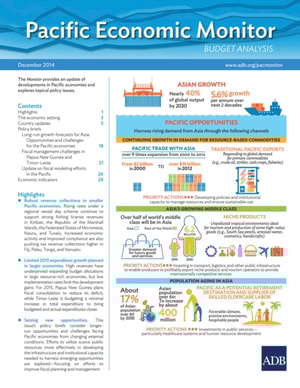
An analysis of 2014 budget outcomes and 2015 budget plans of Pacific developing member countries of the Asian Development Bank is the focus of this issue of the Pacific Economic Monitor.
This comparative study provides an overview of the textbook production chain, starting with its origins in the curriculum, and suggests ways in which policymakers can make improvements at every point in the chain.
This volume focuses on the role of the private sector in diversifying the economics of Gulf countries in the post-petrodollar era, when fluctuating and declining oil prices are negatively impacting national expenditures.
This book is the product of a team-teaching course entitled, "e;Issues in Economic Development"e; offered to the final-year students of Department of Economics and Finance at Hong Kong Shue Yan University.
This book focuses on the development and trends of Chinese local luxury industry in the digital era, which brings a new round of manufacturing transformation and upgrading, as well as development opportunities.
This book places the presidency of Donald Trump as well as the brewing Sino-American Cold War within the broader historical context of American hegemony in Asia, which traces its roots to Alfred Thayer Mahan's call for a naval build up in the Pacific, the subsequent colonization of the Philippines and, ultimately, reaching its apotheosis after the defeat of Imperial Japan in the Second World War.
This book offers a collection of distinguished contributions that identify current growth accelerators in India, and suggest policies and strategies to make India's growth more sustainable and inclusive.
This book explains in simple language the change of perspective and the transition of the systems for poverty alleviation, based on the fifteen-year development of China's poverty alleviation policy.
Outlining important policy requirements for Bangladesh to become an upper middle-income country, the book presents research work conducted during the project "e;Changing Labor Markets in Bangladesh: Understanding Dynamics in Relation to Economic Growth and Poverty,"e; sponsored by the International Development Research Center (IDRC), Canada.
This book is a collection of academic lectures given on fintech, a topic that has been written about extensively but only from a business or technological point of view.
Singapore's progress as an independent nation and the uplifting of its people's livelihood have been made possible by stable social and political conditions.
India is emerging as one of the economic giants of the world, and is gaining international influence and global leadership as the world's largest democracy.
This book brings together experts from four continents (Asia, North America, Europe, Africa) and from varied disciplines to discuss a spectrum of problems created by globalization, such as the economic and financial, environmental, legal, cultural, socio-economic and social media impacts.
This book explores the existing and diverse institutional bottlenecks of land acquisition, ranging from legal and social to political and even environmental within the Asian context.
China has achieved significant socio-economic progress and has become a key player on the international stage after several decades of open-door and reform policy.
This book is the only annual study that dissects Indonesia's sub-national competitiveness at both the provincial level (covering 34 provinces) and the regional level (covering six major island groups).
This book brings together a collection of chapters that investigate sustainable tourism development in different Asian contexts; from stakeholders' perspectives, existing issues in the market, as well as the impacts of COVID-19 on tourism.
The book argues that an increasing corporatisation of agriculture in India that is enabled by its neoliberal State, in the name of 'development', is contributing towards deepening of inequality in the rural India.
Research in this book focuses on the strategic behaviour of the State as a shareholder in businesses, and the implications it has for the other shareholder(s) and business performance.
This book discusses the experience of enterprise transformation and upgrading and the role of government in promoting this dramatic change in Asian emerging economies.
This book is a world-class report by the Asia Competitiveness Institute, updated annually to analyse Indonesia's competitiveness at the provincial level.