Der vorliegende Sammelband möchte auf die Herausforderungen, die Chancen und auf die Erfolgspraktiken eines koordinierten Vorgehens im Aufbau von Resilienz aufmerksam machen.
Dieses Buch versammelt etwa 300 Schlüsselbegriffe, auf Deutsch und auf Englisch, die sich auf nachhaltige Entwicklung und auf ökologische, soziale und Unternehmensführungsthemen beziehen.
In diesem essential lesen Sie, wie durch marktwirtschaftliche Methoden, Innovationen und Investitionen „grünes Wachstum“ erreicht werden kann, ohne dass dabei die Bedürfnisse jener drei Milliarden Menschen vergessen werden, denen es schon heute am Nötigsten fehlt.
The Sustainable Energy for All (SE4All) initiative is the global effort rallying action towards a transformation in the energy sector by the year 2030.
The Star Mountain Investment Holding Limited (SMIHL) is a Papua New Guinean (PNG) landowner holding company operating in Western Province, in the shadows of the huge Ok Tedi mine.
This collection examines the role that foreign aid can play in dealing with the severe global challenge of climate change, one of the most pressing international development issues of the 21st century.
The Asian Development Bank (ADB) supported the provincial authorities of Quang Nam in Viet Nam to scale up the implementation of payments for forest environmental services (PFES) through a technical assistance financed by the Governments of Sweden and Norway.
This book deals with not just complex linkages, interactions and exchanges that form the relationship between the economic activities, human society and the ecosystems, but also the influences and impacts that each causes on the other.
This book focuses on different sustainable products and services, such as electrical vehicles, green buildings, and biophilic and biomimetic systems, at multiple hierarchical levels within its chapters.
The book is the only technical volume that explains how equivalency analysis methods mentioned in Annex II of the European Environmental Liability Directive should be implemented.
The Asian Development Bank (ADB), in collaboration with the United Nations Environment Programme (UN Environment), prepared this tool compendium to help address the issues, challenges, and barriers faced by developing countries from Asia and the Pacific in the successful implementation of the environmental dimensions of the Sustainable Development Goals (SDGs).
From 15-18 November 2013, the Association of Southeast Asian Nations (ASEAN) chief justices and their designees convened in Bangkok, Thailand for their third roundtable on environment with the theme "e;ASEAN's Environmental Challenges and Legal Responses.
This report presents the results of a stocktake of national responses to Sustainable Development Goals 12, 14, and 15, and selected environment-related targets that have a direct relationship with responsible consumption and production, and sustainable marine and terrestrial ecosystems management, by 15 developing countries in Asia and the Pacific.
This book describes the principles of integrated assessment models (IAM) for climate change economics and introduces various computable models for different development mechanisms under climate change governance.
This publication documents the proceedings of the Second South Asia Judicial Roundtable on Environmental Justice, held on 30-31 August 2013 in Thimphu, Bhutan.
The proceedings consist of papers accepted by the 5th ICEMGD, which are carefully selected and reviewed by professional reviewers from corresponding research fields and the editing committee of the conference.
Although the successful economic transformation and reform of China since the 1970s could be regarded as a triumph in human history, China has now entered into the New Normal Era and encountered some slow-down in recent years.
This book is written by experts from Institute of Urban and Environmental Studies of the Chinese Academy of Social Sciences, and National Climate Center, this book provides an overview of China's effort to implement the Paris Agreement.
This book focuses on high-speed rail (HSR) and new town planning and development related to HSR, approaching the issue from three different perspectives: economic cooperation at a regional level; HSR-based economic growth point at a city level; and mixed land use and building environment in the periphery area of HSR stations.
The major challenge for the current generation of mankind is to develop a shared vision of a future that is both desirable to the vast majority of humanity and ecologically sustainable.
This is the first book to introduce the major quantitative tools in risk management taking financial investments and logistics planning as the background: optimization and stochastic programming.
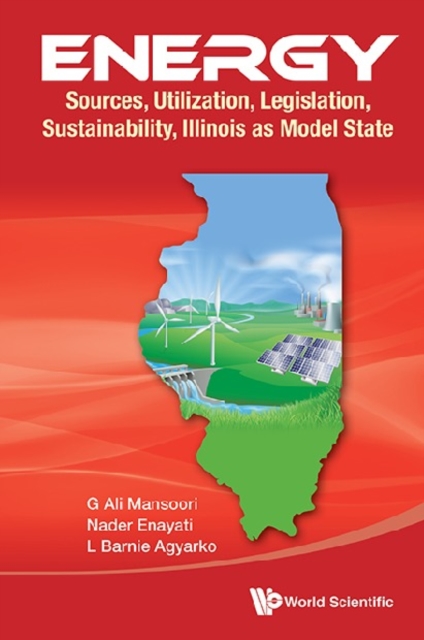
This 800-page premier book on energy focuses on energy sources, utilizations, legislations and sustainability as it relates to a state, a province, or a country, or a community within a state.
The first 50 years of ASEAN integration has brought peace and prosperity to the Southeast Asian region, while the next 50 will undoubtedly be fraught with unprecedented challenges.
This compendium includes a wide range of topics, from energy science and technology, development and utilization of resources to sustainable ecological development.
Environmental Economics and Ecosystem Services provides a rigorous yet accessible introduction to environmental economics, using ecosystem services as the underlying framework.
This book studies the pathways and policies of regional coordinated low carbon development from the perspective of regional spillover-feedback effects.
This book translates the latest theoretical perspectives on the emerging field of Planetary Health Studies into the practical reality of global political decision makers.
This book provides several up-to-date empirical policy-oriented studies on assessing the impacts of climate change on various economic sectors and the role of renewable energy resources in mitigating pollution and climate change.