The existence of fiat currencies has long been cited as one of the major contributing factors to the challenges facing contemporary economies, and the current monetary system is not only a key source of exorable increases in interest rates but also a principal cause of inflation and decline in the value of money in many countries.
The effort to establish economic, political, arid monetary integration in Europe is one of the great dramas of our time, and the implications of its success or failure are enormous for the rest of the world.
This book has greatly benefited from the intellectual advice of Jim Weaver, Don Bowles, and Richard Weisskoff, who supervised my doctoral dissertation at The American University.
In the face of the continuing economic gap between the industrialized and the developing countries, the Third World began to demand a reorganization of the international economic system-its mechanisms, organizations, purposes-that would make the system responsive to the needs of all of its members.
Banking historiography often does not sufficiently take into account bankers deliberations of their decision making, but rather limits investigation to considerations of profit maximisation.
Banking historiography often does not sufficiently take into account bankers' deliberations of their decision making, but rather limits investigation to considerations of profit maximisation.
The book provides deep insight into theoretical and empirical evidence on information and communication technologies (ICT) as an important factor affecting financial markets.
The book provides deep insight into theoretical and empirical evidence on information and communication technologies (ICT) as an important factor affecting financial markets.
Inflation plays a central role in macroeconomic and financial policy regulation, and its dynamic formation has gradually become a popular research topic in this field.
Inflation plays a central role in macroeconomic and financial policy regulation, and its dynamic formation has gradually become a popular research topic in this field.
Social forces are important determinants of how people behave, how economies work at the macroeconomic level, and the effectiveness of economic policies.
Social forces are important determinants of how people behave, how economies work at the macroeconomic level, and the effectiveness of economic policies.
In this book, a historical analysis of the precedents of the euro is examined within the context of the current issues affecting the Eurozone and the long-term effects of the institutional changes implemented since 2010.
In this book, a historical analysis of the precedents of the euro is examined within the context of the current issues affecting the Eurozone and the long-term effects of the institutional changes implemented since 2010.
In most of the currency crises of the 1990s, the largest output falls have occurred in those emerging economies with large currency mismatches, a phenomenon that occurs when assets and liabilities are denominated in different currencies such that net worth is sensitive to changes in the exchange rate.
The dollar rose by about 35 percent in real terms from 1995 through the end of 2001, supporting the booming US economy of the late 1990s but pushing the current account deficit to a record high of almost 5 percent of GDP.
This study reviews the literature on the contribution of low inflation to economic growth and the subsequent widespread adoption of inflation targeting as a monetary policy framework.
Based on a conference held in September 2005 on the future of the International Monetary Fund, this important new book includes an overview of the challenges facing the IMF today.
The global financial crisis produced an important agreement among regulators in 2010-11 to raise capital requirements for banks to protect them from insolvency in the event of another emergency.
For decades, economic policymakers have worshipped at the altar of combating inflation, reducing public deficits, and discouraging risky behavior by investors.
Spurred by the success of the first stress test of US banks toward the end of the global economic crisis in 2009, stress testing of large financial institutions has become the cornerstone of banking supervision worldwide.
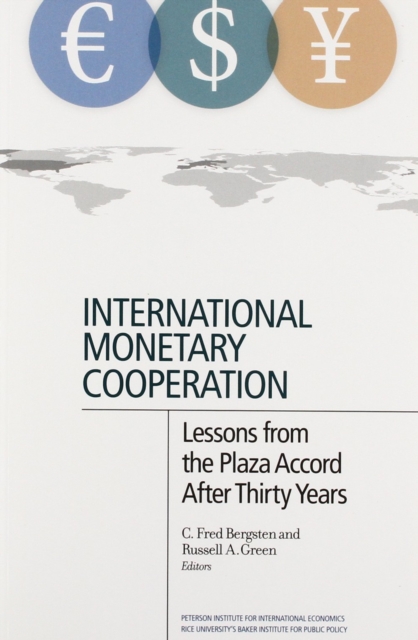
In September 1985, emissaries of the world's five leading industrial nations-the United States, Britain, France, Germany, and Japan-secretly gathered at the Plaza Hotel in New York City and unveiled an unprecedented effort to correct the largest set of current account and exchange rate imbalances that had ever threatened the world economy.
The dispute over Chinese exchange rate policy within the United States has generated a series of legislative proposals to restrict the discretion of the US Treasury Department in determining currency manipulation and to reform the department's accountability to the Congress.
Financialization is a set of processes which has led to a financially driven and commodified economy with rising inequality, tax avoidance, and a lack of investment in the physical and social infrastructure.