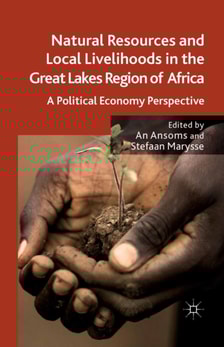
With the current global crisis, high levels of volatility in trade, capital flows, commodity prices, aid, and the looming threat of climate change, this book brings together high-quality research and presents conceptual issues and empirical results to analyze the determinants of the vulnerability to poverty in developing countries.
This book focuses on the concepts of social capital, corporate social responsibility, and economic development in relation to economic theory of institutions and behavioural economics.
This book modifies the existing economic theory of health analysis by integrating the issues and principles of moral philosophy in an extended framework.
Happiness is a private matter and individual pursuit; however, public policy does have an important role and can contribute much through various enabling means.
Specially selected from The New Palgrave Dictionary of Economics 2nd edition, each article within this compendium covers the fundamental themes within the discipline and is written by a leading practitioner in the field.
This book provides an introduction to the relationship between economics and ethics, explaining why ethics enters economics, how ethics affects individual economic behaviour and the interactions of individuals, and how ethics is important in evaluating the performance of economies and of economic policies.
This book is designed to scrutinize the Russian business sector in transition with special attention to firm organization, business integration, corporate governance, and company management.
Following theseminal Palgrave Handbook of Econometrics: Volume I , this second volume brings together the finestacademicsworking in econometrics today andexploresapplied econometrics, containing contributions onsubjects includinggrowth/development econometrics and applied econometrics and computing.
This book discusses both competitive and game theory models of industry growth through new technology, innovations and new entry, and provides a comprehensive treatment of various dynamic models of entry, applications of efficiency and entry models in computers and the pharmaceuticals industry, and applied models of Differential Games.
Easy-to-read and filled with real-world examples of the most complex environmental challenges, this book demonstrates that sound economic analysis and reasoning can be one of the environmental community's strongest allies.
This collection deals with some interesting economic questions related to construction and real estate, namely how construction firms cope with the volatility of construction; whether speculative bubbles or market fundamentals drive those fluctuations; new techniques to predict construction demand; why the office market led the recent real estate cycle; and whether regulation is responsible for speculative behaviour.
This volume presents the most complete collection available of the work of Victor Zarnowitz, a leader in the study of business cycles, growth, inflation, and forecasting.
Personalized and precision medicine (PPM)-the targeting of therapies according to an individual's genetic, environmental, or lifestyle characteristics-is becoming an increasingly important approach in health care treatment and prevention.
Although Japan and the United States are the world's leading economies, there are significant differences in the ways their wealth is translated into living standards.
In recent years the tremendous growth of the service sector-including international trade in services-has outstripped that of manufacturing in many industrialized nations.
In the late 1990s, economic and financial crises raged through East Asia, devastating economies that had previously been considered among the strongest in the developing world.
The recent financial crisis had a profound effect on both public and private universities, which faced shrinking endowments, declining charitable contributions, and reductions in government support.
The Census Bureau has recently begun releasing official statistics that measure the movements of firms in and out of business and workers in and out of jobs.
Redistribution, or subsidies and regulations intended to help the poor, unemployed, and financially distressed, have changed in many ways since the onset of the recent financial crisis.
The Oxford Handbook of the Economics of Networks represents the frontier of research into how and why networks they form, how they influence behavior, how they help govern outcomes in an interactive world, and how they shape collective decision making, opinion formation, and diffusion dynamics.
Redistribution, or subsidies and regulations intended to help the poor, unemployed, and financially distressed, have changed in many ways since the onset of the recent financial crisis.
Conventional economic theory assumes that consumers are fully rational, that they have well-defined preferences and easily understand the market environment.
From Benjamin Franklin to Ragged Dick to Jack Kelly, hero of the Disney musical Newsies, newsboys have long intrigued Americans as symbols of struggle and achievement.
The interactions that occur in securities markets are among the fastest, most information intensive, and most highly strategic of all economic phenomena.
From mad cows to McDonaldization to genetically modified maize, European food scares and controversies at the turn of the millennium provoked anxieties about the perils hidden in an increasingly industrialized, internationalized food supply.
This book brings together in one place the work of one of our most respected economic theorists, on a field in which he has played a large part in originating: the New Institutional Economics.
Conventional economic theory assumes that consumers are fully rational, that they have well-defined preferences and easily understand the market environment.