This book contributes to the understanding of environment-economy relations from the perspective of economic geography, grounded in the institutional context of China.
This book analyzes the various problems of growth, trade and public policy from the perspective of applied economics, based on research in areas such as public policies, trade and regulation, and development economics.
This book examines the struggles of the Japanese economy over the last 30 years, analyzing in detail the formation of the huge economic bubble in the 1980s, its collapse at the beginning of the 1990s, and subsequent two decade long economic stagnation and chronic deflation, with the aim of identifying the mechanism of such processes and drawing lessons for future economic policy management.
This book focuses on the nature and significance of China's state enterprises which have undergone substantial changes since China's economic liberalization in 1978.
This proceedings volume contains papers accepted by the 2022 International Conference on Business and Policy Studies (CONF-BPS 2022), which are carefully selected and reviewed by professional reviewers from corresponding research fields and the editorial team of the conference.
This book examines interesting new topics in applied economics from the perspectives of the economics of information and risk, two fields of economics that address the consequences of asymmetric information, environmental risk and uncertainty for the nature and efficiency of interactions between individuals and organizations.
This is the first book to specify the type of economic system that has arisen in Central Asia, replacing the simplistic ideas of 'petro-state' or 'resource dependent.
An important feature of this book is its analysis of various contemporary issues in applied economics, distinguished by advanced theoretical research and empirical analysis focusing on Japan and Korea.
Welfare rise, spatial mobility, and global information and communication channels (in particular, social media) have prompted the emergence of a specific booming and rapidly growing mobility industry all over the world, namely tourism.
This book focuses on the current tension between China and the US on trade imbalance and discusses China's opening-up strategy in the context of this trade conflict.
This book traces the interacting histories of the disciplines of ecology and economics, from their common origin in the ancient Greek concept of oikonomia, through their distinct encounters with energy physics, to the current obstruction of neoliberal economics to responses to the ecological and climate crisis of the so-called Anthropocene.
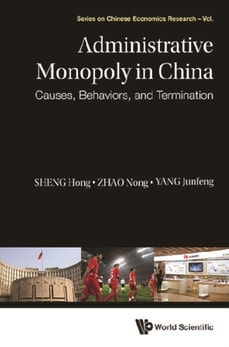
Administrative Monopoly in China: Causes, Behaviors, and Termination is a further work of our previous book, China's State-Owned Enterprises: Nature, Performance and Reform.
The volume on China: The Bankable State rejects neoliberal consensus and focuses on crucial contributions of the Chinese state in shaping Chinese economy.
This book provides a focus on some of the main markers and challenges that are at the core of the study of structural transformations in contemporary capitalism and their implications for labour in the Global South.
This book is a world-class report by the Asian Competitiveness Institute (ACI), updated annually to analyse Indonesia's competitiveness at both the 33 provincial levels and six regional groupings based on the central government's Master Plan for Acceleration and Expansion of Indonesia's Economic Development (MP3EI).
This book focuses on the latest advances in nonlinear dynamic modeling in economics and finance, mainly-but not solely-based on the description of strategic interaction by using concepts and methods from dynamic and evolutionary game theory.
Given its geographical proximity to Asia and its close alliance with the West, Australia, amid the rise of Asian economies, needs to re-formulate its policies on trade, investment and security.
Dieses Buch bietet eine aufschlussreiche Analyse der sich abzeichnenden Flüchtlings- und gemischten Migrationskrise im Kontext von vier großen, aktuellen Migrationsströmen: zwei in West- und Osteuropa und jeweils einer in Amerika und Asien.
This book examines the effects of the Covid-19 pandemic on the degree of inequality in wellbeing (income and wealth, health, access to health care, employment, and education) in a number of different countries around the globe.
Bernie Sanders' socialist advocacy in the United States, communist China's economic successes and a Marxist revival are inspiring many to muse about improved strategies for building superior socialist futures.
This book addresses the economic impact of the COVID-19 outbreak on Central and East European countries and examines the effect the pandemic has had on organizations in the region.
The Politics of the Eurogroup provides an intriguing look inside the euro crisis and the secretive forum of finance ministers that came to dominate it.