In the last two decades of the 20th century, China stood out as the world's star performer in economic growth, thanks to the market-oriented reform that started in 1978.
This volume looks at China's foreign policy from the perspective of learning theory, a relatively new approach to foreign policy analysis based on social psychology.
With mounting discontent due to widespread unemployment, corruption and misgovernment, the Ninth National People's Congress in March 2000 was a letdown.
Taiwan in Troubled Times is concerned with Taiwan's politics and its relations with China following the election of Chen Shui-bian as President in March 2000.
The lack of institutionalization around China's leadership succession was brought into focus again in the run-up to the 16th Congress of the Chinese Communist Party, and the widespread speculation on the final leadership line-up.
In December 2001, Taiwan held an election that many observers said, in addition to the 2000 election that resulted in opposition party leader Chen Shui-bian winning the presidency, consolidated its democracy.
Theorizing the Southeast Asian City as Text examines the ways in which culture, ethnicity, languages, traditions, governance, policies and histories interplay in the creation of the urban experiences in contemporary Southeast Asian cities.
This book collates a number of case studies by former students from the Master of Arts (Social Work) programme whose stream of study was Social Services Administration.
With the new team of Chinese leaders at the helm following the successful hosting of the 16th Party Congress in November 2002, the attention of China's scholars has now shifted to the raft of challenges that await the new leadership.
This book documents the bases for a new view of legitimacy in general and in various parts of Asia, including China, Malaysia, South Korea, Taiwan and Japan.
The fourth generation of leaders of the People's Republic of China, while benefiting from the prestige of China's entry into the World Trade Organization and the honor of hosting the 2008 Olympic Games, also needs to contemplate the sobering side-effects of a rapid and internationally-interdependent economy and a troubled and only partly reformed political system.
This volume is the first comprehensive study of China's "e;political civilization"e; since the term was introduced by then Party Secretary Jiang Zemin in 2002.
This volume is an updated survey and assessment of the recent policy initiatives of Hu Jintao and Wen Jiabao, which have come to be known as the Hu-Wen's New Deal.
There is widespread recognition - among policy-makers, business communities, and scholars - of the importance of improving environmental policy and management in China.
This book provides a discussion of the general impact of WTO membership on both sides of the Taiwan Strait, and addresses the political and economic impact on cross-Strait relations of common membership.
In Interpreting China's Development, leading experts on China provide an overview of this growing superpower, highlighting key issues in the country's political, economic and social development.
The Chinese in Southeast Asia, with their growing economic clout, have been attracting attention from politicians, scholars and observers in recent decades.
This book explores the important topic of fiscal decentralization in Asian countries, and focuses on how government finance and administration are being reformed to bring budgetary decisions closer to voters.
Why have Taiwan, rich parts of China, and Thailand boomed famously, while the Philippines has long remained stagnant both economically and politically?
The recent global financial crisis illustrates how fragile economic globalization is and how vulnerable all global citizens are to economic events outside their own country.
This book focuses solely on the issues of agriculture and forest productivity analysis with advanced modeling approaches to bring solutions to food-insecure regions of South and Southeast Asia.
This book primarily focuses on the domain conditions under which a number of important classes of binary social decision rules give rise to rational social preferences.
Handbook of Contemporary China is a convenient reference in one single volume that offers comprehensive overviews of crucial cultural dimensions and key institutions of China.
International political economy (IPE) is a highly complex discipline, drawing not only from the fields of politics and economics, but also those as varied as philosophy, history and anthropology.
This book examines the national automotive policy in Malaysia to help readers gain an understanding of the country's industrial policy-making processes.
This book analyses and assesses the Agadir Agreement's impact on economic integration, its effect on political cooperation, and its role in promoting peace between participating countries in the Middle East and North Africa (MENA).
This book develops a unified treatment of the income distribution-capital-value problems with respect to actual economies, and then gradually turns to the issues of effective demand and capitalist accumulation fluctuations from both political economy and economic policy perspectives.
This book focuses on an attractive theoretical subject as well as a practical issue, which analyses the inner relationship of economic growth and income distribution in China.
This book looks back to 40 years ago for the whole history of China's reform and opening-up and focuses on the role change of China in the relationship with outside world.
This book provides a focus on some of the main markers and challenges that are at the core of the study of structural transformations in contemporary capitalism and their implications for labour in the Global South.
This book is the first of its kind to offer an understanding, analysis, and prediction of the state of civil society in Bangladesh in relation to development and democracy.
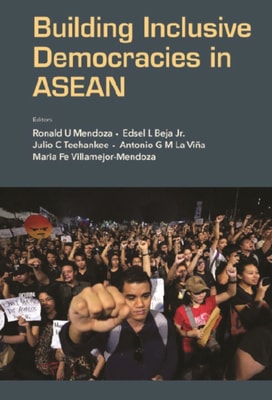
Containing the latest research and insights of academics and development practitioners pursuing political and economic reforms in the ASEAN region, Building Inclusive Democracies in ASEAN recognizes that a well-functioning democracy is part of what ultimately fosters inclusive growth and development.