Through a mixture of concepts and examples, this book demystifies the variety of elements of financial accounting and uncovers the need-to-know information for certification in this field.
This monograph is devoted to a modern theory of capital cost and capital structure created by this book's authors, called the Brusov-Filatova-Orekhova (BFO) theory, and its application to the real economy.
This book explores the key issues of corporate social responsibility (CSR) and reporting as applied to sports organizations, with particular attention to the Italian environment.
This book draws readers' attention to the financial aspects of daily life at a corporation by combining a robust mathematical setting and the explanation and derivation of the most popular models of the firm.
This book integrates the models employed in the fundamental analysis of a company with the models used by investors in the capital markets to diversify risks and maximize expected returns.
The book explores the developing challenges and opportunities within the business and finance world which are likely to impact the accounting profession in the near future.
This book, divided into three main parts, will offer a complete overview of the concept of corporate financial distress, emphasizing the different typologies of corporate paths included in this broad concept.
This book analyses the role of Enterprise Resource Planning (ERP) and Business Intelligence (BI) systems in improving information quality through an empirical analysis carried out in Italy.
Corporate failures and accounting scandals have shaken the foundations of investors' confidence in the transparency, integrity and accountability of corporations and financial markets.
This book provides a critical analysis of the current state of knowledge on the relationship between family firms and a wide range of accounting choices, including earnings management, accounting conservatism, and financial and non-financial disclosure.
This book employs a narrative analytical approach to explore all aspects of the debate surrounding auditor reporting on going concern uncertainty worldwide.
This book provides a detailed assessment of current approaches to transfer pricing in the context of small- and middle-sized enterprises (SMEs), including the newest update of Transfer Pricing Guidelines from 10 July 2017.
This volume presents selected papers on recent management research from the 20th Eurasia Business and Economics Society (EBES) Conference, which was held in Vienna in 2016.
This book investigates how corporate governance is directing the internal audit function (IAF) adaptation as a response to enterprise resource planning (ERP) systems.
This book approaches the question of the relation between financial crises and earnings management from two philosophical perspectives: positivism and critical realism.
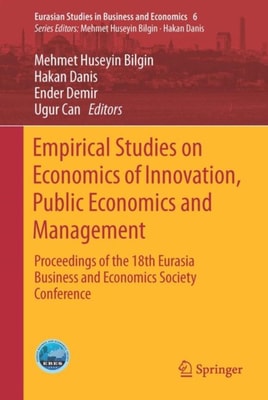
This volume presents selected papers from the 18th Eurasia Business and Economics Society (EBES) Conference, with major emphasis placed on highlighting the latest research developments in the economics of innovation, public economics, and management.
This book describes how auditors exercise different levels of professional skepticism and how they are exposed to different types of affective information on clients' behavior.
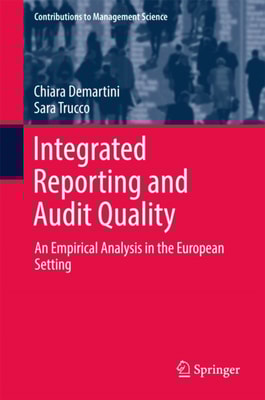
This book analyzes the relationship between integrated reporting and audit quality within the European context, presenting empirical evidence and drawing on a broad review of the available literature in order to evaluate the ability of integrated reporting to enhance audit risk assessment.
This book addresses synergy management, which poses an important challenge for firms, advisors and practitioners involved in mergers and acquisitions (M&A).
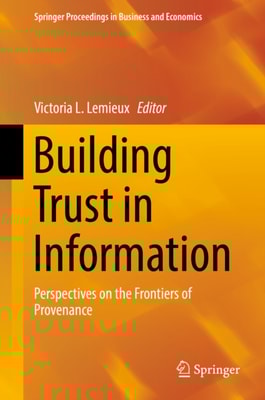
This book reports on the results of an interdisciplinary and multidisciplinary workshop on provenance that brought together researchers and practitioners from different areas such as archival science, law, information science, computing, forensics and visual analytics that work at the frontiers of new knowledge on provenance.
This is the first English translation of Benedetto Cotrugli's The Book of the Art of Trade, a lively account of the life of a Mediterranean merchant in the Early Renaissance, written in 1458.
This book draws readers' attention to the financial aspects of daily life at a corporation by combining a robust mathematical setting and the explanation and derivation of the most popular models of the firm.