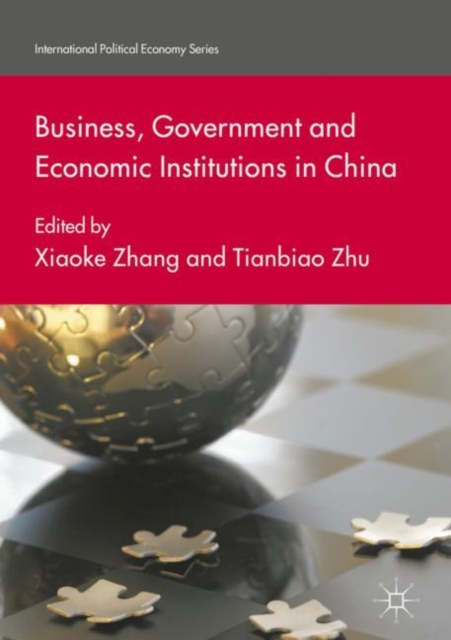
This book brings together conceptual and empirical analyses of the causes and consequences of changing business-government relations in China since the 1990s, against the backdrop of the country's increased integration with the global political economy.
This book explores three particular strategies in the extractives sector for creating shared wealth, increased labour opportunities and positive social, environmental and economic outcomes from corporate projects, namely: state wealth funds (SWF), local content policies (LCP) and corporate social responsibility (CSR) practices.
This book explores the issue of consumer financial education, responding to increased interest in, and calls to improve peoples' financial literacy skills and abilities to understand and manage their money.
This book provides an introduction to the state of the art in financial technology (FinTech) and the current applications of FinTech in digital banking.
Economists broadly define financial asset price bubbles as episodes in which prices rise with notable rapidity and depart from historically established asset valuation multiples and relationships.
This book draws on financial, economic, and management theory in its exploration of the theory underlying risk and risk management at both micro- and macroeconomic levels.
This book employs a narrative analytical approach to explore all aspects of the debate surrounding auditor reporting on going concern uncertainty worldwide.
This book explains the theoretical structure of particle swarm optimization (PSO) and focuses on the application of PSO to portfolio optimization problems.
This study investigates the complex link between natural disasters, individual behaviour - in the form of an individual's risk-taking propensity and level of trust - and the demand for microinsurance.
This book discusses the current landscape of our market economy, which is in the hands of financiers and billionaires who decrease competition as well as consumer power.
This is the second of a two-part guide to quantitative analysis using the IBM SPSS Statistics software package; this volume focuses on multivariate statistical methods and advanced forecasting techniques.
This book develops insights of digitalization and the future of financial services to originate an innovative approach to financial field, in order to underpin research and practice in the wide area of digital finance.
This book analyses several aspects on the efficient resource allocation in the aftermath of the global financial crisis and the European sovereign debt crisis.
This book addresses synergy management, which poses an important challenge for firms, advisors and practitioners involved in mergers and acquisitions (M&A).
Through a mixture of concepts and examples, the second edition of this book demystifies the variety of elements of financial accounting and uncovers the need-to-know information for certification in this field.
When the global financial crisis broke, central banks in both the US and the UK undertook massive asset purchase programmes which resulted in considerable increase in assets.
EBES conferences have been intellectual hub for academic discussion in economics, finance, and business fields and provide network opportunities for participants to make long lasting academic cooperation.
This book introduces readers to a new approach to identifying stock market bubbles by using the illiquidity premium, a parameter derived by employing conic finance theory.
This book is an edited collection by leading insurance historians, examining the historical role of reinsurance (the insurance of insurers) in the insurance markets of eight countries: USA, Netherlands, Sweden, France, Spain, Italy, Mexico and Japan.
Antitrust economics is a field that draws extensively on the economic theory of industrial organization, and the field's frontier is at the cutting edge of economic research.
This book looks at financial advisory from a behavioural perspective, and focuses on how the nature of the relationship between advisors and clients may affect the ability of the advisor to perform its functions.