Style: An Introduction to History, Theory, Research, and Pedagogy conducts an in-depth investigation into the long and complex evolution of style in the study of rhetoric and writing.
The PC era is giving way to a new form of popular computing in which smart, globally-connected objects and environments are the new computational ground.
First-Year Composition: From Theory to Practice's combination of theory and practice provides readers an opportunity to hear twelve of the leading theorists in composition studies answer, in their own voices, the key question of what it is they hope to accomplish in a first-year composition course.
First-Year Composition: From Theory to Practice's combination of theory and practice provides readers an opportunity to hear twelve of the leading theorists in composition studies answer, in their own voices, the key question of what it is they hope to accomplish in a first-year composition course.
ePortfolio Performance Support Systems: Constructing, Presenting, and Assessing Portfolios addresses theories and practices advanced by some of the most innovative and active proponents of ePortfolios.
Composition Studies Through a Feminist Lens offers students a lucid and engaging introduction to the discipline's history, struggles, and accomplishments through the lens of feminism.
Composition Studies Through a Feminist Lens offers students a lucid and engaging introduction to the discipline's history, struggles, and accomplishments through the lens of feminism.
Scientific Writing in a Second Language investigates and aims to alleviate the barriers to the publication of scientific research articles experienced by scientists who use English as a second language.
From the history of the community college in the United States to current issues and concerns facing writing programs and their administrators and instructors, Writing Program Administration and the Community College offers a comprehensive look into writing programs at public two-year institutions.
Critical Conversations About Plagiarism is an edited collection of essays that addresses traditional, overly simplistic treatments of plagiarism by providing approaches to the topic that are complex, critical, and challenging, as well as accessible to both students and teachers.
Critical Conversations About Plagiarism is an edited collection of essays that addresses traditional, overly simplistic treatments of plagiarism by providing approaches to the topic that are complex, critical, and challenging, as well as accessible to both students and teachers.
Offering a comparative analysis of "e;community-literacy studies,"e; Community Literacy and the Rhetoric of Local Publics traces common values in diverse accounts of "e;ordinary people going public.
WRITING PROGRAM ADMINISTRATION AT SMALL LIBERAL ARTS COLLEGES presents an empirical study of the writing programs at one hundred small, private liberal arts colleges.
Andy Kirkpatrick and and Zhichang Xu offer a response to the argument that Chinese students' academic writing in English is influenced by "e;culturally nuanced rhetorical baggage that is uniquely Chinese and hard to eradicate.
Brittany Perham's first collection, THE CURIOSITIES, fixes its sure and unsettling gaze on daughters and fathers, sisters and brothers, madness, sickness, longing and love.
GenAdmin: Theorizing WPA Identities in the Twenty-First Century examines identity formation in a generation of rhetoric and composition professionals who have undergone explicit preparation in scholarly dimensions of writing program administration.
Alert and streetwise, but tuned into the undercurrent of things, Choi's poetry creates environments at once familiar but dreamlike, marked by a preternatural clarity.
Fourteen chapters researched and authored by scholars working in nine different countries and regions explore the contexts of foreign language writing pedagogy, the diversity of national and regional approaches, the role of universities, departments, and programs in pedagogy, and the cognitive and classroom dimensions of teaching and learning.
Fourteen chapters researched and authored by scholars working in nine different countries and regions explore the contexts of foreign language writing pedagogy, the diversity of national and regional approaches, the role of universities, departments, and programs in pedagogy, and the cognitive and classroom dimensions of teaching and learning.
Lisa Fishman's Current follows The Happiness Experiment (Ahsahta, 2007) further into an experience of time as theater, weather, myth, insect body, plantlife, transcription, synchrony, and figment.
Adopting an interdisciplinary perspective, BUILDING GENRE KNOWLEDGE provides a unique look into the processes of building genre knowledge while offering a dynamic theory of those processes that is inclusive of both monolingual and multilingual writers-a necessary move in today's linguistically diverse classrooms.
Tracing the intertidal circuits of story and understory, of body and soul, of land and sea, Christopher Sindt's sensitive and intelligent poetry offers "e;a foundation for becoming.
This reference guide provides a comprehensive review of the literature on all the issues, responsibilities, and opportunities that writing program administrators need to understand, manage, and enact, including budgets, personnel, curriculum, assessment, teacher training and supervision, and more.
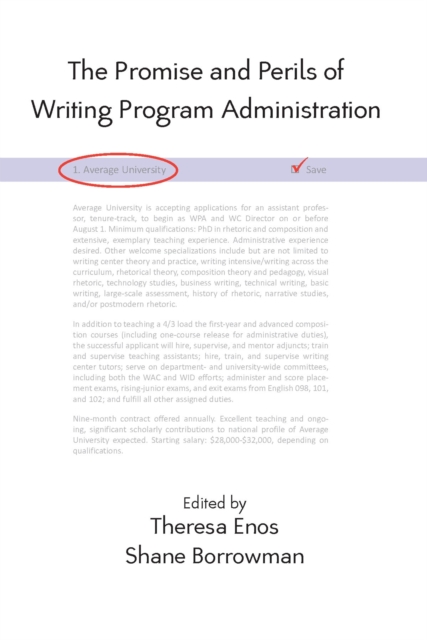
Combining formal quantitative research with narrative-based scholarship, THE PROMISE AND PERILS OF WRITING PROGRAM ADMINISTRATION represents multiple voices from faculty balancing between the demands of teaching, writing, and administering writing programs in professional, ethical ways-often under circumstances that can be defined, at best, as difficult.
Offering a comparative analysis of "e;community-literacy studies,"e; Community Literacy and the Rhetoric of Local Publics traces common values in diverse accounts of "e;ordinary people going public.
WRITING THE VISUAL: A PRACTICAL GUIDE FOR TEACHERS OF COMPOSITION AND COMMUNICATION offers a variety of creative and theoretically based approaches to the development of visual literacy.
In Molly Bendall's fourth book of poems, the verbal underworld of doing and undoing-oath, love charm, prayer, curse-becomes a refuge of tenderness and malediction.
Bibliographic Research in Composition Studies is a student-friendly guide to how knowledge is constructed and disseminated in composition studies, as well as a thorough handbook on how to conduct bibliographic research in the discipline.
Design Discourse: Composing and Revising Programs in Professional and Technical Writing addresses the complexities of developing professional and technical writing programs.
GENRE: AN INTRODUCTION TO HISTORY, THEORY, RESEARCH, AND PEDAGOGY provides a critical overview of the rich body of scholarship that has informed a "e;genre turn"e; in Rhetoric and Composition, including a range of interdisciplinary perspectives from rhetorical theory, applied linguistics, sociology, philosophy, cognitive psychology, and literary theory.
GENRE: AN INTRODUCTION TO HISTORY, THEORY, RESEARCH, AND PEDAGOGY provides a critical overview of the rich body of scholarship that has informed a "e;genre turn"e; in Rhetoric and Composition, including a range of interdisciplinary perspectives from rhetorical theory, applied linguistics, sociology, philosophy, cognitive psychology, and literary theory.
Framed by historic developments-from the Open Admissions movement of the 1960s and 1970s to the attacks on remediation that intensified in the 1990s and beyond-Basic Writing traces the arc of these large social and cultural forces as they have shaped and reshaped the field.
Framed by historic developments-from the Open Admissions movement of the 1960s and 1970s to the attacks on remediation that intensified in the 1990s and beyond-Basic Writing traces the arc of these large social and cultural forces as they have shaped and reshaped the field.
On the Blunt Edge: Technology in Composition's History and Pedagogy tells the stories of composition's techno-history, from the roads of the ancient world, which allowed students to travel to school, to the audio-visual aids that populate the classrooms of the modern world.