This book addresses a question fundamental to any discussion of grammatical theory and grammatical variation: to what extent can principles of grammar be explained through language use?
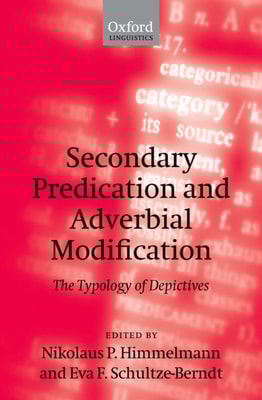
Depictive secondary predicates, such as 'raw' in 'George ate the fish raw', are central to current issues in syntactic and semantic theory - in particular predication theory, phrase structure theories, issues of control and grammatical relations, and verbal aspect.
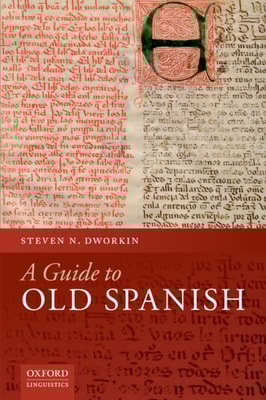
This book is a general introduction to the structures of the different medieval Romance vernaculars most commonly known as Old or Medieval Spanish, as preserved in texts from Spain from the eleventh to the fifteenth centuries.
This book examines the diachronic development of negation in Low German, from Old Saxon up to the point at which Middle Low German is replaced by High German as the written language.
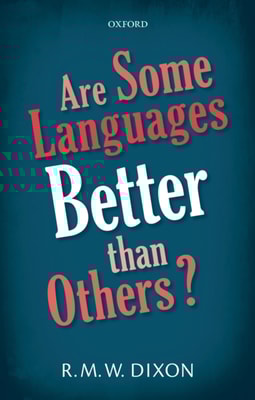
This book examines the question of whether languages can differ in grammatical complexity and, if so, how relative complexity differences might be measured.
In this book, leading linguists explore the empirical scope of syntactic theory, by concentrating on a set of phenomena for which both syntactic and nonsyntactic analyses initially appear plausible.
This handbook offers an extensive crosslinguistic and cross-theoretical survey of polysynthetic languages, in which single multi-morpheme verb forms can express what would be whole sentences in English.
This handbook offers an extensive crosslinguistic and cross-theoretical survey of polysynthetic languages, in which single multi-morpheme verb forms can express what would be whole sentences in English.
This book explores the uses of adjectives in different constructions, and of the problems that arise in their analysis, both in terms of syntactic theory and philosophy of grammar.
This book provides argues for a compositional, truth-conditional, crosslinguistic semantics for evidentiality, the linguistic encoding of the source of information on which a statement is based.
This book is about one of the most intriguing features of human communication systems: the fact that words that go together in meaning can occur arbitrarily far away from each other.
This volume provides a guide to what we know about the interplay between prosody-stress, phrasing, and melody-and interpretation-felicity in discourse, inferences, and emphasis.
The first lessons we learn in school can stay with us all our lives, but this was nowhere more true than in the last decades of the fourteenth century when grammar-school students were not only learning to read and write, but understanding, for the first time, that their mother tongue, English, was grammatical.
The first lessons we learn in school can stay with us all our lives, but this was nowhere more true than in the last decades of the fourteenth century when grammar-school students were not only learning to read and write, but understanding, for the first time, that their mother tongue, English, was grammatical.
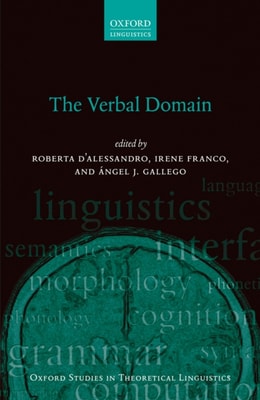
This volume features cutting-edge research from leading authorities on the nature and structure of the verbal domain and the complexity of the Verb Phrase (VP).
The third edition of The Concise Oxford Dictionary of Linguistics is an authoritative and invaluable reference source covering every aspect of its wide-ranging field.
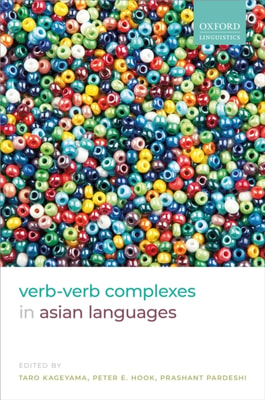
This volume is the first to present a detailed survey of the systems of verb-verb complexes in Asian languages from both a synchronic and diachronic perspective.
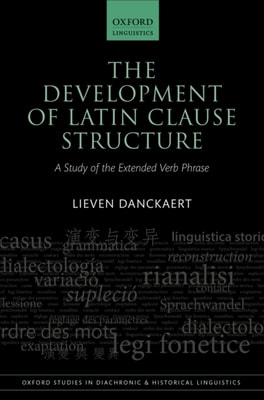
This book examines Latin word order, and in particular the relative ordering of i) lexical verbs and direct objects (OV vs VO) and ii) auxiliaries and non-finite verbs (VAux vs AuxV).
This volume offers a thorough, systematic, and crosslinguistic account of evidentiality, the linguistic encoding of the source of information on which a statement is based.
This volume offers a thorough, systematic, and crosslinguistic account of evidentiality, the linguistic encoding of the source of information on which a statement is based.
This volume brings together distinguished scholars from all over the world to present an authoritative, thorough, and yet accessible state-of-the-art survey of current issues in pragmatics.
This textbook introduces and explains the fundamental issues, major research questions, and current approaches in the study of grammaticalization - the development of new grammatical forms from lexical items, and of further grammatical functions from existing grammatical forms.
This book investigates the phenomenon of morphological length manipulation: changes in segmental length that cannot be explained by phonological means alone but crucially rely on morphological information.
This book presents a controlled evaluation of three widely practised syntactic theories on the basis of the extremely complex agreement system of Archi, an endangered Nakh-Daghestanian language.
In this book, the first full-scale work of its kind in English, Harm Pinkster applies contemporary linguistic theories and the findings of traditional grammar to the study of Latin syntax.
This book examines the tone and accent of Oklahoma Cherokee, in which six possible pitch patterns can occur on a syllable: low, high, low-high, high-low, lowfall, and superhigh.
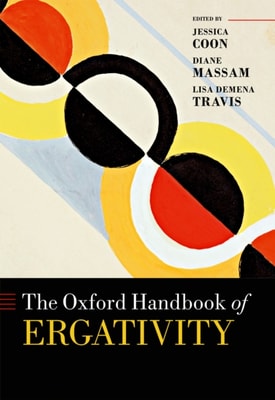
This volume offers theoretical and descriptive perspectives on the issues pertaining to ergativity, a grammatical patterning whereby direct objects are in some way treated like intransitive subjects, to the exclusion of transitive subjects.
This volume offers theoretical and descriptive perspectives on the issues pertaining to ergativity, a grammatical patterning whereby direct objects are in some way treated like intransitive subjects, to the exclusion of transitive subjects.