The purpose of this study is the systematic description of a set of data called Adjectives in Korean, which reduces to a minimum theoretical preoccupations and abstract formalisations with no practical applications.
This study is based on the writings and teaching of Gustave Guillaume (1883-1960), one of the earliest proponents of what is today called Cognitive Linguistics.
Although the contributors to this book do not belong to one particular ‘school’ of linguistic theory, they all share an interest in the external functions of language in society and in the relationship between these functions and internal linguistic phenomena.
In the last decade, there has been a revival of interest regarding negation and polarity, with much cross-fertilization between semantic and syntactic approaches.
Destined to become a landmark work, this book is devoted principally to a reassessment of the content, categories, boundaries, and basic assumptions of pidgin and creole studies.
This monograph aims to close the gap in our knowledge of the nature and pace of grammatical change during the formative period of today’s Indo-Aryan languages.
Fusing insights from cognitive grammar, systemic-functional grammar and Government & Binding, the present work elaborates and refines Davidse’s view that the English grammar of lexical causatives is governed by the transitive and ergative paradigms, two distinct models of causation (Davidse 1991, 1992).
The formal aspects of non-concatenative morphology have received considerable attention in recent years, but the diachronic dimensions of such systems have been little explored.
The earliest use of the term "e;grammaticalization"e; was to refer to the process whereby lexical words of a language (such as English keep in "e;he keeps bees"e;) become grammatical forms (such as the auxiliary in "e;he keeps looking at me"e;).
In this contrastive French-English grammar, the comparisons between French structures and their English equivalents are formulated as rules which associate a French schema (of a particular grammatical structure) with its translation into an equivalent English schema.
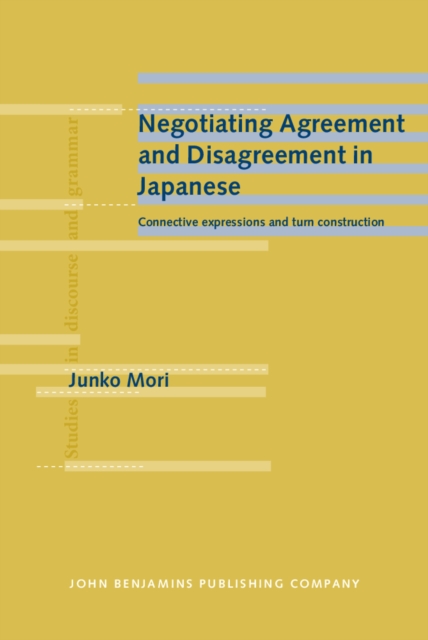
On the basis of the meticulous transcription/observation process of ‘Conversation Analysis’, this book observes recurrent patterns in sequences where Japanese speakers negotiate agreement and disagreement.
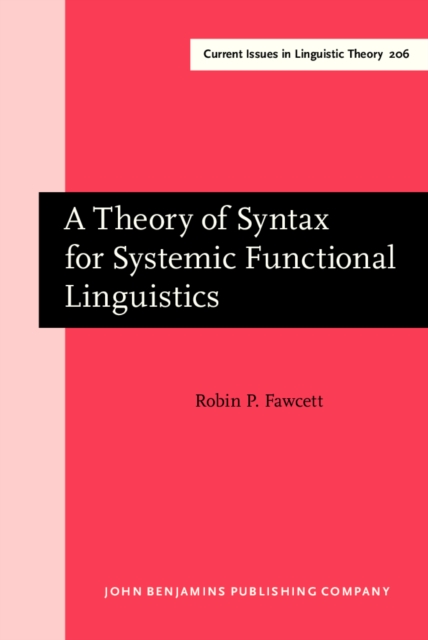
This book describes and evaluates alternative approaches within Systemic Functional Linguistics (SFL) to representing the structure of language at the level of form.
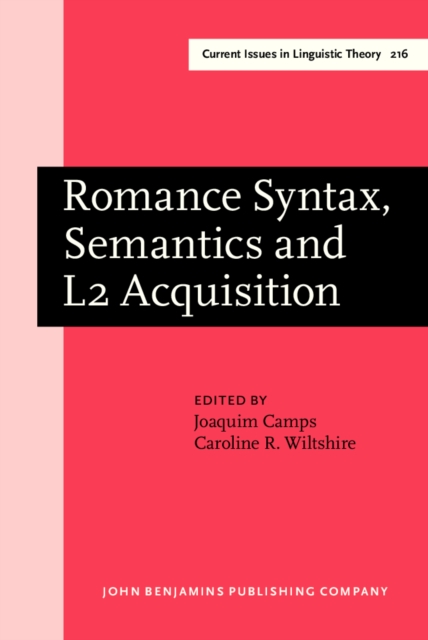
This volume contains a selection of refereed and revised papers, originally presented at the 30th Linguistic Symposium on Romance Languages, representing the areas of syntax, semantics, their interfaces, and second language acquisition.
Basic notions in the field of creole studies, including the category of “creole languages” itself, have been questioned in recent years: Can creoles be defined on structural or on purely sociohistorical grounds?
This volume contributes to the now one-century old question, 'Is the link between forms and meanings in language essentially arbitrary, as Saussure put it, or is it on the contrary also considerably motivated?
This volume is the third one of the revived series of Travaux, which was the well-known international book series of the classical Prague Linguistic Circle, published in the years 1929-39.
In light of recent generative minimalism, and comparative parametric theory of language variation, the book investigates key features and parameters of Arabic grammar.
Within the framework of Chomsky's Principles and Parameters Theory and the Minimalist Program, this work presents a detailed discussion of the different types of wh-question formation and relativization strategies in Cape Verdean Creole (Santiago variety), especially focusing on wh-movement of PPs.
This monograph is one of the first studies that approaches Latin syntax from a formal perspective, combining detailed corpus-based description with formal theoretical analysis.
This book is a collection of articles dealing with various aspects of grammatical relations and argument structure in the languages of Europe and North and Central Asia (LENCA).
Morphology, and in particular word formation, has always played an important role in Romance linguistics since it was introduced in Diez's comparative Romance grammar.
This book offers new work by some major figures in the field of linguistics, addressing old debates from the perspective of current explanatory grammatical theory.
This collective volume on nominal expressions in Basque, a language isolate with no known relatives, comprises original papers on the syntactic structure and the interpretation of both Noun Phrases and nominalization constructions - a traditionally neglected aspect of Basque linguistics.