This book envisions the study of bare noun phrases as a field of research in its own right rather than an accessory matter in the wider domain of nominal determination.
Sharing certain assumptions but differing in theory and practice, both Columbia School linguistics (CS) and Cognitive Grammar (CG) have increasingly supported their analyses with quantitative evidence.
This volume presents some of the latest research in Frame Semantics, including work in computational lexicography as developed within the FrameNet project.
The present collection offers fresh perspectives on the lexicon-syntax interface, drawing on novel data from South Asian languages like Bangla, Hindi-Urdu, Kashmiri, Kannada, Malayalam, Manipuri, Punjabi, and Telugu.
The volume aims at a universal definition of modality or "e;illocutionary/speaker's perspective force"e; that is strong enough to capture the entire range of different subtypes and varieties of modalities in different languages.
This volume is dedicated to exploring the crossroads where complex sentences and information management - more specifically information structure and reference tracking - come together.
The chapters in this volume address current topics in the morphology, syntax, and semantics of nominalizations, drawing on a range of typologically and geographically diverse languages.
Although the Germanic and Romance languages are two branches of the same language family and although both have developed the adjective as a separate syntactic and morphological category, the syntax, morphology, and interpretation of adjectives is by no means the same in these two language groups, and there is even variation within each of the language groups.
This is the first book to present an account of literary meaning and effects drawing on our best understanding of mind and language in the form of a Cognitive Grammar.
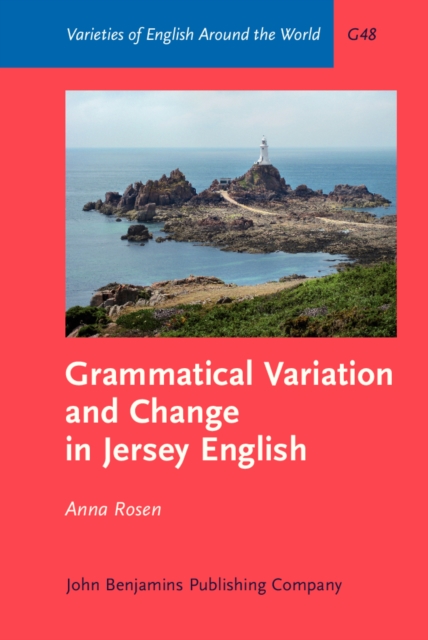
Situated at the crossroads of dialectology, sociolinguistics and contact linguistics, this volume provides a first comprehensive description of the morphosyntactic inventory of the variety of English spoken on Jersey, the largest of the Channel Islands.
The aim of this book is to investigate and attain new insights on how and to what extent the wider sociolinguistic context of language use and contact impinges on formal grammatical structures.
The contributions of this volume offer new perspectives on the relation between syntax and information structure in the history of Germanic and Romance languages, focusing on English, German, Norwegian, French, Spanish and Portuguese, and both from a synchronic and a diachronic perspective.
Although usage-based linguistics emphasises the need for studies of language change to take frequency effects into account, there is a lack of research that tries to systematically model frequency effects and their relation to diffusion processes in language change.
This is the first of three volumes dealing with clausal architecture, grammatical relations, case-marking and the syntax-semantics interface in Baltic.
This book, intended primarily for researchers and advanced students, expands greatly on previous work by the authors exploring the topography of the multidimensional "e;functional-cognitive space"e; within which functional, cognitive and/or constructionist approaches to language can be located.
This volume offers the reader a unique possibility to obtain a concise introduction to dependency linguistics and to learn about the current state of the art in the field.
The differences among functionalist, cognitivist and/or constructionist models are generally taken to be not absolute, but rather a matter of emphasis and degree, with an increasing permeability between paradigms arising from cross-fertilizing influences.
While the argument structure of verbs has long been a central issue in linguistic research of all varieties and continues to be a vexed area of research across a wide range of theoretical and empirical approaches, the inter-disciplinary perspective and dialogue remain largely under explored.
This volume provides both a quantitative statistical and qualitative analysis of Late Northumbrian verbal morphosyntax as recorded in the Old English interlinear gloss to the Lindisfarne Gospels.
This monograph offers the first in-depth lexical and semantic analysis of motion verbs in their development from Latin to nine Romance languages - Spanish, French, Italian, Portuguese, Romanian, Catalan, Occitan, Sardinian, and Raeto-Romance - demonstrating that the patterns of innovation and continuity attested in the data can be accounted for in cognitive linguistic terms.
The universal and typological status of the notion of word class - closely related to part-of-speech systems, morphology, syntax and the lexicon-syntax interface - continues to be of major linguistic theoretical interest.
The studies in this volume approach English grammatical patterns in novel ways by interrogating corpora, focusing on patterns in the verb phrase (tense, aspect and modality), the noun phrase (intensification and focus marking), complementation structures and clause combining.
The contributions in this volume are devoted to various aspects of the internal and external syntax of DPs in a wide variety of languages belonging to the Slavic, Turkic, Finno-Ugric, Semitic and Germanic language families.
The chapters in this book show how the different flavors of Construction Grammar provide illuminating insights into the syntax, semantics, pragmatics and discourse-functional properties of specific phenomena in Romance languages such as (Castilian) Spanish, French, Romanian, and Latin from a synchronic as well as a diachronic viewpoint.
Endocentric Structuring of Projection-free Syntax puts forward a novel theory of syntax that rigidly adheres to the principle of Minimal Computation, in which a number of traditional but extraneous stipulations such as referential indices and representational labels/projections are eliminated.
Cognitive linguistics has an honourable tradition of paying respect to naturally occurring language data and there have been fruitful interactions between corpus data and aspects of linguistic structure and meaning.
This volume brings together studies in the domain of weak referentiality, the phenomenon that a definite or indefinite noun phrase lacks its usual referential force.
Dialect syntax has proven to be an invaluable data source for theoretical syntax, and theoretical syntax has provided useful analytical tools for uncovering fascinating grammatical properties of dialects.
In contrast with the central arguments of the event structure, which have been extensively studied, much less attention has been given to non-arguments.
The Language of Emotions: The case of Dalabon (Australia) is the first extensive study of the linguistic encoding of emotions in an Australian language, and further, in an endangered, non-European language.