In former times, the study of language was rarely pursued in isolation, and many of the other intellectual concerns that used to be intertwined with language study have long been on the record of historians of linguistics.
In this reader, 19 articles have been collected that bring out the central position of John Wilkins and his Essay Toward a Real Character, and a Philosophical Language (1668) in the history of ideas in 17th-century Britain.
This volume contains a selection of papers from the Fifth International Conference on the History of the Language Sciences, dealing with subjects ranging from the classical period till the 20th century.
Progress in Language, first published in 1894, dates from fairly early in Otto Jespersen's (1860-1943) academic career; it already contains many of the essentials of his argument against the prevailing mode of 19th-century linguistic thought which he maintained until the end of his life.
This study aims to describe the typological characteristics of the original Indo-European structure, called the derivative-flectional stage (or (sub)type), and to trace its developments to the paradigmatically organized structure of the individual Indo-European languages, called the paradigmatic-flectional stage (or (sub)type).
In part due to its exotic place within the languages of Europe, but mainly because of its basic typological differences with better-described languages, Basque has often attracted the interest of linguists of very different theoretical persuasions.
This is the first major study of the conservative or basilectal English creoles of the Anglophone Caribbean since Bailey's (1966) and Bickerton's (1975) descriptions of Jamaican and Guyanese Creole respectively.
Although varieties of North American English have come in for a good deal of linguistic scrutiny in recent years, the vast majority of published works have dealt with American rather than Canadian English.
The aim of this volume is to witness how the activities of the Prague School have continued to bring important new insights and discussions between the 1940s and the present time.
This volume contains a selection of 34 of the 96 papers presented at ICHL 1993, including several of the contributions to the workshop on Parameters and Typology organized jointly by Henning Andersen and David W.
A language of Indic origin heavily infuenced by European idioms for many centuries now, Romani provides an interesting experimental field for students of language contact, linguistic minorities, standardization, and typology.
This volume presents the key examples of morphological correspondences between Indo-European and Semitic languages, afforded by nouns, verbal roots, pronouns, prepositions, and numerals.
This collection of eight papers is a continuation of Manfred Gorlach's previous collection "e;Englishes"e; with the author's most influential writings in the field of varieties of English
This volume presents recent theoretical research on Romance languages, selected from papers presented at the 25th Linguistic Symposium on Romance Languages.
This volume contains ten revised and expanded papers selected from the dozens presented at the last Michigan-Berkeley Germanic Linguistics Roundtable, five contributions each from syntax (by Werner Abraham, Sarah Fagan, Isabella Barbier, John te Velde, and Ruth Lanouette) and historical linguistics (by Garry Davis and Gregory Iverson, Mary Niepokuj, Neil Jacobs, Edgar Polomé, and David Fertig).
Richard Kayne’s introduction to this volume stresses that comparative work on the syntax of very closely related languages and dialects is a research tool promising to provide both a broad understanding of parameters at their finest-grained and an approach to the question of the minimal units of syntactic variation.
Among the topics treated in this collection are the status of Scots as a national language; the orthography of Scots; the actual and potential degree of standardisation of Scots; the debt of the vocabulary of Scots to Gaelic; the use of Scots in fictional dialogue; and the development of Scots as a poetic medium in the modern period.
There is a growing awareness that a fruitful cooperation between the (diachronic and synchronic) study of language variation and change and work in phonological theory is both possible and desirable.
Contributions to this collection focus on the unity and diversity of the language of the Roma (Gypsies), the only Indic language spoken exclusively in Europe.
This book contributes to a more balanced view of the most dramatic results of language contact by presenting linguistic and historical sketches of lesser-known contact languages.
Destined to become a landmark work, this book is devoted principally to a reassessment of the content, categories, boundaries, and basic assumptions of pidgin and creole studies.
The body of theory on speech production and speech disorder developed prior to Descartes has been so neglected by historians that its very existence is practically unknown today.
The two volumes of Englishes around the World present high-quality original research papers written in honour of Manfred Gorlach, founder and editor of the journal English World-Wide and the book series Varieties of English Around the World.
The two volumes of Englishes around the World present high-quality original research papers written in honour of Manfred Görlach, founder and editor of the journal English World-Wide and the book series Varieties of English Around the World.
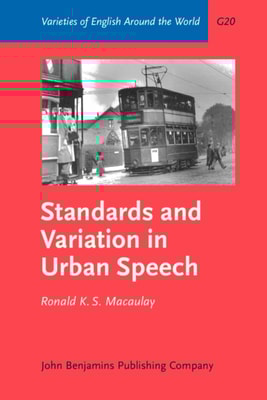
Standards and Variation in Urban Speech is an examination and exploration of the aims and methods of sociolinguistic investigation, based on studies of Scottish urban speech.
Irish English is both the oldest overseas variety of English and, thanks to its co-existence with Irish Gaelic, one of the longest-documented examples of a contact-influenced language variety.
The “Nostratic” hypothesis — positing a common linguistic ancestor for a wide range of language families including Indo-European, Uralic, and Afro-Asiatic — has produced one of the most enduring and often intense controversies in linguistics.