Starting in 1498, contact between Ibero-Romance and Asian languages has taken place along a vast stretch of the coastlines of continental and insular Asia, producing a string of contact varieties which are among the least visible in the field of Creole Studies.
The volume brings together seventeen peer-reviewed, revised papers originally presented at the 16th International Conference on English Historical Linguistics (ICEHL 16), held in August 2010 at the University of Pecs, Hungary.
This book offers an in-depth analysis of several features of spoken Indian English that are generally considered as 'typical', but have never before been studied empirically.
This first published full-scale study of the Ghanaian variety of West African Pidgin English (GhaPE) makes extensive use of hitherto neglected historical material and provides a synchronic account of GhaPE’s structure and sociolinguistics.
This volume provides the first-ever comprehensive analysis of a potential variety of English, spoken in the Greek part of the Mediterranean island of Cyprus.
This book offers fresh perspectives on "e;shared grammaticalization"e;, a state whereby two or more languages have the source and the target of a grammaticalization process in common.
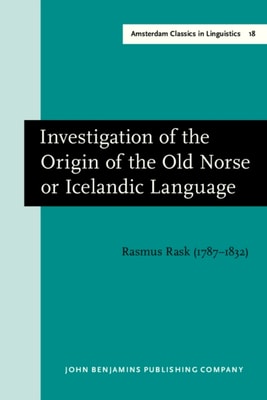
This edition constitutes a reprint of Niels Ege's English translation of Rasmus Rask's prize essay of 1818, which appeared as volume XXVI in the Travaux du Cercle Linguistique de Copenhague in 1993.
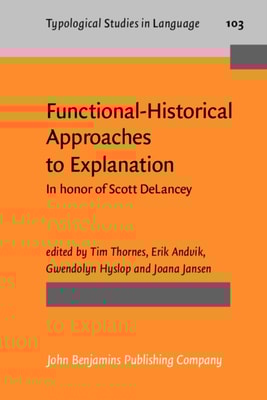
Contributions from both well-known practitioners and new voices in the areas of language typology, historical linguistics, and function-based approaches to language description define this volume, as does its foci in two major geographical areas - southeast Asia and northwestern North America.
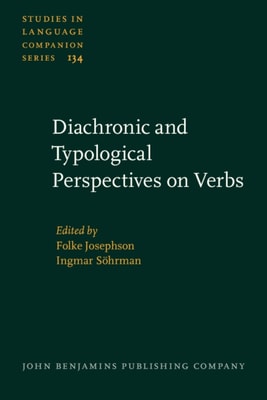
This volume applies a diachronic perspective to the verb and mainly deals with typological change affecting tense, aspect, mood and modality in a variety of Indo-European languages (Latin, Romance, Celtic, Germanic, Slavic, Indo-Iranian, Hittite, and Semitic) and the non-Indo-European Turkic, Amerindian and some Australian languages.
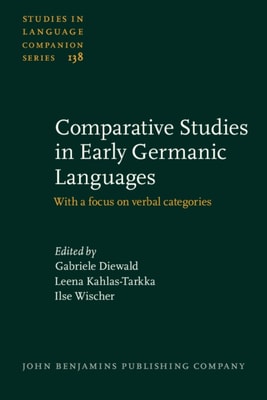
This volume offers a coherent and detailed picture of the diachronic development of verbal categories of Old English, Old High German, and other Germanic languages.
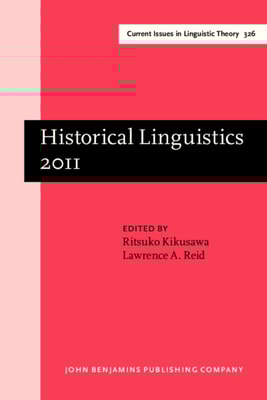
This volume of selected papers from the 20th International Conference on Historical Linguistics (Osaka, Japan, July 2011) presents a set of stimulating and ground-breaking studies on a wide range of languages and language families.
Uncovering the meaning of individual words or entire texts is a complex process that needs to take into consideration the multiple interactions of linguistic organization including orthography, morphology, syntax and, ultimately, pragmatics.
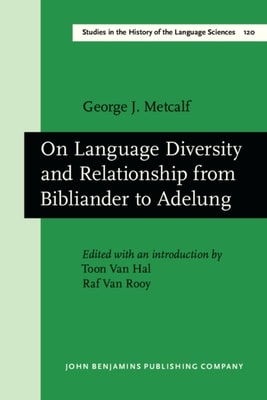
What is the range of diversity in linguistic types, what are the geographical distributions for the attested types, and what explanations, based on shared history or universals, can account for these distributions?
This book offers a study of long-term, intensive language contact between more than a dozen Mayan languages spoken in the lowlands of Guatemala, Southern Mexico and Belize.
The contributions of this volume offer new perspectives on the relation between syntax and information structure in the history of Germanic and Romance languages, focusing on English, German, Norwegian, French, Spanish and Portuguese, and both from a synchronic and a diachronic perspective.
The English language is changing every day and it is us - the individual speakers and writers - that drive those changes in small ways by choosing to use certain strings of words over others.
The papers in this volume aim at facilitating exchange between three fields of inquiry that are of great importance in historical linguistics: language change, (socio)linguistic research on variation, and contact linguistics.
Greenberg's (1954) concept of a 'Khoisan' language family, while heartily embraced by non-specialists, has been harshly criticized by linguists working on these languages.
This monograph offers the first in-depth lexical and semantic analysis of motion verbs in their development from Latin to nine Romance languages - Spanish, French, Italian, Portuguese, Romanian, Catalan, Occitan, Sardinian, and Raeto-Romance - demonstrating that the patterns of innovation and continuity attested in the data can be accounted for in cognitive linguistic terms.
Since the 1980s theories and studies of grammaticalization have provided a major source of inspiration for the description and explanation of language change, giving rise to many publications and conferences.
The articles in this volume examine a number of critical issues in grammaticalization studies, including the relationship between grammaticalization and pragmaticalization, subjectification and intersubjectification, and grammaticalization and language contact.
This volume discusses topics of historical syntax from different theoretical perspectives, ranging from Indo-European studies to generative grammar, functionalism, and typology.
The volume presents an innovative approach to studies in Late Modern English by giving attention to variation and change in varieties of English on both sides of the Atlantic.
This lucid and theory-neutral introduction to the study of pidgins, creoles and mixed languages covers both theoretical and empirical issues pertinent to the field of contact linguistics.
Language Variation - European Perspectives V is based on papers presented at the Seventh International Conference on Language Variation in Europe (ICLaVE 7), which was held in Trondheim, Norway from 26 to 28 June 2013.
Construction Grammar as a framework offers a new perspective on traditional historical questions in diachronic linguistics and language change: how do new constructions arise, how should competition in diachronic variation be accounted for, how do constructions fall into disuse, and how do constructions change in general, formally and/or semantically, and with what implications for the language system as a whole?
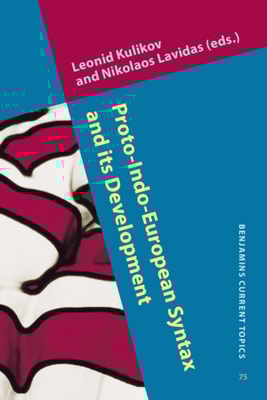
Although for some scholars the very possibility of syntactic reconstruction remains dubious, numerous studies have appeared reconstructing a variety of basic elements of Proto-Indo-European syntax based on evidence available particularly from ancient and/or archaic Indo-European languages.