The present volume collects contributions addressing different aspects of the measurement of linguistic differences, a topic which probably is as old as language itself but at the same time has acquired renewed interest over the last decade or so, reflecting a rapid development of data-intensive computing in all fields of research, including linguistics.
Syntactic dependencies are often non-local: They can involve two positions in a syntactic structure whose correspondence cannot be captured by invoking concepts like minimal clause or predicate/argument structure.
The volume investigates the different alignment patterns in Indo-Aryan and shows that the variation of alignment patterns in Indo-Aryan goes beyond the opposition between accusativity and ergativity.
This present book studies from a dialectological perspective various African Arabic varieties, such as Maghreb Arabic, Bongor Arabic, Juba Arabic and Logori Arabic.
This book deals with syntax in three dimensions: in part I with the history of grammatical theory, in part II with synchronic aspects of Present-Day English, and in part III with diachronic aspects of English.
The volume is a collection of thirteen papers given at the "e;Third Syntax of the World's Languages"e; conference, complemented with four additional papers as well as an introduction by the editors.
The Mouton World Atlas of Variation in English (WAVE) presents grammatical variation in spontaneous spoken English, mapping 235 features in 48 varieties of English (traditional dialects, high-contact mother tongue Englishes, and indiginized second-language Englishes) and 26 English-based Pidgins and Creoles in eight Anglophone world regions (Africa, Asia, Australia, British Isles, the Caribbean, North America, the Pacific, and the South Atlantic).
The intention of the present volume is to unite the research of a range of scholars who have been working on features of non-standard, vernacular English which show an areal distribution, i.
Functionalism, as characterized by Allen, (2007:254) "e;holds that linguistic structures can only be understood and explained with reference to the semantic and communicative functions of language, whose primary function is to be a vehicle for social interaction among human beings.
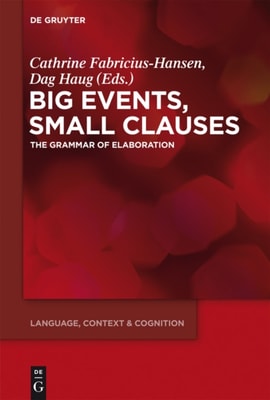
This book investigates specific syntactic means of event elaborationacross seven Indo-European languages (English, German, Norwegian,French, Russian, Latin and Ancient Greek): bare and comitative smallclauses ("e;absolutes"e;), participle constructions and related clause-like butnon-finite adjuncts that increase descriptive granularity with respect toconstitutive parts of the matrix event (elaboration in the narrowestsense), or describe eventualities that are co-located and connectedwith but not part of the matrix event.
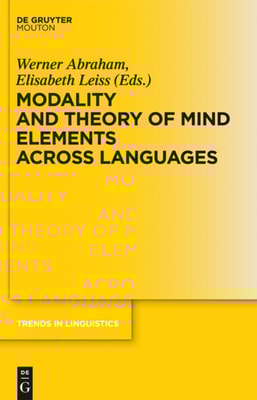
The book presents new issues and areas of work in modality and evidentiality in English(es), and in relation to other European languages (French, Galician, Lithuanian, Spanish).
Modality is the way a speaker modifies her declaratives and other speech acts to optimally assess the common ground of knowledge and belief of the addressee with the aim to optimally achieve understanding and an assessment of relevant information exchange.
This book, which emerges in the context of the European research network LINEE (Languages in a Network of European Excellence), is concerned with European multilingualism both as a political concept and as a social reality.