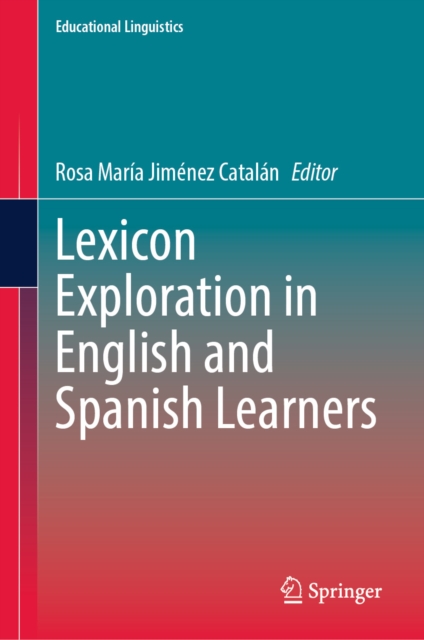
This book delves into psycholinguistic and cognitive aspects of lexical activation, availability, and production in English or Spanish as additional languages in classroom settings.
The volume examines lexical and idiomatic phenomena in various Indo-European languages, covering a wide range of linguistic and interdisciplinary studies while addressing both single-language issues and contrastive perspectives.
This book is the first of its kind in providing a lexicon of kinship terms prevalent in the Western dialects of Iran, with a parallel glossary in English.
This book is the first of its kind in providing a lexicon of kinship terms prevalent in the Western dialects of Iran, with a parallel glossary in English.
This book provides an examination of the academic language found in Content and Language Integrated Learning (CLIL) primary-school written input, with a focus on the lexical demands of CLIL textbooks.
This book provides an examination of the academic language found in Content and Language Integrated Learning (CLIL) primary-school written input, with a focus on the lexical demands of CLIL textbooks.
This book examines legal language as a language for special purposes, evaluating the functions and characteristics of legal language and the terminology of law.
This book examines legal language as a language for special purposes, evaluating the functions and characteristics of legal language and the terminology of law.
The main purpose of the publication is to present a linguo-cultural picture of traditional values (such as the value of life, freedom, dignity, family, religion, community, truth, good, beauty, and God) reflected in Anglo-American and Polish paremiological units.
The main purpose of the publication is to present a linguo-cultural picture of traditional values (such as the value of life, freedom, dignity, family, religion, community, truth, good, beauty, and God) reflected in Anglo-American and Polish paremiological units.
El libro Ortografía de las desinencias verbales de la lengua castellana de Horacio Barrios Hernández contiene una innovación pedagógica que mediante un enfoque estructuralista pretende explicar y divulgar la lengua de Cervantes de un modo sencillo y formal.