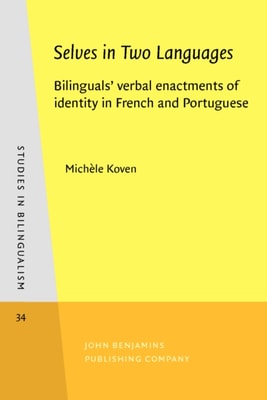
This volume presents both an analysis of how identities are built, represented and negotiated in narrative, as well as a theoretical reflection on the links between narrative discourse and identity construction.
A number of previous approaches to linguistic borrowing and contact phenomena in general have concluded that there are no formal boundaries whatsoever to the kinds of material that can pass from one language into another.
This volume gives an up-to-date account of various situations of language contact and multilingualism in Europe especially from a historical point of view.
This monograph addresses three basic questions regarding the development of word-internal prosodic structure: How much of the phonological structure of early words is regulated by the same constituents and principles that govern the organization of prosodic structure of mature grammar?
Recently, many SLA researchers have adopted a postmodernist approach which challenges the assumption that SLA research is a rationalist, scientific endeavour.
The book focuses on the question of how and to what extent cognitive semantic approaches can contribute to the new field of the cognitive science of science.
Wolfgang Wildgen presents three perspectives on the evolution of language as a key element in the evolution of mankind in terms of the development of human symbol use.
Cognitive Exploration of Language and Linguistics is designed as a comprehensive introductory text for first and second-year university students of language and linguistics.
Spanish/English codeswitching in published work represents a claim to the right to participate in the marketplace on a bilingual and not just monolingual basis.
The eleven chapters of Vocabulary in a Second Language are written by the world's leading researchers in the field of vocabulary studies in second language acquisition.
This volume brings together work by scholars with backgrounds in linguistics, psycholinguistics, developmental psychology, education, and language pathology.
The book defines the concept of Semantic-Communicative Structure [= Sem-CommS]-a formal object that is imposed on the starting Semantic Structure [= SemS] of a sentence (under text synthesis) in order to turn the selected meaning into a linguistic message.
The chapters in this volume provide the first comprehensive overview of trends in research on early phonological, lexical, syntactic and pragmatic development in children acquiring two (or more) languages simultaneously.
Givon's new book re-casts pragmatics, and most conspicuously the pragmatics of sociality and communication, in neuro-cognitive, bio-adaptive, evolutionary terms.
Politeness and Face in Caribbean Creoles is the first collection to focus on socio-pragmatic issues in the Caribbean context, including the socio-cultural rules and principles underlying strategic language use.
This book revisits the theoretical and psycholinguistic controversies centred around the intriguing nature of idioms and proposes a more systematic cognitive-linguistic model of their grammatical status and use.
Modeling of linguistic knowledge generally involves the compartmentalization of grammar into phonological, morphological, lexical, syntactic, semantic, and pragmatic components.
The main focus of generative language development research in recent decades has been the logical problem of language acquisition - how learners go beyond the input to acquire complex linguistic knowledge.
This volume presents a collection of new articles by sixteen specialists in the field of pidgin and creole studies, assembled in honor of the world-renowned creolist, Albert Valdman.
The selected contributions of this volume focus on various issues related to second language pedagogy and second language acquisition in the Japanese context.
Along with its companion volume, this book offers a fascinating glimpse into the current avenues of research into colour, a phenomenon which daily affects all our lives in often surprising ways.
This stimulating collection of articles from leading international researchers provides a state-of-the-art overview of core issues in second language speech perception and production.
Although it has long been recognized that second language pronunciation is strongly influenced by the native language, second language phonology has only become a recognized area of study during the last thirty years.
Despite a growing interest for space in language, most research has focused on spatial markers specifying the static or dynamic relationships among entities (verbs, prepositions, postpositions, case markings.
In this collection of carefully selected papers connectivity is looked at from the vantage points of language contact, language change, language acquisition, multilingual communication and related domains based on various European and Non-European languages.
This book explores the contributions that cognitive linguistics and psychology, including neuropsychology, have made to the understanding of the way that second languages are processed and learnt.
As one of the first books in child second language acquisition (SLA), this book focuses on the core area of tense-aspect morphology, reporting on three L1-Italian children learning L2 English vs.
How do infants and young children coordinate information in real time to arrive at sentence meaning from the words and structure of the sentence and from the nonlinguistic context?
This volume is a collection of 13 chapters, each devoted to a particular issue that is crucial to our understanding of the way learners acquire, learn, and use an L2 sound system.