This book provides an analysis of whether the International Criminal Court can be regarded as an International Criminal World Court, capable of exercising its jurisdiction upon every individual despite the fact that not every State is a Party to the Rome Statute.
This book reports on advanced concepts in fuzzy graph theory, showing a set of tools that can be successfully applied to understanding and modeling illegal human trafficking.
Globalization has increased the number of individuals in criminal proceedings who are unable to understand the language of the courtroom, and as a result the number of court interpreters has also increased.
This study analyzes the methods used by international criminal tribunals when determining customary international criminal law and to consider the compatibility of these approaches with the nullum crimen sine lege principle.
This book examines two types of transnational money laundering: the use of offshores and wire transfers to "e;invest"e; in real estate; and agribusiness, a nebulous activity that is difficult to regulate.
One of the most important aspects for a successful police operation is the ability for the police to obtain timely, reliable and actionable intelligence related to the investigation or incident at hand.
This book analyses how the complementarity regime of the ICC's Rome Statute can be implemented in member states, specifically focusing on African states and Nigeria.
This book analyses the rights of crime victims within a human rights paradigm, and describes the inconsistencies resulting from attempts to introduce the procedural rights of victims within a criminal justice system that views crime as a matter between the state and the offender, and not as one involving the victim.
This book considers the effectiveness and fairness of using international cooperation to obtain confession evidence or evidence of a suspect or accused person's silence across borders.
This book discusses the relation between morality and politics, and morality and law, a field that has been studied for more than two thousand years The law is a part of human culture, and this touches upon a dynamic reality that is connected to the relation between nature and freedom, nature and culture.
This work compiles experiences and lessons learned in meeting the unique needs of women and children regarding crime prevention and criminal justice, in particular the treatment and social reintegration of offenders and serves as a cross-disciplinary work for academic and policy-making analyses and follow-up in developing and developed countries.
This book offers a brand new point of view on immigration detention, pursuing a multidisciplinary approach and presenting new reflections by internationally respected experts from academic and institutional backgrounds.
The book is a comprehensive narration of the use of expertise in international criminal trials offering reflection on standards concerning the quality and presentation of expert evidence.
This book challenges the assumptions of modern criminal law that insanity is a natural, legally and medically defined phenomenon (covering a range of medical disorders).
This book examines how the functioning of the International Criminal Court has become a forum of convergence between the common law and civil law criminal justice systems.
This book is about the International Criminal Court (ICC), a new and highly distinctive criminal justice institution with the ability to prosecute the highest-level government officials, including heads of state, even in countries that have not accepted its jurisdiction.
The Unmaking of Crime documents the pathways of offenders reforming their journey and desisting from crime, and assesses the opportunities and limitations of the criminal justice system in aiding this process.
This work compiles experiences and lessons learned in meeting the unique needs of women and children regarding crime prevention and criminal justice, in particular the treatment and social reintegration of offenders, and serves a as a cross-disciplinary work for academic and policy-making analyses and follow-up in developing and developed countries.
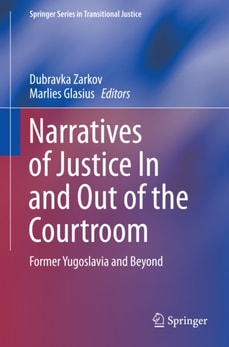
This volume considers the dynamic relations between the contemporary practices of international criminal tribunals and the ways in which competing histories, politics and discourses are re-imagined and re-constructed in the former Yugoslavia and beyond.
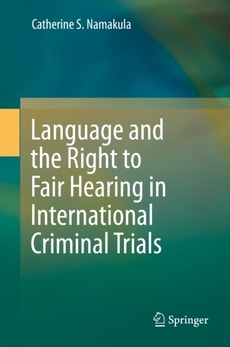
Language and the Right to Fair Hearing in International Criminal Trials explores the influence of the dynamic factor of language on trial fairness in international criminal proceedings.
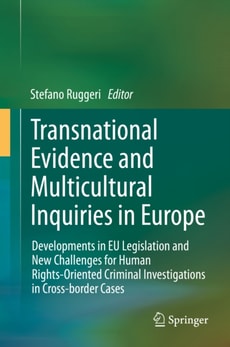
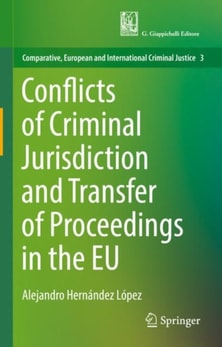
Framework Decision 2009/948/JHA on the prevention and settlement of conflicts of exercise of jurisdiction in criminal proceedings established an ad hoc procedure for settling conflicts of criminal jurisdiction based on the mutual exchange of information and the establishment of direct consultations between the competent authorities with a view to reaching consensus on an effective solution.
This book focuses on the enforcement aspect of tobacco control policy, and argues that the intense regulation of the tobacco market will never be successful as long as it can be circumvented by the availability of illicit tobacco products.