Responding to a need for a deeper and more nuanced understanding of the consequences of climate change, this book brings experts in climate science, engineering, urban planning, and conservation biology into conversation with scholars in law, geography, anthropology and ethics.
This volume examines the role and function of religious-based organizations in strengthening associational life in a representative sample of West European countries: newly democratized and long-established democracies, societies with and without a dominant religious tradition, and welfare states with different levels and types of state-provided social services.
This brief reference surveys the national policy of three representative African countries on the legal guardianship of children who are without parents or families.
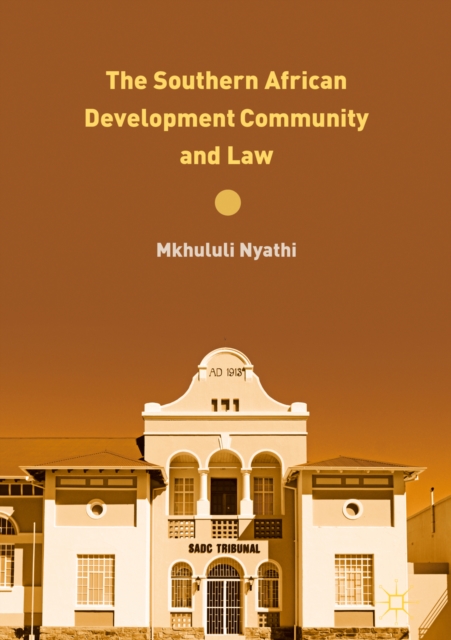
This book analyses whether the design of the institutions of Southern African Development Community (SADC) reflects the community's treaty objectives and principles of democracy and the rule of law.
This book reports on advanced concepts in fuzzy graph theory, showing a set of tools that can be successfully applied to understanding and modeling illegal human trafficking.
Globalization has increased the number of individuals in criminal proceedings who are unable to understand the language of the courtroom, and as a result the number of court interpreters has also increased.
This book offers an edited volume for all readers who wish to gain an in-depth grasp of the economic analysis of recent developments in energy law and policy in Europe and the United States.
This book provides an insight into commercial relations between large economies and Small States, the benefits of regional integration, the role of Small States as financial centres as well as B2B and State to State dispute resolution involving Small States.
The book considers some of the solutions proposed by Muslim activists and thinkers in their attempts to renew (tajdid) their ways of life and thought in accord with the demands of the age in which they lived.
The book reflects on the issues concerning, on the one hand, the difficulty in feeding an ever- increasing world population and, on the other hand, the need to build new productive systems able to protect the planet from overexploitation.
The focus of this publication is the uniqueness of the Baltic Sea from a legal perspective, and the regulatory voids that result from the multiple layers of regulation this area is subjected to: up to six layers of regulation (general international law, regional conventions, EU law, national laws, local and municipal rules plus a whole range of non-binding norms and other 'soft law' arrangements) act in parallel.
This book raises awareness of environmentally friendly and resource-sparing management of winter sports areas, in order to increase the number of certified ski areas.
As the epicenter of Christianity has shifted towards Africa in recent decades, Pentecostalism has emerged as a particularly vibrant presence on the continent.
This book focuses on the World Bank's sanctions system, which is an innovative instrument of global governance implemented by the leading multilateral development bank in order to impose penalties on legal entities and individuals that are involved in Bank-financed projects.
This book provides a broad set of information and data on the rise of private actors in the space sector, organized into different topics covering the various trends that have shaped the space sector during the last decade.
This book describes the global legal framework for safeguarding the "e;Intangible Cultural Heritage"e; - as defined by the UNESCO Convention in 2003 - and analyses its use in selected countries in the Americas, Asia, Africa and Europe.
This edited volume provides a fresh analysis for researcher and practitioners regarding United Nations Security Council resolution 1540, the status of its implementation, and its future by providing an original evaluation of progress in implementation and challenges faced during the resolution's first decade.
Designed and modeled after a six-week introductory food law course taught at Northeastern University, Food Law and Regulation for Non-Lawyers offers a succinct overview of key topics and core concepts for food scientists, quality managers, and others who need to understand the regulation of food in the U.
This book takes up one of the key theoretical challenges in the English School's conceptual framework, namely the nature of the institutions of international society.
This Brief examines the role of United States private military contractors (PMCs) in human trafficking and forced labor in case studies of Iraq and Bosnia-Herzegovina.
On the occasion of the 50th anniversary of the Outer Space Treaty this book gives a first insight into where the next generation considers room for further improvement of the Outer Space Treaty in order to cope with upcoming aspects such as providing solutions for the emerging commercial, economic, environmental and social questions.
This book offers new insights and original empirical research on private military and security companies (PMSCs), including China's negotiation approach to governance, an account of Nigeria's first engagement with regulatory cooperation under the threat of Boko Haram, and a study of PMSCs in Ebola-hit Western Africa.
The book offers a comprehensive perspective on the highly topical issue of protecting and promoting labour standards in international economic law and the globalized economy.