This book investigates the impact of EU law and policy on the Member States' higher education institution (HEI) sectors with a particular emphasis on the exposure of research in universities to EU competition law.
This book examines the employment arrangements of professional athletes in the Premier League football competition, the National Basketball Association competition and rugby union played at an international level.
This book addresses the most important judicial aspects in relation to the FIFA Dispute Resolution Chamber (DRC), as well as the different categories of disputes, inter alia, the termination of player contracts, the amount of compensation, sporting sanctions, training compensation and the solidarity mechanism.
This book is a systematic comparative study of WTO and EU law relevant for universal service provision, and a timely contribution to the ongoing scholarly and policy debates about the concept and scope of universal service.
This second Volume in the book Series on Nuclear Non-Proliferation in International Law discusses the legal interpretation and implementation of verification and compliance with the Treaty of the Non-Proliferation of Nuclear Weapons, 1968; the Comprehensive Nuclear Test-Ban Treaty, 1996; and the Treaty establishing the European Atomic Energy Community (EURATOM), 1957.
The present collection of essays offers the reader a broad range of original perspectives on democracy and the rule of law in the European Union, approaching the existing policy area from new points of view.
This book brings into focus the legal status of armed forced on foreign territory within, inter alia, the context of multi-national exercises and a variety of so-called crisis management operations.
The doctrine of universal jurisdiction has evolved throughout modern times in the context of global criminal justice as a paramount agent of combating impunity emanating from international criminality.
This book seeks to bridge the gap between academic, political and military thinking concerning the success and failure of peacekeeping operations and their termination.
Since the Second World War, States have increasingly relied upon economic sanctions programs, in lieu of military action, to exert pressure and generally to fill the awkward gap between verbal denunciation and action.
The Convention on the Prohibition of the Development, Production, Stockpiling and Use of Chemical Weapons and on Their Destruction (CWC), which entered into force on 29 April 1997, bans an entire category of weapons of mass destruction.
Since the historic Nuremberg Trial of 1945 an international customary law principle has developed that commission of a core crime under international law - war crimes, genocide, crimes against humanity and aggression - should not go unpunished.
This volume contains several articles on the topic 'Detention in non-international armed conflict', including the Copenhagen Process, and moreover features contributions on autonomous weapons systems, Apartheid and the second Turkel Report.
In this book the interaction between the rights guaranteed in the European Convention of Human Rights (ECHR) and private international law has been analysed by examining the case law of the European Court of Human Rights (the Court) and selected national courts.
The volume discusses the legal interpretation and implementation of the three pillars of the Treaty of the Non-Proliferation of Nuclear Weapons, 1968, regarding the non-proliferation of nuclear weapons; the right to develop research, production and use of nuclear energy for peaceful purposes; and issues relating to nuclear disarmament.
Topics as diverse as the evolving spectrum of conflict, innovations in weaponry, automated and autonomous attack, the depersonalisation of warfare, detention operations, the influence of modern media and the application of human rights law to the conduct of hostilities are examined in this book to see to what extent existing legal norms are challenged.
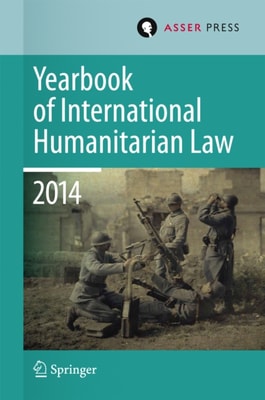
The general theme of this volume of the Yearbook of International Humanitarian Lawis armed groups and the challenges arising from the participation of such groups incontemporary armed conflicts.
This book provides an in-depth examination of the judicial response at the internationalcriminal tribunals (ICTs) to the violation of procedural standards in thepre-trial phase of proceedings.
This book is an attempt to approach the issue of defining international terrorism, proposing that the most workable way to do so is to achieve due balance between the two principal driving forces of international law developments: State sovereignty interests and cosmopolitan ideals.
This book moves from the circumstance whereby currently the obligation to provide fair and equitable treatment (FET) to foreign investments is included in the majority of international investment agreements and has proved to be the most invoked standard in investor-State arbitration.
Written by a team of international lawyers from Europe, Asia, Africa, and the Caribbean,this book analyses some of the most significant aspects of the ongoing armed conflictbetween the Russian Federation and Ukraine.
This book examines the position of 'contextual elements' as a constitutive element of the legal definition of the crime of genocide, and determines the extent to which an individual genocidaire is required to act within a particular genocidal context.
The book presents timely and needed contributions on privacy and data protection seals as seen from general, legal, policy, economic, technological, and societal perspectives.
This book examines the criminalisation of denials of genocide and of other mass atrocities in Europe and discusses the implications of protecting institutional historical memory through criminal law.
The Yearbook of International Sports Arbitration is the first academic publication aiming to offer comprehensive coverage, on a yearly basis, of the most recent and salient developments regarding international sports arbitration, through a combination of general articles and case notes.
Combining both legal and empirical research, this book explores the statutory aspects and practice of Gacaca Courts (inkiko gacaca), the centrepiece of Rwanda's post-genocide transitional justice system, assessing their contribution to truth, justice and reconciliation.
This book provides a comprehensive study of border control: from data analysis andinformation warfare, frameworks for command and control, and game-theoretic riskmanagement, up to the (optimal) deployment of law enforcement missions.