This book explores the evolution of international punishment from a natural law-based ground for the use of force and conquest to a series of jurisdictional and disciplinary practices in international law not previously seen as being conceptually related.
This book offers guidelines for the upcoming discussions on reform, representing an attempt to work out conceptions for a better international competition order on the basis of the scientific approach 'law and economics'.
Charles Covell considers the poltical thought of Thomas Hobbes in relation to the tradition of international law, and with the intention to challenge the reading of Hobbes as the exponent of the realist standpoint in international thought and practice.
This book presents a comprehensive exploration of historical perspectives on justice, equity, and equality, which have been, and still are, considered as the core values of any balanced political system.
The book analyses state of play regarding regional level of government in the countries of South East Europe, particularly countries succeeding former Yugoslavia (Slovenia, Croatia, Bosnia and Herzegovina, Serbia, Montenegro, Kosovo, and North Macedonia) using the research methods from the fields of Law, Public Administration and Political Science.
Over the past two decades Global Legal Pluralism has become one of the leading analytical frameworks for understanding and conceptualizing law in the 21st century.
Economic Morality and Jewish Law compares the way in which welfare economics and Jewish law determine the propriety of an economic action, whether by a private citizen or the government.
In Problem Solving, Decision Making, and Professional Judgment, Paul Brest and Linda Hamilton Krieger have written a systematic guide to creative problem solving that prepares students to exercise effective judgment and decision making skills in the complex social environments in which they will work.
When an economic collapse, natural disaster, epidemic outbreak, terrorist attack, or internal crisis puts a country in dire need, governments must rise to the occasion to protect their citizens, sometimes employing the full scope of their powers.
Economic Morality and Jewish Law compares the way in which welfare economics and Jewish law determine the propriety of an economic action, whether by a private citizen or the government.
Kahneman and Tversky's Prospect Theory posits that people do not perceive outcomes as final states of wealth or welfare, but rather as gains or losses in relation to some reference point.
Legislation and case law following the relatively recent corporate scandals have increased scrutiny on the ethics and integrity of individuals, and the culture they create, at the highest levels within the corporate structure.
The American prosecutor plays a powerful role in the judicial system, wielding the authority to accept or decline a case, choose which crimes to allege, and decide the number of counts to charge.
Today, a California resident can incorporate her shipping business in Delaware, register her ships in Panama, hire her employees from Hong Kong, place her earnings in an asset-protection trust formed in the Cayman Islands, and enter into a same-sex marriage in Massachusetts or Canada--all the while enjoying the California sunshine and potentially avoiding many facets of the state's laws.
This book transcends current debate on government regulation by lucidly outlining how regulations can be a fruitful combination of persuasion and sanctions.
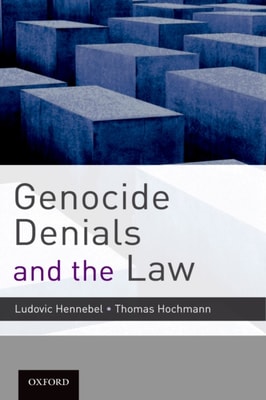
In Genocide Denials and the Law, Ludovic Hennebel and Thomas Hochmann offer a thorough study of the relationship between law and genocide denial from the perspectives of specialists from six countries.
Legislation and case law following the relatively recent corporate scandals have increased scrutiny on the ethics and integrity of individuals, and the culture they create, at the highest levels within the corporate structure.
Focusing contemporary democratic theory on the neglected topic of punishment, Punishment, Participatory Democracy, and the Jury argues for increased civic engagement in criminal justice as an antidote to the American penal state.
International Transactions in Goods: Global Sales in Comparative Context explains the complex transactional structures common in international sales, from both an international and a domestic legal perspective.
The Grammar of Criminal Law is a 3-volume work that addresses the field of international and comparative criminal law, with its primary focus on the issues of international concern, ranging from genocide, to domestic efforts to combat terrorism, to torture, and to other international crimes.
Today, a California resident can incorporate her shipping business in Delaware, register her ships in Panama, hire her employees from Hong Kong, place her earnings in an asset-protection trust formed in the Cayman Islands, and enter into a same-sex marriage in Massachusetts or Canada--all the while enjoying the California sunshine and potentially avoiding many facets of the state's laws.