A Distinct Judicial Power: The Origins of an Independent Judiciary, 1606-1787, by Scott Douglas Gerber, provides the first comprehensive critical analysis of the origins of judicial independence in the United States.
Winner of Honorable Mention in the Jordan Schnitzer Book Awards of the Association for Jewish StudiesMoshe Simon-Shoshan offers a groundbreaking study of Jewish law (halakhah) and rabbinic story-telling.
Supreme Court Justice Antonin Scalia once remarked that the theory of an evolving, "e;living"e; Constitution effectively "e;rendered the Constitution useless.
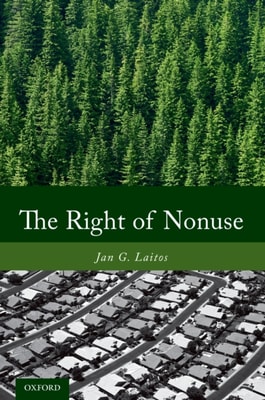
The Right of Nonuse provides a fresh and remarkably different perspective on the real causes of the ills plaguing the world's resources and environment.
Among the most prominent and significant political and legal developments since the end of the Cold War is the proliferation of mechanisms for addressing the complex challenges of transition from authoritarian rule to human rights-based democratic constitutionalism, particularly with regards to the demands for accountability in relation to conflicts and abuses of the past.
Corrective and Distributive Justice: From Aristotle to Modern Times retraces the intricate history of the distinction between corrective and distributive justice.
Ronald Dworkin famously argued that fidelity in interpreting the Constitution as written calls for a fusion of constitutional law and moral philosophy.
Despite widespread admiration for the First Amendment's protection of speech, this iconic feature of American legal thought has never been adequately theorized.
Ronald Dworkin famously argued that fidelity in interpreting the Constitution as written calls for a fusion of constitutional law and moral philosophy.
In the United States today criminal justice can vary from state to state, as various states alter the Modern Penal Code to suit their own local preferences and concerns.
John Rawls (1921-2002) was one of the 20th century's most important philosophers and continues to be among the most widely discussed of contemporary thinkers.
In this brilliantly innovative work, Jennifer Nedelsky claims that we must rethink our notion of autonomy, rejecting the usual vocabulary of control, boundaries, and individual rights.
This book discusses the particular conditions necessary for the state to legally interfere with our freedom of choice, whether it be to either satisfy our individual pursuit of happiness (paternalism) or to prevent us from making immoral choices (perfectionism).
This volume collects thirteen of David Schmidtz's essays on the question of what it takes to live a good life, given that we live in a social and natural world.
While most authors frame problems at the intersection of law and science in terms of how rapidly scientific information changes and how frequently the legal system distorts science, this book argues that problems at the intersection of law and science flow not from the changing nature of science, but from the changing nature of law.
During the past decade, rapid developments in information and communications technology have transformed key social, commercial and political realities.
Supreme Court Justice Antonin Scalia once remarked that the theory of an evolving, "e;living"e; Constitution effectively "e;rendered the Constitution useless.
In the myriad choices of interpretation judges face when confronted with rules and cases, legal realists are concerned with how these doctrinal materials carry over into judicial outcomes.
Judicial decision-making may ideally be impartial, but in reality it is influenced by many different factors, including institutional context, ideological commitment, fellow justices on a panel, and personal preference.
People convicted of crimes are subject to a criminal sentence, but they also face a host of other restrictive legal measures: Some are denied access to jobs, housing, welfare, the vote, or other goods.
Although many modern philosophers of law describe custom as merely a minor source of law, formal law is actually only one source of the legal customs that govern us.
All over the world, the practice of peacebuilding is beset with common dilemmas: peace versus justice, religious versus secular approaches, individual versus structural justice, reconciliation versus retribution, and the harmonization of the sheer number of practices involved in repairing past harms.
In an ideal world, the laws of Congress--known as federal statutes--would always be clearly worded and easily understood by the judges tasked with interpreting them.
In an ideal world, the laws of Congress--known as federal statutes--would always be clearly worded and easily understood by the judges tasked with interpreting them.
Judges, courts, and scholars in the United States agree that the Constitution is the supreme law of the land, but there is much disagreement about its meaning.
In the myriad choices of interpretation judges face when confronted with rules and cases, legal realists are concerned with how these doctrinal materials carry over into judicial outcomes.
Intellectual property law plays a pivotal role in ensuring that luxury goods companies can recoup their investments in the creation and dissemination of their copyrighted works, trademarked logos, and patented designs.
Intellectual property law plays a pivotal role in ensuring that luxury goods companies can recoup their investments in the creation and dissemination of their copyrighted works, trademarked logos, and patented designs.