This monograph examines the legal dimension of European defence integration from the Second World War to the Treaty Establishing a Constitution for Europe.
The aim of this book is to assess recent developments in international law seeking to bring an end to impunity by bringing to justice those accused of war crimes and crimes against humanity.
The reform of the European Constitution continues to dominate news headlines and has provoked a massive debate, unprecedented in the history of EU law.
The imagined community of the nation,which served as the affective basis for the post-French Revolution social contract, as well as its institutional counter-part, the welfare state, are currently under great stress as states lose control over what once was referred to as the national economy In this book a number of authors historians, legal scholars, political theorists consider the fate of national democracy in the age of globalization.
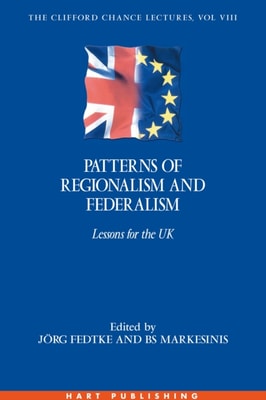
Federalism remains a highly contentious issue in the United Kingdom, but however suspect the 'F' word may be, a substantial amount of devolution has already become part of the local landscape and more may yet follow.
This book explores the extent to which European Community law confers upon individuals the right to gain access to public services in other Member States.
Traditionally,the theory of human rights limited its application to the public domain, namely the relationships between individuals and public authorities.
The Charter of Fundamental Rights of the European Union includes,in addition to the traditional 'civil and political rights', a large number of rights of an economic or social nature.
The English Constitution addresses two burning contemporary and complementary questions; one regarding the so-called English 'question', the changing identities of England and English-ness, and a second regarding the changing shape of the Anglo-British constitution.
Sovereignty in Transition brings together a group of leading scholars from law and cognate disciplines to assess contemporary developments in the framework of ideas and the variety of institutional forms associated with the concept of sovereignty.
This book presents a comparison of the development of legitimate expectations and proportionality in European and English law against the different traditions of administrative law.
Governing by Numbers is a jargon-free account of how delegated legislation - laws that do not pass through the full legislative scrutiny to which Acts of Parliament are subjected - is made.
These studies by a group of eminent academics and judges compare the different approaches of the British, European and American courts to the questions of free speech, which lie at the heart of much debate in constitutional law.
This comparative study explores the lives of some of the women who first initiated challenges to male exclusivity in the legal professions in the late-nineteenth and early-twentieth centuries.
Designed to succeed previous books on the Maastricht and Amsterdam treaties,this new work includes contributions from leading EU lawyers assessing the Nice Treaty and the Post-Nice process, which is rapidly developing in the lead-up to the next Intergovernmental conference.
This book contributes to the debate about the impact of European Community Law on the national constitutional orders and cultures of the respective Member States.
This book's principal aim is to critically address the institutional and substantive legal issues resulting from European enlargement, chiefly those relating to the legal foundations on which the enlarged Union is being built.
The place of utility as a critical theory of human existence has been largely discredited and its potential undermined in the course of modern debates in ethical,political and legal theory.
Over the last two decades the development of the 'third sector' has been underpinned by principles of independence and autonomy,regulation and accountability and patronage through partnership.
This book tackles the important topic of the relationship between three parts of the public law regime in a common law jurisdiction: the common law of judicial review or the unwritten constitution, the written constitution and public international law.
Recent years have witnessed a vibrant debate concerning the constitutional basis of judicial review,which reflects a broader discourse about the role of the courts, and their relationship with the other institutions of government, within the constitutional order.
International law is increasingly referred to and utilised in English courts,in fields as diverse as criminal proceedings, children's rights, tort law, and asylum cases.
The contributions brought together in this book derive from joint seminars, held by scholars between colleagues from the University of Oxford and the University of Paris II.
There has been a considerable focus in the last few years on the meaning of the Human Rights Act 1998 and its real and potential impact on judges and lawyers.
This book examines how the increasing interdependence between trade and foreign policy can be managed within the legal framework of the European Union.
On Liberty is the story of today's threats to our freedoms and a highly personal, impassioned plea in defence of fundamental rights, from Shami Chakrabarti, Britain's leading human rights campaignerOn 11 September 2001, our world changed.
While most scholarship on public administration in Latin America has taken an overtly legal approach, this handbook examines the subject from a political and public management perspective.
While most scholarship on public administration in Latin America has taken an overtly legal approach, this handbook examines the subject from a political and public management perspective.
The fifth volume of the Yearbook of Socio-Economic Constitutions (YSEC Yearbook) offers an in-depth exploration of socio-economic constitutionalism, a field gaining rapidly in importance as global economies shift.
The Law and Economics of Privacy, Personal Data, Artificial Intelligence, and Incomplete Monitoring presents new findings and perspectives from leading international scholars on several emerging areas issues in legal and economic research.
The Law and Economics of Privacy, Personal Data, Artificial Intelligence, and Incomplete Monitoring presents new findings and perspectives from leading international scholars on several emerging areas issues in legal and economic research.
This book challenges the wide use of majority rule in many constitutional courts for declaring statutes unconstitutional and argues that these courts should rather perform constitutional review by using supermajority rules.