The EU's General Data Protection Regulation created the position of corporate Data Protection Officer (DPO), who is empowered to ensure the organization is compliant with all aspects of the new data protection regime.
From predictive policing to self-surveillance to private security, the potential uses to of big data in crime control pose serious legal and ethical challenges relating to privacy, discrimination, and the presumption of innocence.
From predictive policing to self-surveillance to private security, the potential uses to of big data in crime control pose serious legal and ethical challenges relating to privacy, discrimination, and the presumption of innocence.
Based on peer-reviewed articles from the Second International Conference of the South Asian Society of Criminology and Victimology, Interpersonal Criminology investigates the roots of crime and victimization, rather than dissecting criminal behavior after the fact.
This edited book explores the history, development and use of technology in the policing of society, showing that technology plays a key, if not pivotal role in the work of law enforcement.
This book examines how digital communications technologies have transformed modern societies, with profound effects both for everyday life, and for everyday crimes.
This book explores the manifold actual, possible and probable interconnections between gambling and crime in the context of the increased availability of wagering activities across many regions of the world.
This book examines the practices of cybercriminals who steal and sell personal information acquired through various means, including mass data breaches, to engage in cybercrime and fraud.
This book responds to the claim that criminology is becoming socially and politically irrelevant despite its exponential expansion as an academic sub-discipline.
In this book Konstantinos Komaitis identifies a tripartite problem - intellectual, institutional and ethical - inherent in the domain name regulation culture.
In this book Konstantinos Komaitis identifies a tripartite problem - intellectual, institutional and ethical - inherent in the domain name regulation culture.
Just as the previous generation was raised in front of televisions, adolescents at the turn of the 21st century are being raised in an internet-enabled world where blogs, social networking, and instant messaging are competing with face-to-face and telephone communication as the dominant means through which personal interaction takes place.
Just as the previous generation was raised in front of televisions, adolescents at the turn of the 21st century are being raised in an internet-enabled world where blogs, social networking, and instant messaging are competing with face-to-face and telephone communication as the dominant means through which personal interaction takes place.
The Telecommunications Act of 1996 and the Federal Communications Commission's Local Competition Order are just two examples of the continuing monumental and far-reaching changes occurring throughout the telecommunications industry.
The Telecommunications Act of 1996 and the Federal Communications Commission's Local Competition Order are just two examples of the continuing monumental and far-reaching changes occurring throughout the telecommunications industry.
Providing an authoritative perspective on the best current research regarding telecommunication policy, this book is based on the 22nd Annual Telecommunications Policy Research Conference.
Providing an authoritative perspective on the best current research regarding telecommunication policy, this book is based on the 22nd Annual Telecommunications Policy Research Conference.
This timely volume provides a comprehensive examination of how the proposed new European Health Data Space (EHDS) legislation will impact upon health and genetic data, individual privacy and providers of health services.
Email and Internet use is increasingly topical as employers and employees test the boundaries of acceptable use of new communications technology in the workplace.
Email and Internet use is increasingly topical as employers and employees test the boundaries of acceptable use of new communications technology in the workplace.
Electronic Media Law and Regulation is a case-based law text that provides students with direct access to case law as well as the context in which to understand its meaning and impact.
Electronic Media Law and Regulation is a case-based law text that provides students with direct access to case law as well as the context in which to understand its meaning and impact.
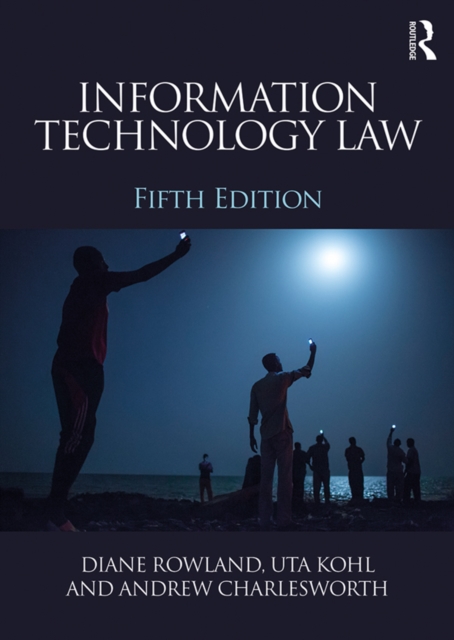
The fifth edition of Information Technology Law continues to be dedicated to a detailed analysis of and commentary on the latest developments within this burgeoning field of law.
The fifth edition of Information Technology Law continues to be dedicated to a detailed analysis of and commentary on the latest developments within this burgeoning field of law.