Although Mexico's Constitution of 1917 mandated the division of large landholdings, provided land for the landless, and guaranteed workers the rights to organize, strike, and bargain collectively, it also guaranteed fundamental liberal rights to property and due process that enabled property owners and employers to resist the implementation of the new social rights by filing suit in federal court.
This timely and accessible volume takes a fresh approach to a question of increasing public concern: whether or not the federal government should regulate media violence.
Government seizure of the nation's strikebound steel mills on 8 April 1952 stands as one of President Harry S Truman's most controversial actions, representing an unprecedented use of presidential power.
Questions of academic freedom--from hate speech to the tenure structure-continue to be of great urgency and perennial debate in American higher education.
Despite its importance to the life of the nation and all its citizens, the Supreme Court remains a mystery to most Americans, its workings widely felt but rarely seen firsthand.
This book offers a close look at the development of legal thought during the era of prohibition and documents the impact of prohibition on law as an intellectual discipline.
Recent high-profile lawsuits involving cigarettes, guns, breast implants, and other products have created new frictions between litigation and regulation.
"e;Addresses fascinating aspects of obtaining justice in Florida: both historical court systems before Florida became a state and alternative courts operating within Florida now.
Challenging traditional accounts of the development of American private law, Peter Karsten offers an important new perspective on the making of the rules of common law and equity in nineteenth-century courts.
Bodies of Truth offers an intimate account of how apartheid victims deal with the long-term effects of violence, focusing on the intertwined themes of embodiment, injury, victimhood, and memory.
This is the first book to focus on the legal question of the incorporation of arbitration clauses, even though this issue constitutes a common problem that arises frequently in practice.
This is the first book to focus on the legal question of the incorporation of arbitration clauses, even though this issue constitutes a common problem that arises frequently in practice.
Addressing the relationship between law and the visual, this book examines the importance of photography in Central, East, and Southeast European show trials.
How to Make Money as a Mediator (and Create Value for Everyone) is an invaluable and inspirational resource filled with practical, proven, and down-to-earth information on how you can develop a satisfying and lucrative career as a mediator, no matter what your area of interest labor and employment mediation, intellectual property, environment, personal injury, family and divorce, contract, securities, or international peacekeeping.
The authors use confidential interviews with Supreme Court justices, analysis of their rulings from 1970 to 2005, and measures that tap their perceived ideological tendencies to provide a critical examination of the ideological roots of judicial decision making, uncovering the complexity of contemporary judicial behaviour.
Baker argues that coordinate interpretation - a model which requires both elected and appointed officials to interpret the Charter - allows for the creation of a more robust democracy, alleviating some of the tension between constitutionalism and democracy while limiting judicial activism.
Baker argues that coordinate interpretation - a model which requires both elected and appointed officials to interpret the Charter - allows for the creation of a more robust democracy, alleviating some of the tension between constitutionalism and democracy while limiting judicial activism.
Images of Justice resonates with voices of the North and comes alive through interviews with many of those involved in the cases - defendants, judges, and prosecutors.
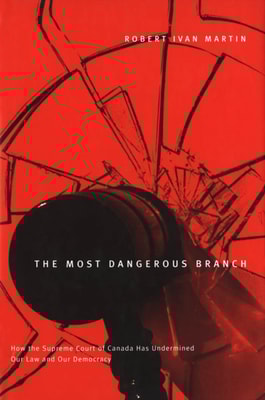
The Most Dangerous Branch shows that the Supreme Court has done exactly this in dealing with abortion, assisted suicide, homosexuality, and Quebec secession through decisions that were guided not by reasoned understanding of the principles of law but by the values of judges - values they, as unelected representatives of the Canadian state, had no right to impose.
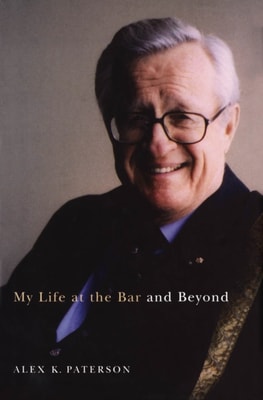
A litigation lawyer for fifty years, Paterson describes some of his earlier cases, including those involving alleged brainwashing experiments at the Allan Memorial Institute funded by the CIA.
Images of Justice resonates with voices of the North and comes alive through interviews with many of those involved in the cases - defendants, judges, and prosecutors.