In recent years, space optical payloads have advanced toward higher spatial, temporal, radiometric, and spectral resolution, while becoming increasingly intelligent.
In recent years, space optical payloads have advanced toward higher spatial, temporal, radiometric, and spectral resolution, while becoming increasingly intelligent.
Il libro descrive le stelle principali (nella quasi totalità le più luminose), quelle realmente visibili anche dall'interno delle grandi città, tali per cui il lettore sia in grado di vedere ciò di cui il libro parla.
Il libro descrive le stelle principali (nella quasi totalità le più luminose), quelle realmente visibili anche dall'interno delle grandi città, tali per cui il lettore sia in grado di vedere ciò di cui il libro parla.
Las estrellas dibujan por la noche formas sobre las que el ser humano ha proyectado imágenes e historias: la Osa Mayor, la Osa Menor, la Lira u Orión son relativamente conocidas y de fácil localización.
Tras el nombre de agujeros negros, que alimenta el imaginario colectivo, se esconden cuerpos celestes conceptualmente muy simples y, al mismo tiempo, muy difíciles de estudiar.
This book presents new editions and investigations of 114 Babylonian planetary tables: cuneiform tablets inscribed with computed dates, positions, and other data for the planets Mercury, Venus, Mars, Jupiter, and Saturn.
It has been recognised for centuries that, statistically, the Earth must be one of many, literally billions, of planets in our Galaxy, but the first planets beyond the solar system were recognised only 30 years ago.
Los pilares de la creación cuenta la historia de uno de los mayores logros científicos en la historia de la civilización, un telescopio que ha costado 10 000 millones de dólares y tiene el objetivo más ambicioso posible: descubrir los secretos del cosmos.
It has been recognised for centuries that, statistically, the Earth must be one of many, literally billions, of planets in our Galaxy, but the first planets beyond the solar system were recognised only 30 years ago.
This proceedings book reviews the state of the art in the exploitation of machine learning techniques for the astrophysics community and gives the reader a complete overview of the field.
This proceedings book reviews the state of the art in the exploitation of machine learning techniques for the astrophysics community and gives the reader a complete overview of the field.
th th Mars, the Red Planet, fourth planet from the Sun, forever linked with 19 and 20 Century fantasy of a bellicose, intelligent Martian civilization.
It has always been ESO's aim to operate the VLT in an interferometric mode (VLTI) which allows the coherent combination of stellar light beams col- lected by the four 8-m telescopes and by several smaller auxiliary telescopes.
This extended volume (in total 700+ pages, 124 b/w illustrations, 338 in colour) starts with an interesting Foreword entitled The Nature of beings and the Reasons of beings by the Rev.
This extended volume (in total 700+ pages, 124 b/w illustrations, 338 in colour) starts with an interesting Foreword entitled The Nature of beings and the Reasons of beings by the Rev.
The Life and Work of James Bradley: The New Foundations of 18th Century Astronomy is the first major work on the life and achievements of James Bradley for 190 years.
The physics of vortices in classical fluids has been a highly important subject for many years, both in fundamental science and in engineering applications.
The 34th Saas-Fee advanced course of the Swiss Society of Astronomy and Astrophysics (SSAA) took place from March 15 to 20, 2004, in Davos, on the subject of The Sun, Solar Analogs and the Climate.
Astronomy and Astrophysics Abstracts aims to present a comprehensive documen- tation of the literature concerning all aspects of astronomy, astrophysics, and their border fields.
Astronomy and Astrophysics Abstracts aims to present a comprehensive documen- tation of the literature concerning all aspects of astronomy, astrophysics, and their border fields.
From June 7-9, 1995, the European Southern Observatory (ESO) and the Max Plank Institut fiir Astrophysik (MPA) jointly held the Workshop on Spiral Galaxies in the Near-IR.
This volume is the result of the dedicated effort undertaken by an international group of scientists and administrators, who have contemplated the challenge of the future of space-based earth science for the next decade.
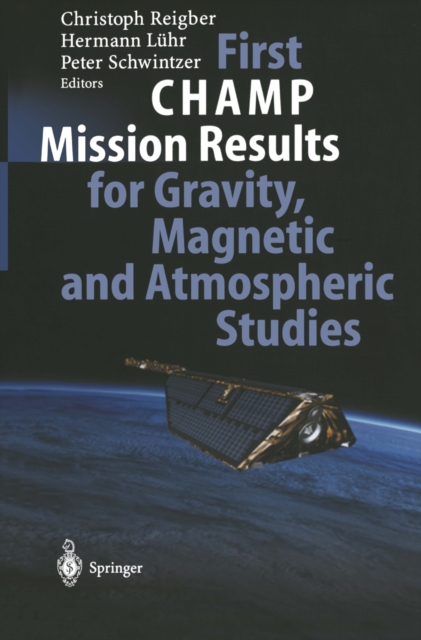
In 1995, the German Space Agency DARA selected the CHAllenging Minisatellite Payload (CHAMP) mission for development under a special support programme for the space industry in the new states of the unified Germany, with the Principal Investigator and his home institution GFZ Potsdam being ultimately responsible for the success of all mission phases.
Since the early use of the occultation measurement principle for sounding pla- tary atmospheres and ionospheres, its exploitation in atmospheric remote sensing has seen tremendous advances.
Three eminent scientists, each well known for the clarity of their writing, present for students and researchers what is known about the internal structure, origin and evolution of White Dwarfs, Neutron Stars and Black Holes, all objects at the final stage of stellar evolution.