The SpringerBriefs on Atmospheric and Space Sciences in two volumes presents a concise and interdisciplinary introduction to the basic theory, observation & modeling of atmospheric and ionospheric coupling processes on Earth.
Based on extensive primary sources, many never previously translated into English, this is the definitive account of the origins of Ceres as it went from being classified as a new planet to reclassification as the first of a previously unknown group of celestial objects.
Dragon V2 is a futuristic vehicle that not only provides a means for NASA to transport its astronauts to the orbiting outpost but also advances SpaceX's core objective of reusability.
The proceedings published in this book document and foster the goals of the 11th International Space Conference on "e;Protection of Materials and Structures from Space Environment"e; ICPMSE-11 to facilitate exchanges between members of the various engineering and science disciplines involved in the development of space materials.
This book considers two key educational tools for future generations of professionals with a space architecture background in the 21st century: (1) introducing the discipline of space architecture into the space system engineering curricula; and (2) developing space architecture as a distinct, complete training curriculum.
Young addresses the impressive expansion across existing and developing commercial space business markets, with multiple private companies competing in the payload launch services sector.
This book is devoted to the problems that occur when attempting to understand and construct a concise representation of the original conditions, composition and dynamics of the evolution of the Earth-Moon system in the form in which it is seen today.
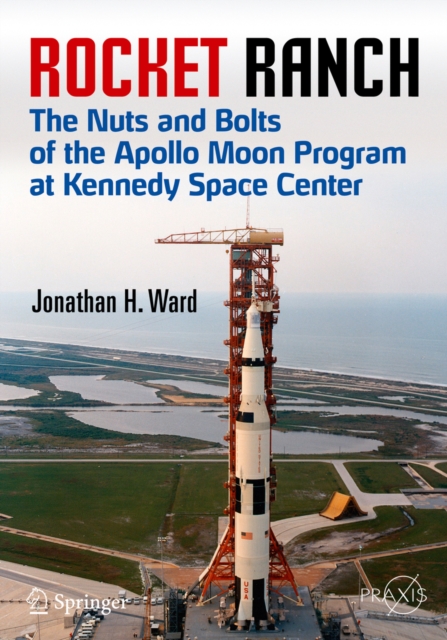
Jonathan Ward takes the reader deep into the facilities at Kennedy Space Center to describe NASA's first computer systems used for spacecraft and rocket checkout and explain how tests and launches proceeded.
Addressing a pressing issue in space policy, Pelton explores the new forms of technology that are being developed to actively remove the defunct space objects from orbit and analyzes their implications in the existing regime of international space law and public international law.
In this book, Giovanni Bignami, the outstanding Italian scientist and astronomer, takes the reader on a journey through the "e;seven spheres"e;, from our own planet to neighboring stars.
In this spellbinding account of an historic but troubled orbital mission, noted space historian Colin Burgess takes us back to an electrifying time in American history, when intrepid pioneers were launched atop notoriously unreliable rockets at the very dawn of human space exploration.
The subject of the book is helium, the element, and its use in myriad applications including MRI machines, particle accelerators, space telescopes, and of course balloons and blimps.
Given the fact that there are perhaps 400 billion stars in our Galaxy alone, and perhaps 400 billion galaxies in the Universe, it stands to reason that somewhere out there, in the 14-billion-year-old cosmos, there is or once was a civilization at least as advanced as our own.
This book provides a general introduction to the rapidly developing astrophysical frontier of stellar tidal disruption, but also details original thesis research on the subject.
This book explains how it came to be that Venus and Earth, while very similar in chemical composition, zonation, size and heliocentric distance from the Sun, are very different in surface environmental conditions.
This textbook covers fundamental and advanced topics in orbital mechanics and astrodynamics to expose the student to the basic dynamics of space flight.
Presents a comprehensive approach to the open questions in solar cosmic ray research and includes consistent and detailed considerations of conceptual, observational, theoretical, experimental and applied aspects of the field.
As our closest stellar companion and composed of two Sun-like stars and a third small dwarf star, Alpha Centauri is an ideal testing ground of astrophysical models and has played a central role in the history and development of modern astronomy-from the first guesses at stellar distances to understanding how our own star, the Sun, might have evolved.
Thirty years ago when Sir Richard Branson called up Boeing and asked if they had a spare 747, few would have predicted the brash entrepreneur would so radically transform the placid business of air travel.
Archaean terrains contain a wealth of structural, stratigraphic, textural, mineralogical, geochemical and isotopic features allowing insights into the nature of the early Earth.
In the 25th Century, the effects of overpopulation and global warming on Earth have led to the formation of human colonies on the Moon, Mars and elsewhere in the Solar System, yet the limited number of viable places forces humanity to look to the stars.
Nominated as an outstanding thesis by the Department of Physics and Astronomy of the University of New Mexico, this thesis seeks to identify the gamma-ray burst (GRB) progenitor.