Our vast Universe is filled with an enormous amount of matter and energy, which are the source of large gravitational potentials affecting all physical phenomena.
This book presents gravity aspects (gravity disturbance, Marussi tensor, two gravity invariants, their certain ratio, the strike angles, and the virtual deformations) which are computed and evaluated for the Moon, using the recent static global gravity field model (GRGM1200A) to degree and order of 600 in spherical harmonic expansion.
This book argues that while the historiography of the development of scientific ideas has for some time acknowledged the important influences of socio-cultural and material contexts, the significant impact of traumatic events, life threatening illnesses and other psychotropic stimuli on the development of scientific thought may not have been fully recognised.
Seen from "e;inside the IAU,"e; this book tells the in-depth story of a major crisis in which China "e;divorced"e; from the International Astronomical Union in 1960 as a protest against the admission of Taiwan.
This 2nd edition lays out an updated version of the general theory of light propagation and imaging through Earth's turbulent atmosphere initially developed in the late '70s and '80s, with additional applications in the areas of laser communications and high-energy laser beam propagation.
This is a hands-on guide for both the budding astronomer in need of a mentor and the seasoned observer who wants to learn how to effectively share their knowledge with newcomers.
Cosmic Origins tells the story of how physicists and astronomers have struggled for more than a century to understand the beginnings of our universe, from its origins in the Big Bang to the modern day.
This book brings together in-depth information on a wide array of bio-engineering topics and their application to enhance human health, performance, comfort, and survival in extreme environments.
This book includes a selection of reviewed and enhanced contributions presented at the SpaceOps 2021, the 16th International Conference on Space Operations, held virtually in May 2021.
The book is based on the author's PhD thesis, which deals with the concept of time in quantum gravity and its relevance for the physics of the early Universe.
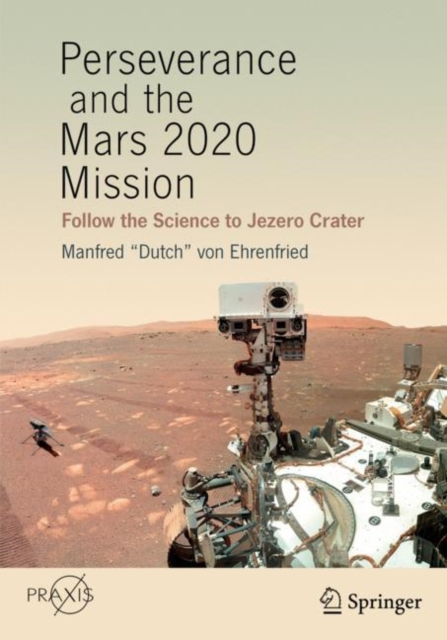
This is the comprehensive story of NASA's pioneering Mars 2020 mission, which at this moment continues to break ground on the surface of the Red Planet.
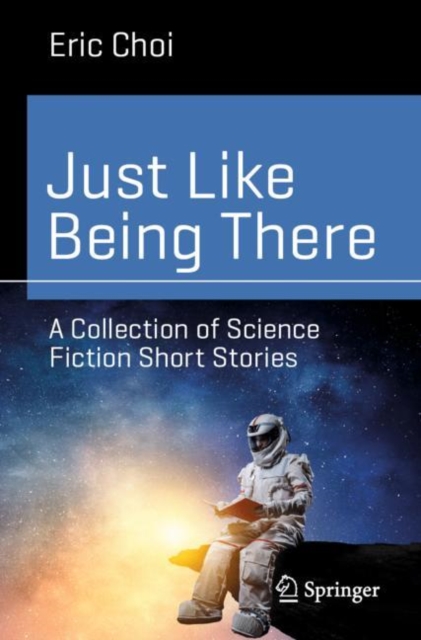
Just Like Being There is the first collection of science fiction stories by award-winning author and aerospace engineer Eric Choi spanning his 25 year writing career.
This book addresses the problems of Geocosmos and provides a snapshot of the current research in a broad area of Earth Sciences carried out in Russia and elsewhere.
This book provides a detailed, state-of-the-art overview of key observational and theoretical aspects of the rapidly developing and highly interdisciplinary field of exoplanet science, as viewed through the lenses of eight world-class experts.
This book includes nine chapters written by internationally recognized experts, covering all aspects of millisecond pulsars in one concise and cohesive volume.
In this book, Boston University Professor of Astronomy Michael Mendillo takes readers deep into the annals of history, showing how visual depictions of the heavens evolved in tandem with science and religion throughout much of Western culture.
This book is a comprehensive advancement about the understanding of the volcanology of Mars in all its aspects, from its primary formation to its evolution in time, from the smaller structures to the bigger structures.
With a focus on modified gravity this book presents a review of the recent developments in the fields of gravity and cosmology, presenting the state of the art, high-lighting the open problems, and outlining the directions of future research.
This book tells the story of how, over the past century, dedicated observers and pioneering scientists achieved our current understanding of the universe.
Starting from Newton's times this follow-up to the author's Springer book "e;Our Place in the Universe - Understanding Fundamental Astronomy from Ancient Discoveries"e; addresses the question of "e;our place in the Universe"e; from astronomical, physical, chemical, biological, philosophical and social perspectives.
Owing to the increased accuracy requirements in fields such as astrometry and geodesy the general theory of relativity must be taken into account for any mission requiring highly accurate orbit information and for practically all observation and measurement techniques.
For centuries, our ancestors carefully observed the movements of the heavens and wove that astronomical knowledge into their city planning, architecture, mythology, paintings, sculpture, and poetry.
This monograph develops an innovative approach that utilizes the Birman-Schwinger principle from quantum mechanics to investigate stability properties of steady state solutions in galactic dynamics.