The two-volume set LNCS 5601 and LNCS 5602 constitutes the refereed proceedings of the Third International Work-Conference on the Interplay between Natural and Artificial Computation, IWINAC 2009, held in Santiago de Compostela, Spain, in June 2009.
This book constitutes the thoroughly refereed post-conference proceedings of the Fifth International Meeting on Computational Intelligence Methods for Bioinformatics and Biostatistics, CIBB 2008, held in Vietri sul Mare, Italy, in October 2008.
I was invited to join the Organizing Committee of the First International Conference on Complex Sciences: Theory and Applications (Complex 2009) as its ninth member.
As future generation information technology (FGIT) becomes specialized and fr- mented, it is easy to lose sight that many topics in FGIT have common threads and, because of this, advances in one discipline may be transmitted to others.
It is with greatpleasure that we present the proceedings of the 5th International Symposium on Visual Computing (ISVC 2009), which was held in Las Vegas, Nevada.
This book constitutes the refereed proceedings of the 7th International Conference On Smart Homes and and Health Telematics, ICOST 2009, held in Tours, France, in July 2009.
It is with greatpleasure that we present the proceedings of the 5th International Symposium on Visual Computing (ISVC 2009), which was held in Las Vegas, Nevada.
The two-volume set LNCS 5601 and LNCS 5602 constitutes the refereed proceedings of the Third International Work-Conference on the Interplay between Natural and Artificial Computation, IWINAC 2009, held in Santiago de Compostela, Spain, in June 2009.
This volume contains the papers selected for presentation at The 2009 Inter- tional Conference on Brain Informatics (BI 2009) held at Beijing University of Technology, China, on October 22-24, 2009.
This book constitutes the refereed proceedings of the 13th Annual International Conference on Research in Computational Molecular Biology, RECOMB 2009, held in Tucson, Arisona, USA in May 2009.
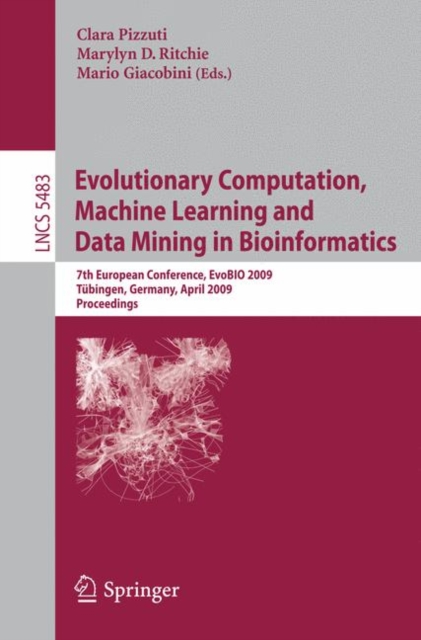
This book constitutes the refereed proceedings of the 7th European Conference on Evolutionary Computation, Machine Learning and Data Mining in Bioinformatics, EvoBIO 2009, held in Tubingen, Germany, in April 2009 colocated with the Evo* 2009 events.
This book constitutes the refereed proceedings of the 5th International Conference on Functional Imaging and Modeling of the Heart, FIMH 2009, held in Nice, France in June 2009.
This book constitutes the refereed proceedings of the 9th European Conference on Evolutionary Computation in Combinatorial Optimization, EvoCOP 2009, held in Tubingen, Germany, in April 2009.
This book constitutes the refereed proceedings of the 5th International Symposium on Bioinformatics Research and Applications, ISBRA 2009, held in Fort Lauderdale, FL, USA, in May 2009.
This book constitutes the refereed proceedings of the 11th European Conference on Genetic Programming, EuroGP 2009, held in Tubingen, Germany, in April 2009 colocated with the Evo* 2009 events.
This book constitutes the refereed proceedings of the 4th International Conference on Computer Vision/Computer Graphics Collaboration Techniques, MIRAGE 2009, held in Rocquencourt, France, in May 2009.
This book constitutes the refereed proceedings of the First International on Bioinformatics and Computational Biology, BICoB 2007, held in New Orleans, LA, USA, in April 2007.
This book constitutes the refereed proceedings of the Third International Workshop on Algorithms and Computation, WALCOM 2009, held in Kolkata, India, in February 2009.
eHealth 2008, the First International Conference on Electronic healthcare for the twenty-first century, was held in City University, London, during September 8-9, 2008.
This book constitutes the refereed proceedings of the International Workshop on Biosurveillance and Biosecurity, BioSecure 2008, held in Raleigh, NC, USA, in December 2008.
This book constitutes the refereed proceedings of the Third International Symposium on Intelligence Computation and Applications, ISICA 2008, held in Wuhan, China, in December 2008.
This book constitutes the refereed proceedings of the 8th International Workshop on Algorithms in Bioinformatics, WABI 2008, held in Karlsruhe, Germany, in September 2008 as part of the ALGO 2008 meeting.
This volume contains a selection of papers presented at the 9th Workshop on Membrane Computing, WMC9, which took place in Edinburgh, UK, during July 28-31,2008.
This book constitutes the refereed proceedings of the 6th RECOMB Comparative Genomics Satellite Workshop, RECOMB-CG 2008, held in Paris, France, in October 2008.
The LNCS journal Transactions on Computational Systems Biology is devoted to inter- and multidisciplinary research in the fields of computer science and life sciences and supports a paradigmatic shift in the techniques from computer and information science to cope with the new challenges arising from the systems oriented point of view of biological phenomena.
This book constitutes the refereed proceedings of the 6th International Conference on Computational Methods in Systems Biology, CMSB 2008, held in Rostock, Germany, in September 2008.
This book constitutes the refereed proceedings of the 8th International Conference on Evolvable Systems, ICES 2008, held in Prague, Czech Republic, in September 2008.
In the post-genomic era, a holistic understanding of biological systems and p- cesses,inalltheircomplexity,is criticalincomprehendingnature'schoreography of life.
This book constitutes the refereed proceedings of the 7th International Conference on Unconventional Computation, UC 2008, held in Vienna, Austria, in August 2008.
This book constitutes the refereed proceedings of the 7th International Conference on Artificial Immune Systems, ICARIS 2008, held in Phuket, Thailand, in August 2008.
This book constitutes the refereed proceedings of the Fourth International Symposium on Bioinformatics Research and Applications, ISBRA 2008, held in Atlanta, GA, USA in May 2008.
This book constitutes the refereed proceedings of the Third International Computer Science Symposium in Russia, CSR 2008, held in Moscow, Russia, June 7-12, 2008.
This book constitutes the refereed proceedings of the 8th International Conference on Cellular Automata for Research and Industry, ACRI 2008, held in Yokohama, Japan, in September 2008.
This volume contains a selection of papers presented at the Eighth Workshop on Membrane Computing, WMC8, which took place in Thessaloniki, Greece, during June 25-28, 2008.
The work group Human-Computer Interaction & Usability Engineering (HCI&UE) of the Austrian Computer Society (OCG) serves as a platform for interdisciplinary exchange, research and development.
The human brain is remarkably complex, permitting sophisticated behavioural rep- toires, such as languages, tool use, self-awareness, symbolic thought, cultural learning and consciousness.