This book gathers, in a single resource, fundamental and applied knowledge about matrix-assisted laser desorption ionisation (MALDI) mass spectrometry imaging.
This book gathers, in a single resource, fundamental and applied knowledge about matrix-assisted laser desorption ionisation (MALDI) mass spectrometry imaging.
Mass Spectrometry: A Foundation Course is a textbook covering the field of mass spectrometry across the chemical, physical, biological, medical and environmental sciences.
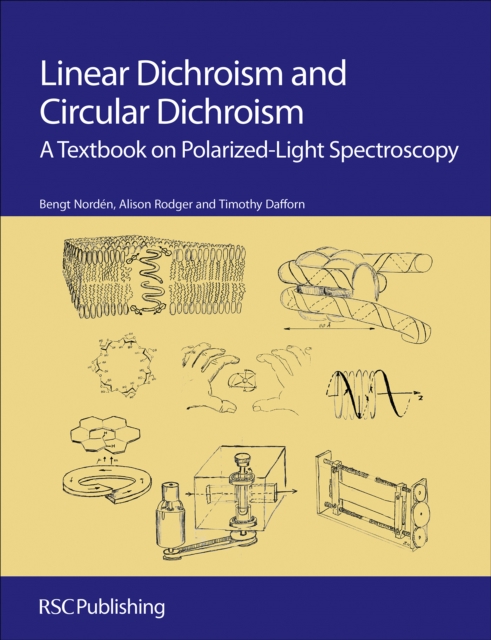
This book provides an introduction to optical anisotropy (linear dichroism, LD) and optical activity (circular dichroism, CD) as techniques for the study of structures and interactions of molecules in solution.
Isotope Dilution Mass Spectrometry (IDMS) has become an essential tool in research laboratories and is increasingly used in routine analysis labs (including environmental, food safety and clinical applications).
Mass spectrometric techniques have developed over recent years to offer ever increasing solutions to solving problems in food processing and packaging.
Ten years after the first volume, this book highlights the important contribution Raman spectroscopy makes as a non-destructive method for characterising the chemical composition of objects with archaeological and historical importance.
Capillary electrophoresis-mass spectrometry (CE-MS) has become a very useful analytical technique for the profiling of highly polar and charged metabolites in biological samples.
Ten years after the first volume, this book highlights the important contribution Raman spectroscopy makes as a non-destructive method for characterising the chemical composition of objects with archaeological and historical importance.
Mass spectrometric techniques have developed over recent years to offer ever increasing solutions to solving problems in food processing and packaging.
Capillary electrophoresis-mass spectrometry (CE-MS) has become a very useful analytical technique for the profiling of highly polar and charged metabolites in biological samples.
The ultra-bright femtosecond X-ray pulses provided by X-ray free electron lasers (XFELs) open up opportunities to study the structure and dynamics of a wide variety of systems beyond what is possible with synchrotron sources.
Providing a definitive reference source on novel methods in NMR acquisition and processing, this book will highlight similarities and differences between emerging approaches and focus on identifying which methods are best suited for different applications.
Developments in optical spectroscopy have taken new directions in recent decades, with the focus shifting from understanding small gas phase molecules towards applications in materials and biological systems.
Analytical Applications of Ionic Liquids reviews the current research in analytic chemistry, covering subjects as diverse as separation science, chromatography, spectroscopy and analytical electrochemistry.
Surface enhanced Raman scattering (SERS) might be one of the most impressive effects to demonstrate the power of plasmonic approaches in spectroscopy and became one of the 'triggers' for the rapidly emerging field of plasmonics.
Providing a definitive reference source on novel methods in NMR acquisition and processing, this book will highlight similarities and differences between emerging approaches and focus on identifying which methods are best suited for different applications.
Ambient ionization has emerged as one of the hottest and fastest growing topics in mass spectrometry enabling sample analysis with minimal sample preparation.
The field of proteomics has developed rapidly over the past decade nurturing the need for a detailed introduction to the various informatics topics that underpin the main liquid chromatography tandem mass spectrometry (LC-MS/MS) protocols used for protein identification and quantitation.
The emerging field of lipidomics has been made possible because of advances in mass spectrometry, and in particular tandem mass spectrometry of lipid ions generated by electrospray ionization.
The first edition of this book was a first book for atomic spectroscopists to present the basic principles of experimental designs, optimization and multivariate regression.
The ultra-bright femtosecond X-ray pulses provided by X-ray free electron lasers (XFELs) open up opportunities to study the structure and dynamics of a wide variety of systems beyond what is possible with synchrotron sources.
With the increasing role of porous solids in conventional and newly emerging technologies, there is an urgent need for a deeper understanding of fluid behaviour confined to pore spaces of these materials especially with regard to their transport properties.
Mid-infrared (MIR) or Fourier Transform Infrared (FTIR) spectroscopy is a vibrational spectroscopy technique that identifies chemicals based on the interaction of molecules with electromagnetic radiation in the mid-infrared region.
The presented work summarizes and systematizes an extensive experimental material of the results of studying polymers using spectroscopy in the low-frequency infrared region.
Man's first experience with the ordered state of matter to which we now apply the generic term "e;crystals"e; came about when he found specimens of some of the natural crystalline mineral substances that are re- latively common in the surface and near-surface areas of the earth's crust.
Each class of spectroscopy has been presented in this book in the form of a sufficient number of solved problems and their answers have been provided in simple and lucid language which will help the students attain deeper understanding of the subject.
Spectroscopic Methods in Mineralogy and Material Science covers significant advances in the technological aspects and applications of spectroscopic and microscopic techniques used in the Earth and Materials Sciences.
This book looks at global atmospheric processes from a physical standpoint using available current and past observational data taken from measurements of relevant atmospheric parameters.
This thesis makes significant advances towards an understanding of superconductivity in the cuprate family of unconventional, high-temperature superconductors.
Applications of NMR Spectroscopy, Volume 2, originally published by Bentham and now distributed by Elsevier, presents the latest developments in the field of NMR spectroscopy, including the analysis of plant polyphenols, the role of NMR spectroscopy in neuroradiology, NMR-based sensors, studies on protein and nucleic acid structure and function, and mathematical formations for NMR spectroscopy in structural biology.
Applications of NMR Spectroscopy, Volume 1, originally published by Bentham and now distributed by Elsevier, presents the latest developments in the field of NMR spectroscopy, including the analysis of edible oils and lipid content in foods, the role of NMR spectroscopy in the human metabolomics and the diagnosis of autism-related disorders, protein-protein interactions, and NMR spectroscopy of chiral molecules.
Simple carbohydrates, complex oligosaccharides and polysaccharides all belong to a class of ubiquitous (macro)molecules that exhibit a wide range of biological functions, and the recent advent of enhanced enzymatic, chemical and analytical tools used to study these sugars has inaugurated a genuine explosion in the field of glycomics.
This book includes three chapters that discuss the analytical tool called mass spectrometry, which is used to measure the mass-to-charge ratio of ions.
Conjugated polymeric materials and their nanocomposites are widely used for the creation of alternative sources of renewable energy, cell phone screens, mobile gadgets, video players and OLED-TV, as well as organic diodes, transistors, sensors, etc.
Chemical Analysis of Firearms, Ammunition, and Gunshot Residue, Second Edition continues in the tradition of the popular first edition, filling the void in forensic texts on the subject.
Presenting a detailed, hands-on approach to fluorescence spectroscopy, this book describes experiments that cover basic spectroscopy and advanced aspects of fluorescence spectroscopy.
Food forensics is a multi-disciplinary science involving advanced analytical techniques, plant and animal metabolism, and sophisticated data interpretation tools.
This book explores the recent advances and integrations in molecular technology in food research platforms, which have revolutionized the way we discover and trace potential allergens in our food and drugs and how we utilize that for diagnosis and management.
Originally published in 1982 by Pearson/Prentice-Hall, the Forensic Science Handbook, Third Edition has been fully updated and revised to include the latest developments in scientific testing, analysis, and interpretation of forensic evidence.