The increasing awareness of the effects of pollutants in the eco-system and on the development of suitable methods of analysis has stimulated a lot of research recently.
Basic Concepts of Environmental Chemistry, Second Edition provides a theoretical basis for the behavior and biological effects of natural chemical entities and contaminants in natural systems, concluding with a practical focus on risk assessment and the environmental management of chemicals.
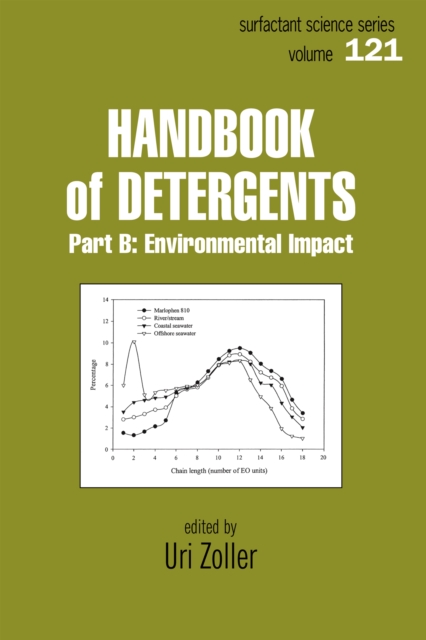
The second installment of the multivolume Handbook of Detergents deals with the potential environmental impact of detergents as a result of their production, formulation, usage, consumption, and disposal.
Pursuing a multidisciplinary approach, this book highlights current challenges in, and potential solutions to, environmental water management in Mexico.
This volume continues the retrospective analyses of Volumes I and II, but goes beyond that in an attempt to understand how phenolic acids are partitioned in seedling-solution and seedling-microbe-soil-sand culture systems and how phenolic acid effects on seedlings may be related to the actual and/or conditional physicochemical properties (e.
This textbook offers a comprehensive and authoritative introduction to the latest analytical methods, tools and techniques used in the marine environment, bringing together the two fields of chemical oceanography and analytical chemistry.
Advances in Geophysics, Volume 61 - Machine Learning and Artificial Intelligence in Geosciences, the latest release in this highly-respected publication in the field of geophysics, contains new chapters on a variety of topics, including a historical review on the development of machine learning, machine learning to investigate fault rupture on various scales, a review on machine learning techniques to describe fractured media, signal augmentation to improve the generalization of deep neural networks, deep generator priors for Bayesian seismic inversion, as well as a review on homogenization for seismology, and more.
Chemical Fate and Transport in the Environment, Fourth Edition explains the fundamental principles of mass transport, chemical partitioning, and chemical/biological transformations of pollutants and naturally occurring chemicals in surface waters, in the subsurface (which includes soil and groundwater), and in the atmosphere.
Urban Soil and Water Degration, Volume Seven explores a wide breadth of emerging and state-of-the-art technologies, including comprehensive coverage of topics such as Urban sprawl, Soil degradation, Hydrological challenges in urban areas, Soil and water quality - pollutant sources and pathways, Ecosystem services in urban areas, Freshwater-related nature-based solutions in cities, Property Rights and Climate Change - land use under changing environmental conditions, Municipal planning to prevent soil and water degradation: The case of Vilnius, In between water and fires: soil degradation in a new Mediterranean peri-urban landscape, and more.
The term "e;total petroleum hydrocarbons"e; (TPHs) is used for any mixture of several hundred hydrocarbons found in crude oil, and they represent the sum of volatile petroleum hydrocarbons and extractable petroleum hydrocarbons.
Advances in Geophysics, Volume 60, the latest release in this highly-respected publication in the field of geophysics, contains new chapters on a variety of topics, including Marchenko imaging, Fiber-optic sensing and distributed acoustic sensing, Diffractions, and Time-lapse interferometry across scales.
This book presents a comprehensive collection of articles illustrating the importance of microbial community structure and function for ecosystem sustainability and environmental reclamation.
Rampant industrialization has caused high levels of contamination by various toxic chemicals in our water bodies, which is a matter of concern in terms of ecosystems, as well as human and animal health.
This book offers a comprehensive and accessible guide covering various aspects of trace metal contamination in abiotic and biotic matrices of an iconic Indian tropical mangrove wetland - Sundarban.
This book provides an in-depth review of heavy metals in corals, describing the sources of heavy metals in the marine environment and their effect on corals.
This is the second volume on adsorption using green adsorbents and is written by international contributors who are the leading experts in the adsorption field.
In its second volume, this book aims to link the academic research with development in the real world and provide a historical and institutional background that can enrich more formal research.
This book provides a concise, yet comprehensive overview of the many facets relating to human health risk assessments in relation to chemical exposure problems.
The Indian Nitrogen Assessment: Sources of Reactive Nitrogen, Environmental and Climate Effects, and Management Options and Policies provides a reference for anyone interested in Reactive N, from researchers and students, to environmental managers.
Green Chemistry: An Inclusive Approach provides a broad overview of green chemistry for researchers from either an environmental science or chemistry background, starting at a more elementary level, incorporating more advanced concepts, and including more chemistry as the book progresses.
The Application of Green Solvents in Separation Processes features a logical progression of a wide range of topics and methods, beginning with an overview of green solvents, covering everything from water and organic solvents, to ionic liquids, switchable solvents, eutectic mixtures, supercritical fluids, gas-expanded solvents, and more.
This book is a sister volume to Volume 20 of the Handbook of Environmental Engineering Series, "e;Integrated Natural Resources Management"e;, and expands on the themes of that volume by addressing the conservation and protection of natural resources in an environmental engineering context through state-of-the-art research methodologies and technologies.
Chemical Fate and Transport in the Environment, Fourth Edition explains the fundamental principles of mass transport, chemical partitioning, and chemical/biological transformations of pollutants and naturally occurring chemicals in surface waters, in the subsurface (which includes soil and groundwater), and in the atmosphere.
Biochar: Fundamentals and Applications in Environmental Science and Remediation Technologies, Volume Six provides readers with the fundamentals of scientific and technological aspects of biochar application in stormwater treatment, its use in contaminant removal, greenhouse gas mitigation, as landfill cover material, and new environmental and agronomic applications.
Key Concepts in Environmental Chemistry provides a modern and concise introduction to environmental chemistry principles and the dynamic nature of environmental systems.
This is the first complete edited volume devoted to providing comprehensive and state-of-the art descriptions of science principles and pilot- and field-scaled engineering applications of nanoscale zerovalent iron particles (NZVI) for soil and groundwater remediation.
Microbial or biological degradation has long been the subject of active concern, and the rapid expansion and growing sophistication of various industries in the last century has significantly increased the volume and complexity of toxic residues of wastes.
Featuring a collection of informative and descriptive chapters, this book is essential reading for environmental scientists, environmental toxicologists and people from allied fields.
Accidents involving reactive chemicals can often be prevented, or their effects alleviated, if those handling them have a sound knowledge both of their hazardous properties and of appropriate handling methods.
To achieve successful solutions to the problems resulting from local, distant and global radioactive fallout after nuclear explosions and accidents and to achieve successful retrospective analyses of the radiation conditions from recent observations, certain information is needed: the distribution of the exposure dose rate in the atmosphere and in a country; the distribution of radionuclides in natural environments and the nuclide composition of the radioactive fallout; the features of formation of the aerosol particle-carriers of the radioactivity and of the nuclide distribution of the particles of different sizes formed under different conditions; the processes involved in the migration of radioactive products in different zones and environments; the external and internal effects of nuclear radiation on human beings.
The steadily increasing presence of both natural and anthropogenic pollutants in our environment poses a considerable challenge, given the recalcitrance of many of these pollutants.
Arsenic contamination in drinking water and crops is a major health issue in many countries worldwide, threatening the health of millions of people due to arsenic's toxicity and carcinogenicity.
Arsenic contamination in drinking water and crops is a major health issue in many countries worldwide, threatening the health of millions of people due to arsenic's toxicity and carcinogenicity.
Over the last century and a half, groundwaters have become contaminated by a growing number of organic and inorganic substances ranging from petroleum-derived hydrocarbons to radioactive compounds, to cancer-causing hexavalent chromium.
This edited volumes contains overviews and case studies of land and water contamination and remediation from international scholars, most from developing countries.
This edited volumes contains overviews and case studies of land and water contamination and remediation from international scholars, most from developing countries.