The Advances in Inorganic Chemistry series present timely and informative summaries of the current progress in a variety of subject areas within inorganic chemistry, ranging from bio-inorganic to solid state studies.
Molten salts and fused media provide the key properties and the theory of molten salts, as well as aspects of fused salts chemistry, helping you generate new ideas and applications for fused salts.
The Advances in Inorganic Chemistry presents timely and informative summaries of the current progress in a variety of subject areas within inorganic chemistry, ranging from bio-inorganic to solid state studies.
This book focuses on inorganic nanosheets, including various oxides, chalcogenides, and graphenes, that provide two-dimensional (2D) media to develop materials chemistry in broad fields such as electronics, photonics, environmental science, and biology.
The Advances in Inorganic Chemistry series present timely and informative summaries of the current progress in a variety of subject areas within inorganic chemistry, ranging from bio-inorganic to solid state studies.
The Advances in Inorganic Chemistry series present timely and informative summaries of the current progress in a variety of subject areas within inorganic chemistry, ranging from bio-inorganic to solid state studies.
Photonic and Electronic Properties of Fluoride Materials: Progress in Fluorine Science, the first volume in this new Elsevier series, provides an overview of the important optical, magnetic, and non-linear properties of fluoride materials.
By some measure the most widely produced chemical in the world today, sulfuric acid has an extraordinary range of modern uses, including phosphate fertilizer production, explosives, glue, wood preservative and lead-acid batteries.
Inorganic Controlled Release Technology: Materials and Concepts for Advanced Drug Formulation provides a practical guide to the use and applications of inorganic controlled release technology (iCRT) for drug delivery and other healthcare applications, focusing on newly developed inorganic materials such as bioresorbable glasses and bioceramics.
The First International Nitrogen Conference provided an opportunity for researchers and decision-makers to exchange information on environmental pollution by nitrogen compounds on three scales: global, continental/regional and local.
This volume presents and evaluates reported solubility data for the title compounds, complementing an earlier volume in the IUPAC Solubility Data Series dealing with alkali metal halides.
By some measure the most widely produced chemical in the world today, sulfuric acid has an extraordinary range of modern uses, including phosphate fertilizer production, explosives, glue, wood preservative and lead-acid batteries.
This comprehensive database on physical properties of pure ionic liquids (ILs) contains data collected from 269 peer-reviewed papers in the period from 1982 to June 2008.
The Advances in Inorganic Chemistry series present timely and informative summaries of the current progress in a variety of subject areas within inorganic chemistry, ranging from bio-inorganic to solid state studies.
This continuing authoritative series deals with the chemistry, materials science, physics and technology of the rare earth elements in an integrated manner.
Coordination compounds have been well-known for their wide variety of applications for over a century, as well as enhancing the researcher's interest and concern in evaluating their action mechanism.
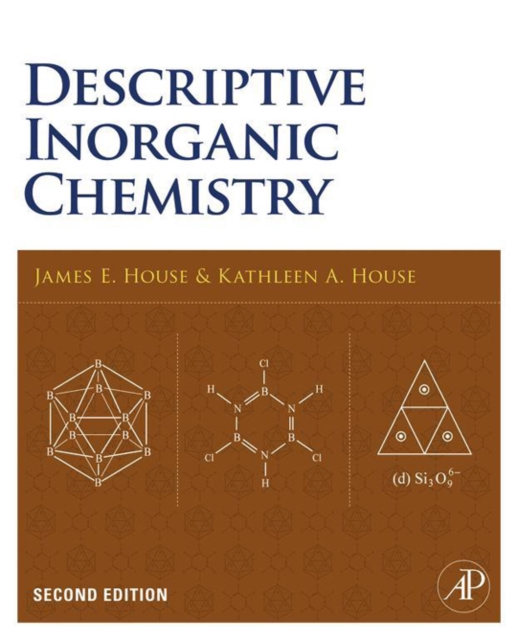
Descriptive Inorganic Chemistry, Second Edition, covers the synthesis, reactions, and properties of elements and inorganic compounds for courses in descriptive inorganic chemistry.
The Advances in Inorganic Chemistry series present timely and informative summaries of the current progress in a variety of subject areas within inorganic chemistry, ranging from bio-inorganic to solid state studies.
Carboranes, Second Edition is designed as a comprehensive source of information in a field that has experienced enormous growth in both its fundamental and applied aspects in the four decades since the publication of Carboranes (1970).
This book treats the different current as well as unusual and hitherto often unstudied physico-chemical and surface-thermodynamic properties of water that govern all polar interactions occurring in it.
Since the publication Comprehensive Organometallic Chemistry in 1982, studies on the chemistry of moleculeswith carbon-metal bonds have continued to expand rapidly.
Written by a preeminent teacher and scientist in the field, Bioinorganic Chemistry provides specialists, students, and general readers with an understanding of the basic chemistry of interactions of inorganic substances with biological systems at the molecular level.
The purpose of the symposium was to present recent advances in characterization and control of odour and volatile organic compound emissions in the atmosphere, and to contribute to the state-of-the-art of measurement and sampling tools, impact prediction methods and abatement techniques.