This is the first volume in a comprehensive two-volume set, 'Advances in Quantum Science', whose second volume is 'Advances in Quantum Science II: Computational and Experimental Approaches'.
This is the second volume in a comprehensive two-volume set, 'Advances in Quantum Science', whose first volume is 'Advances in Quantum Science I: Theoretical and Methodological Approaches'.
“Recent Computational Techniques in De Novo Drug Design” gives a thorough overview of modern computational methods used to discover new chemical compounds.
“Recent Computational Techniques in De Novo Drug Design” gives a thorough overview of modern computational methods used to discover new chemical compounds.
This volume collects research findings presented at the 8th Edition of the Electronic Structure: Principles and Applications (ESPA-2012) International Conference, held in Barcelona, Spain on June 26-29, 2012.
This textbook offers a rigorous, self-contained introduction to quantum many-body theory, developed from lecture notes at the University of Naples “Federico II.
This textbook offers a rigorous, self-contained introduction to quantum many-body theory, developed from lecture notes at the University of Naples “Federico II.
This is the first book to focus on the topological index, the Harary index, of a graph, including its mathematical properties, chemical applications and some related and attractive open problems.
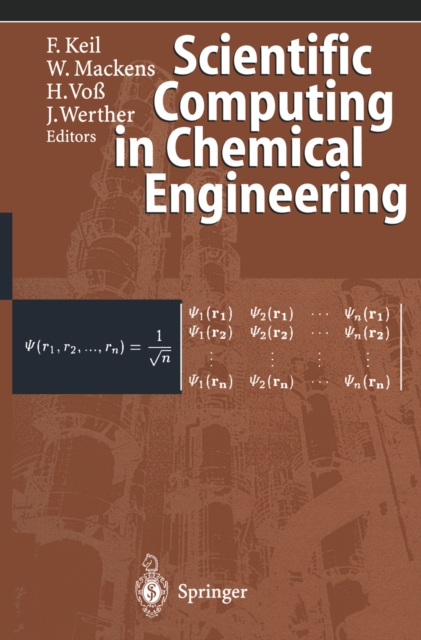
Scientific Computing in Chemical Engineering gives the state of the art from the point of view of the numerical mathematicians as well as from the engineers.
"e;Modern Thermodynamics- Based on the Extended Carnot Theorem"e; provides comprehensive definitions and mathematical expressions of both classical and modern thermodynamics.
Spanning energy regimes from ultracold atoms to plasma chemistry, this concise volume presents a unified treatment of termolecular reaction dynamics, integrating statistical models, direct three-body recombination, and classical mechanisms such as Lindemann-Hinshelwood.
Spanning energy regimes from ultracold atoms to plasma chemistry, this concise volume presents a unified treatment of termolecular reaction dynamics, integrating statistical models, direct three-body recombination, and classical mechanisms such as Lindemann-Hinshelwood.
The first volume of Lecture Notes in Quantum Chemistry (Lecture Notes in Chemistry 58, Springer Verlag, Berlin 1992) contained a compilation of selected lectures given at the two first European Summer Schools in Quantum Chemistry (ESQC), held in southern Sweden in August 1989 and 1991, respectively.
This updated, second edition features a new section how to document and measure all the mass and charge transport properties of a material and a comprehensive solution manual for end-of-chapter exercise problems, that is designed to help readers themselves grasp and apply the fundamental knowledge of kinetics.
This book, the first volume of a two-part monograph, is centered on key background fundamentals and results, and on the description of the State- and Property-Specific Approach (SPSA) to the construction and implementation of efficacious methods for the quantitative solution of various types of time-independent or time-dependent problems in Quantum Chemistry and in Atomic, Molecular, Optical, and Chemical Physics.
Nuclear magnetic resonance (NMR) spectroscopy is the gold standard for identification of reaction products and unknown substances in the synthetic laboratory.
Nuclear magnetic resonance (NMR) spectroscopy is the gold standard for identification of reaction products and unknown substances in the synthetic laboratory.
Die Zusammenstellung dieser grundlegenden Beiträge und echten "highlights" aus früheren Bänden des Analytiker-Taschenbuchs befaßt sich mit den Themen "Chemometrie, Statistik, Nachweisgrenzen und GLP".
Mathematiker haben in den letzten Jahren grundlegende Beiträge zu Fragestellungen in der Industrie, in Transport und Kommunikation, Versicherungen und Banken, in Medizin und Biologie geleistet.
Scientists are increasingly finding themselves engaged in research problems that cross the traditional disciplinary lines of physics, chemistry, biology, materials science, and engineering.
This textbook presents an introduction to electromagnetism intended for undergraduate and graduate students in chemistry, chemical engineering, materials science, and related areas.
This book explores how thermodynamics, together with its statistical rationalization in terms of constituent atoms, provides a coherent framework for understanding contemporary developments in our increasingly digital world.
This book explores how thermodynamics, together with its statistical rationalization in terms of constituent atoms, provides a coherent framework for understanding contemporary developments in our increasingly digital world.
From the So You Want To Be A… Series — 2026 Purple Dragonfly Book Awards, Grand Prize Winner Somewhere right now, a space telescope is staring at a single patch of sky and tracking thousands of stars at once — watching for a flicker of dimming light so faint that one part in ten thousand counts as a signal.