In order to study discrete Abelian groups with wide range applications, the use of classical functional equations, difference and differential equations, polynomial ideals, digital filtering and polynomial hypergroups is required.
The book is the first full-size Encyclopedia which simultaneously covers such well-established and modern subjects as quantum field theory, supersymmetry, supergravity, M-theory, black holes and quantum gravity, noncommutative geometry, representation theory, categories and quantum groups, and their generalizations.
Several of the contributions to this volume bring forward many mutually beneficial interactions and connections between the three domains of the title.
Mathematical Morphology is a speciality in Image Processing and Analysis, which considers images as geometrical objects, to be analyzed through their interactions with other geometrical objects.
The Curves The Point of View of Max Noether Probably the oldest references to the problem of resolution of singularities are found in Max Noether's works on plane curves [cf.
The purpose of the book is to take stock of the situation concerning Algebra via Category Theory in the last fifteen years, where the new and synthetic notions of Mal'cev, protomodular, homological and semi-abelian categories emerged.
Galois connections provide the order- or structure-preserving passage between two worlds of our imagination - and thus are inherent in hu- man thinking wherever logical or mathematical reasoning about cer- tain hierarchical structures is involved.
A look at one of the most exciting unsolved problems in mathematics todayElliptic Tales describes the latest developments in number theory by looking at one of the most exciting unsolved problems in contemporary mathematics-the Birch and Swinnerton-Dyer Conjecture.
This textbook teaches the fundamentals of algebra, keeping points clear, succinct and focused, with plenty of diagrams and practice but relatively few words.
"e;Presents the structure of algebras appearing in representation theory of groups and algebras with general ring theoretic methods related to representation theory.
Clear prose, tight organization, and a wealth of examples and computational techniques make Basic Matrix Algebra with Algorithms and Applications an outstanding introduction to linear algebra.
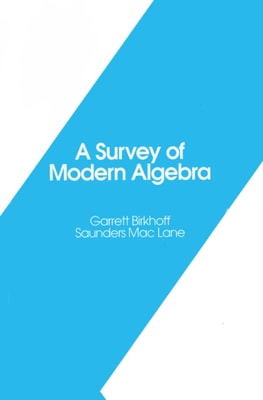
This classic, written by two young instructors who became giants in their field, has shaped the understanding of modern algebra for generations of mathematicians and remains a valuable reference and text for self study and college courses.
Designed for use in a second course on linear algebra, Matrix Theory and Applications with MATLAB covers the basics of the subject-from a review of matrix algebra through vector spaces to matrix calculus and unitary similarity-in a presentation that stresses insight, understanding, and applications.
Since abstract algebra is so important to the study of advanced mathematics, it is critical that students have a firm grasp of its principles and underlying theories before moving on to further study.
In one exceptional volume, Abstract Algebra covers subject matter typically taught over the course of two or three years and offers a self-contained presentation, detailed definitions, and excellent chapter-matched exercises to smooth the trajectory of learning algebra from zero to one.
The techniques of linear algebra are used extensively across the applied sciences, and in many different areas of algebra such as group theory, module theory, representation theory, ring theory, and Galois theory.
The techniques of linear algebra are used extensively across the applied sciences, and in many different areas of algebra such as group theory, module theory, representation theory, ring theory, and Galois theory.
The 39 self-contained sections in this book present worked-out examples as well as many sample problems categorized by the level of difficulty as Bronze, Silver, and Gold in order to help the readers gauge their progress and learning.
The 39 self-contained sections in this book present worked-out examples as well as many sample problems categorized by the level of difficulty as Bronze, Silver, and Gold in order to help the readers gauge their progress and learning.
Concise Introduction to Linear Algebra deals with the subject of linear algebra, covering vectors and linear systems, vector spaces, orthogonality, determinants, eigenvalues and eigenvectors, singular value decomposition.
Concise Introduction to Linear Algebra deals with the subject of linear algebra, covering vectors and linear systems, vector spaces, orthogonality, determinants, eigenvalues and eigenvectors, singular value decomposition.
Linear Methods: A General Education Course is expressly written for non-mathematical students, particularly freshmen taking a required core mathematics course.
Linear Methods: A General Education Course is expressly written for non-mathematical students, particularly freshmen taking a required core mathematics course.