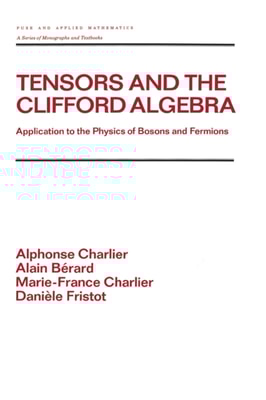
This practical reference and text presents the applications of tensors, Lie groups and algebra to Maxwell, Klein-Gordon and Dirac equations, making elementary theoretical physics comprehensible and high-level theoretical physics accessible.
This book introduces various notions defined in graded terms extending the notions most frequently used as basic ingredients in the theory of Azumaya algebras: separability and Galois extensions of commutative rings, crossed products and Galois cohomology, Picard groups, and the Brauer group.
Sequence spaces and summability over valued fields is a research book aimed at research scholars, graduate students and teachers with an interest in Summability Theory both Classical (Archimedean) and Ultrametric (non-Archimedean).
Sequence spaces and summability over valued fields is a research book aimed at research scholars, graduate students and teachers with an interest in Summability Theory both Classical (Archimedean) and Ultrametric (non-Archimedean).
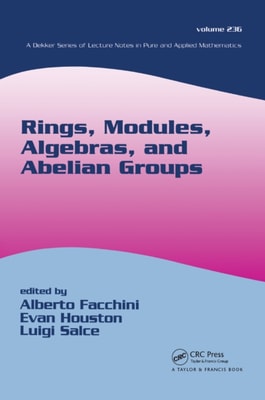
Rings, Modules, Algebras, and Abelian Groups summarizes the proceedings of a recent algebraic conference held at Venice International University in Italy.
Building on the author's previous edition on the subject (Introduction to Linear Algebra, Jones & Bartlett, 1996), this book offers a refreshingly concise text suitable for a standard course in linear algebra, presenting a carefully selected array of essential topics that can be thoroughly covered in a single semester.
This book presents the general theory of categorical closure operators to- gether with a number of examples, mostly drawn from topology and alge- bra, which illustrate the general concepts in several concrete situations.
"e;102 Combinatorial Problems"e; consists of carefully selected problems that have been used in the training and testing of the USA International Mathematical Olympiad (IMO) team.
One of the great successes of twentieth century mathematics has been the remarkable qualitative understanding of rational and integral points on curves, gleaned in part through the theorems of Mordell, Weil, Siegel, and Faltings.
The subject of Clifford algebras has become an increasingly rich area of research with a significant number of important applications not only to mathematical physics but to numerical analysis, harmonic analysis, and computer science.
A group of Gerry Schwarz's colleagues and collaborators gathered at the Fields Institute in Toronto for a mathematical festschrift in honor of his 60th birthday.
One of the landmarks in the history of mathematics is the proof of the nonex- tence of algorithms based solely on radicals and elementary arithmetic operations (addition, subtraction, multiplication, and division) for solutions of general al- braic equations of degrees higher than four.
An Introduction to Tensors and Group Theory for Physicists provides both an intuitive and rigorous approach to tensors and groups and their role in theoretical physics and applied mathematics.
The first book of its kind, New Foundations in Mathematics: The Geometric Concept of Number uses geometric algebra to present an innovative approach to elementary and advanced mathematics.
A cornerstone of undergraduate mathematics, science, and engineering, this clear and rigorous presentation of the fundamentals of linear algebra is unique in its emphasis and integration of computational skills and mathematical abstractions.
Semisimple Lie groups, and their algebraic analogues over fields other than the reals, are of fundamental importance in geometry, analysis, and mathematical physics.
Advances in technology over the last 25 years have created a situation in which workers in diverse areas of computerscience and engineering have found it neces- sary to increase their knowledge of related fields in order to make further progress.
The field of vertex operator algebras is an active area of research and plays an integral role in infinite-dimensional Lie theory, string theory, and conformal field theory, and other subdisciplines of mathematics and physics.
Building bridges between classical results and contemporary nonstandard problems, Mathematical Bridges embraces important topics in analysis and algebra from a problem-solving perspective.
Rooted in a pedagogically successful problem-solving approach to linear algebra, this work fills a gap in the literature that is sharply divided between, on the one end, elementary texts with only limited exercises and examples, and, at the other end, books too advanced in prerequisites and too specialized in focus to appeal to a wide audience.