This book features a selection of revised and extended research articles written by prominent researchers who participated in the 26th World Congress on Engineering and Computer Science (WCECS 2018), held in San Francisco, USA, on October 23-25, 2018.
This book contains a selection of revised and extended research articles written by prominent researchers participating in the 27th World Congress on Engineering and Computer Science (WCECS 2019) which was held in San Francisco, USA, on October 22-24, 2019.
This book uses kinematics, mechanics, mathematics, and so on, to systematically propose the fixturing performance evaluation and fixturing layout planning method.
The book is an introduction, for both graduate students and newcomers to the field of the modern theory of mesoscopic complex systems, time series, hypergraphs and graphs, scaled random walks, and modern information theory.
This book will give readers the possibility of finding very important mathematical tools for working with fractional models and solving fractional differential equations, such as a generalization of Stirling numbers in the framework of fractional calculus and a set of efficient numerical methods.
Current mathematical models are notoriously unreliable in describing the time evolution of unexpected social phenomena, from financial crashes to revolution.
The monograph applies sophisticated topological symmetry tools to biological applications of information theory, along with a Black-Scholes model invocation of the Data Rate Theorem which links information and control theories.
MATLAB and Simulink Crash Course for Engineers is a reader-friendly introductory guide to the features, functions, and applications of MATLAB and Simulink.
Zadeh introduced in 1965 the theory of fuzzy sets, in which truth values are modelled by numbers in the unit interval [0, 1], for tackling mathematically the frequently appearing in everyday life partial truths.
This book discusses the P-graph framework for developing and understanding effective design tools for process systems engineering, and addresses the current state of its theory and applications.
This contributed volume investigates several mathematical techniques for the modeling and simulation of viral pandemics, with a special focus on COVID-19.
This book investigates in detail model-based fault diagnosis methods, including observer-based residual generation, residual evaluation based on threshold computation, observer-based fault isolation strategies, observer-based fault estimation, Kalman filter-based fault diagnosis methods, and parity space approach.
This edited volume collects six surveys that present state-of-the-art results on modeling, qualitative analysis, and simulation of active matter, focusing on specific applications in the natural sciences.
Delve into the realm of statistical methodology for mediation analysis with a Bayesian perspective in high dimensional data through this comprehensive guide.
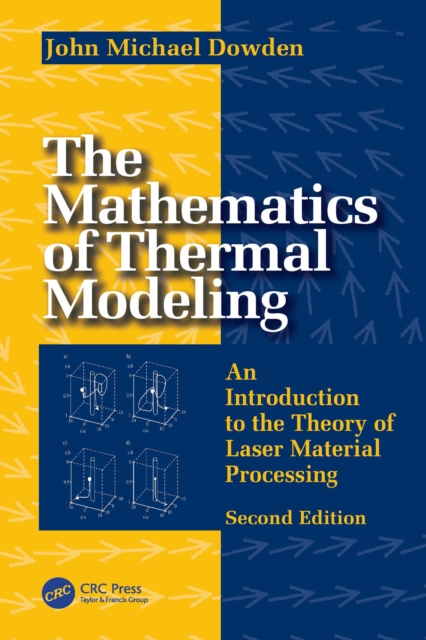
The Mathematics of Thermal Modeling, Second Edition, provides an introduction to the basics of the mathematics and physics needed to understand and use the physical principles employed in constructing models of a number of aspects of thermal modeling in industrial processes, notably laser welding; most of the techniques are applicable to many other technological processes, however.
This proceedings volume convenes selected, peer-reviewed papers presented at the 3rd International Conference on Mathematics and its Applications in Science and Engineering - ICMASE 2022, which was held on July 4-7, 2022 by the Technical University of Civil Engineering of Bucharest, Romania.
This third volume of the book series shows R-calculus is a Gentzen-typed deduction system which is non-monotonic, and is a concrete belief revision operator which is proved to satisfy the AGM postulates and the DP postulates.
As the first book of a three-part series, this book is offered as a tribute to pioneers in vision, such as Bela Julesz, David Marr, King-Sun Fu, Ulf Grenander, and David Mumford.
The volume provides a comprehensive understanding of the macroscopic failure behavior of solids from the description of the microscopic failure processes and their coupling with the microstructure.
This book mathematically analyzes the basic problems of biology, decision making and psychology within the framework of the theory of open quantum systems.
Special functions play a very important role in solving various families of ordinary and partial differential equations as well as their fractional-order analogs, which model real-life situations.
Triangulations, and more precisely meshes, are at the heart of many problems relating to a wide variety of scientific disciplines, and in particular numerical simulations of all kinds of physical phenomena.
This text describes a comprehensive adjoint sensitivity analysis methodology (nth-CASAM), developed by the author, which enablesthe efficient and exact computation of arbitrarily high-order functional derivatives of model responses to model parameters in large-scale systems.
This book mathematically analyzes the basic problems of biology, decision making and psychology within the framework of the theory of open quantum systems.
The new edition of Mathematical Modeling, the survey text of choice for mathematical modeling courses, adds ample instructor support and online delivery for solutions manuals and software ancillaries.
This book introduces a new approach in the field of macroeconomic inventory studies: the use of multivariate statistics to evaluate long-term characteristics of inventory investments in developed countries.