The book illustrates the theoretical results of fractional derivatives via applications in signals and systems, covering continuous and discrete derivatives, and the corresponding linear systems.
This two-volume work focuses on the mathematical aspects of Darwinian evolution starting from the basic model of stochastic evolution of a single isolated locus in the presence of mutation to the multi-locus models of sexual and asexual populations.
This two-volume work focuses on the mathematical aspects of Darwinian evolution starting from the basic model of stochastic evolution of a single isolated locus in the presence of mutation to the multi-locus models of sexual and asexual populations.
This book presents the state-of-the-art methods in Linear Integer Programming, including some new algorithms and heuristic methods developed by the authors in recent years.
The revised edition gives a comprehensive mathematical and physical presentation of fluid flows in non-classical models of convection - relevant in nature as well as in industry.
This book presents a comprehensive overview of the mathematics and physics behind the simulation of turbulent flows and discusses in detail (i) the phenomenology of turbulence in fluid dynamics, (ii) the role of direct and large-eddy simulation in predicting these dynamics, (iii) the multiple considerations underpinning subgrid modelling, and, (iv) the issue of validation and reliability resulting from interacting modelling and numerical errors.
The contributions by leading experts in this book focus on a variety of topics of current interest related to information-based complexity, ranging from function approximation, numerical integration, numerical methods for the sphere, and algorithms with random information, to Bayesian probabilistic numerical methods and numerical methods for stochastic differential equations.
Introduction to Statistical Analysis of Laboratory Data presents a detailed discussion of important statistical concepts and methods of data presentation and analysis Provides detailed discussions on statistical applications including a comprehensive package of statistical tools that are specific to the laboratory experiment process Introduces terminology used in many applications such as the interpretation of assay design and validation as well as fit for purpose procedures including real world examples Includes a rigorous review of statistical quality control procedures in laboratory methodologies and influences on capabilities Presents methodologies used in the areas such as method comparison procedures, limit and bias detection, outlier analysis and detecting sources of variation Analysis of robustness and ruggedness including multivariate influences on response are introduced to account for controllable/uncontrollable laboratory conditions
This volume provides an introduction to modern space-time discretization methods such as finite and boundary elements and isogeometric analysis for time-dependent initial-boundary value problems of parabolic and hyperbolic type.
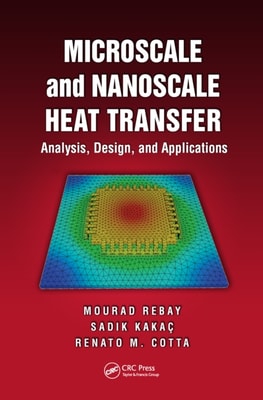
Microscale and Nanoscale Heat Transfer: Analysis, Design, and Applications features contributions from prominent researchers in the field of micro- and nanoscale heat transfer and associated technologies and offers a complete understanding of thermal transport in nano-materials and devices.
The revised edition gives a comprehensive mathematical and physical presentation of fluid flows in non-classical models of convection - relevant in nature as well as in industry.
This book addresses the increasing energy demand and costs associated with the global refrigeration industry, primarily driven by the need for cooling.
The text provides insight into the different mathematical tools and techniques that can be applied to the analysis and numerical computations of flow models.
The text provides insight into the different mathematical tools and techniques that can be applied to the analysis and numerical computations of flow models.
Comprising sixteen independent chapters, this book covers recent advancements and emerging pathways within human-friendly robotics on physical and cognitive levels.
Comprising sixteen independent chapters, this book covers recent advancements and emerging pathways within human-friendly robotics on physical and cognitive levels.