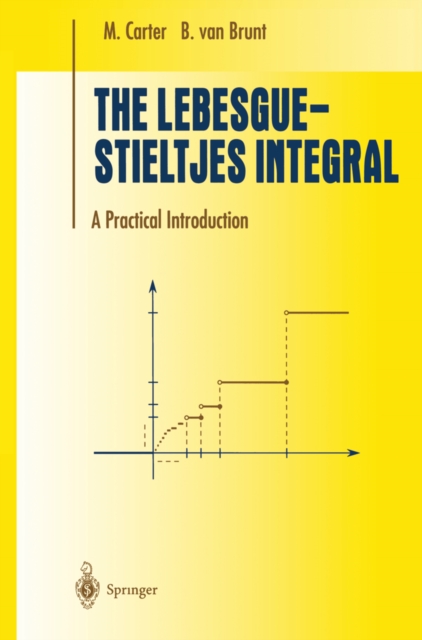
Mathematics students generally meet the Riemann integral early in their undergraduate studies, then at advanced undergraduate or graduate level they receive a course on measure and integration dealing with the Lebesgue theory.
From the reviews: "e;A good introduction to a subject important for its capacity to circumvent theoretical and practical obstacles, and therefore particularly prized in the applications of mathematics.
Broadly speaking, analysis is the study of limiting processes such as sum- ming infinite series and differentiating and integrating functions, and in any of these processes there are two issues to consider; first, there is the question of whether or not the limit exists, and second, assuming that it does, there is the problem of finding its numerical value.
Assuming only calculus and linear algebra, this book introduces the reader in a technically complete way to measure theory and probability, discrete martingales, and weak convergence.
The present course on calculus of several variables is meant as a text, either for one semester following A First Course in Calculus, or for a year if the calculus sequence is so structured.
This book was planned originally not as a work to be published, but as an excuse to buy a computer, incidentally to give me a chance to organize my own ideas ~n what measure theory every would-be analyst should learn, and to detail my approach to the subject.
Responses from colleagues and students concerning the first edition indicate that the text still answers a pedagogical need which is not addressed by other texts.
The purpose of a first course in calculus is to teach the student the basic notions of derivative and integral, and the basic techniques and applica- tions which accompany them.
Significantly revised and expanded, this authoritative reference/text comprehensively describes concepts in measure theory, classical integration, and generalized Riemann integration of both scalar and vector types-providing a complete and detailed review of every aspect of measure and integration theory using valuable examples, exercises, and applications.
Aimed primarily at undergraduate level university students, An Illustrative Introduction to Modern Analysis provides an accessible and lucid contemporary account of the fundamental principles of Mathematical Analysis.
Aimed primarily at undergraduate level university students, An Illustrative Introduction to Modern Analysis provides an accessible and lucid contemporary account of the fundamental principles of Mathematical Analysis.
Basic Analysis I: Functions of a Real Variable is designed for students who have completed the usual calculus and ordinary differential equation sequence and a basic course in linear algebra.
Basic Analysis I: Functions of a Real Variable is designed for students who have completed the usual calculus and ordinary differential equation sequence and a basic course in linear algebra.
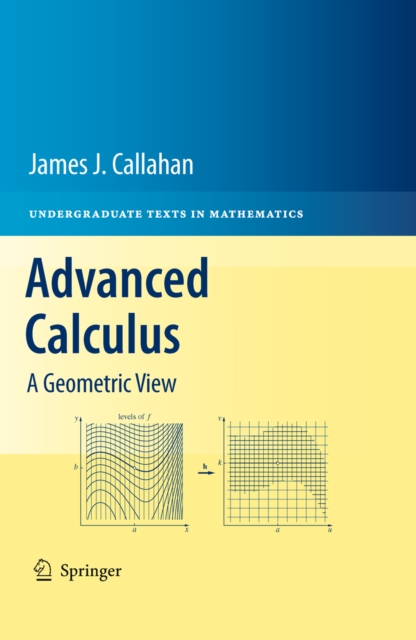
Advanced Calculus: An Introduction to Modem Analysis, an advanced undergraduate textbook,provides mathematics majors, as well as students who need mathematics in their field of study,with an introduction to the theory and applications of elementary analysis.
Advanced Calculus: An Introduction to Modem Analysis, an advanced undergraduate textbook,provides mathematics majors, as well as students who need mathematics in their field of study,with an introduction to the theory and applications of elementary analysis.
Chapter 1 poses 134 problems concerning real and complex numbers, chapter 2 poses 123 problems concerning sequences, and so it goes, until in chapter 9 one encounters 201 problems concerning functional analysis.
Chapter 1 poses 134 problems concerning real and complex numbers, chapter 2 poses 123 problems concerning sequences, and so it goes, until in chapter 9 one encounters 201 problems concerning functional analysis.