These are the Proceedings of the 6th International Symposium on Multibody Systems and Mechatronics (MUSME 2017) which was held in Florianopolis, Brazil, October 24-28, 2017.
This contributed volume contains a collection of articles on state-of-the-art developments on the construction of theoretical integral techniques and their application to specific problems in science and engineering.
This book presents a collection of results from the interdisciplinary research project "e;ELLI"e; published by researchers at RWTH Aachen University, the TU Dortmund and Ruhr-Universitat Bochum between 2011 and 2016.
This book introduces the reader to the field of jet substructure, starting from the basic considerations for capturing decays of boosted particles in individual jets, to explaining state-of-the-art techniques.
This book is devoted to the study of certain integral representations for Neumann, Kapteyn, Schlomilch, Dini and Fourier series of Bessel and other special functions, such as Struve and von Lommel functions.
This volume comprises the carefully revised papers of the 9th IUTAM Symposium on Laminar-Turbulent Transition, held at the Imperial College, London, UK, in September 2019.
The purpose of this volume is to explore new bridges between different research areas involved in the theory and applications of the fractional calculus.
This monograph presents a synopsis of fluid dynamics based on the personal scientific experience of the author who has contributed immensely to the field.
his two-volume set LNCS 12689-12690 constitutes the refereed proceedings of the 12th International Conference on Advances in Swarm Intelligence, ICSI 2021, held in Qingdao, China, in July 2021.
This book covers the development of innovative computational methodologies for the simulation of steel material fracture under both monotonic and ultra-low-cycle fatigue.
This book constitutes the revised papers of the 46th International Workshop on Graph-Theoretic Concepts in Computer Science, WG 2020, held in Leeds, UK, in June 2020.
This book presents the singular configurations associated with a robot mechanism, together with robust methods for their computation, interpretation, and avoidance path planning.
The articles in this collection are a sampling of some of the research presented during the conference "e;Stochastic Analysis and Related Topics"e;, held in May of 2015 at Purdue University in honor of the 60th birthday of Rodrigo Banuelos.
This book collects original peer-reviewed contributions to the conferences organised by the international research network "e;Minimal surfaces: Integrable Systems and Visualization"e; financed by the Leverhulme Trust.
This book develops tools to handle C*-algebras arising as completions of convolution algebras of sections of line bundles over possibly non-Hausdorff groupoids.
This three-volume set LNCS 12452, 12453, and 12454 constitutes the proceedings of the 20th International Conference on Algorithms and Architectures for Parallel Processing, ICA3PP 2020, in New York City, NY, USA, in October 2020.
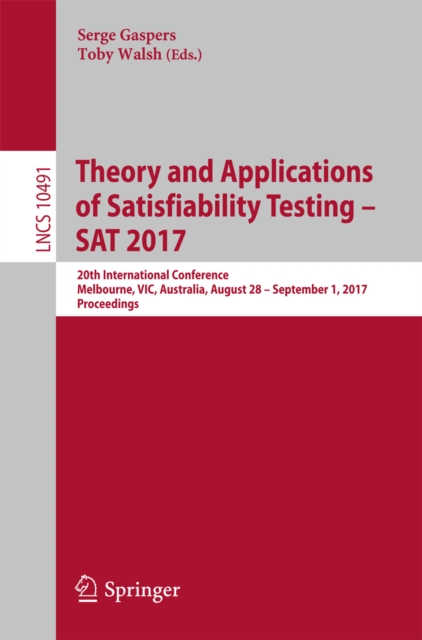
This book constitutes the refereed proceedings of the 20th International Conference on Theory and Applications of Satisfiability Testing, SAT 2017, held in Melbourne, Australia, in August/September 2017.
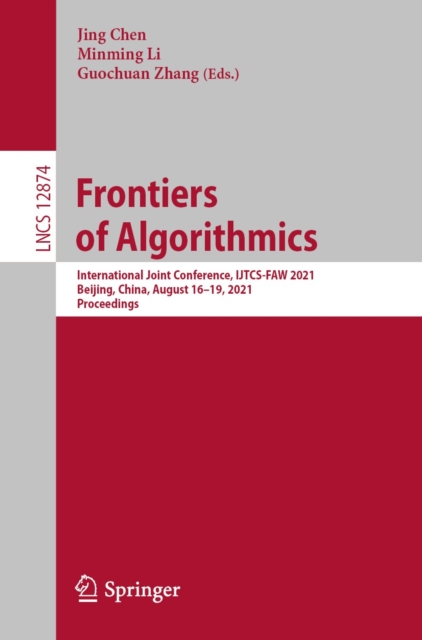
This book constitutes the proceedings of the 15th International Workshop on Frontiers in Algorithmics, FAW 2021, held in conjunction with second International Joint Conference on Theoretical Computer Science (IJTCS 2021), as IJTCS-FAW 2021, in Beijing, China, in August 2021.
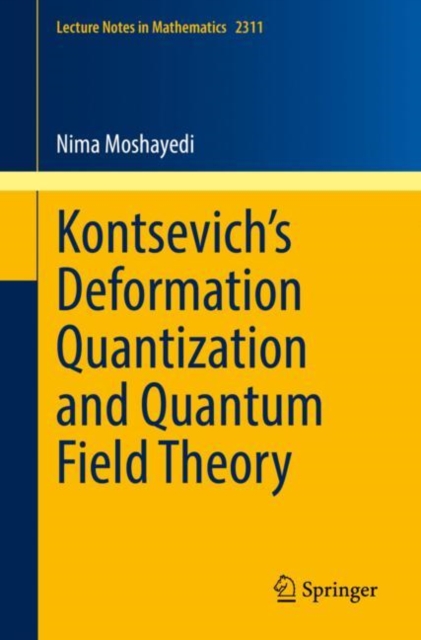
This book provides an introduction to deformation quantization and its relation to quantum field theory, with a focus on the constructions of Kontsevich and Cattaneo & Felder.
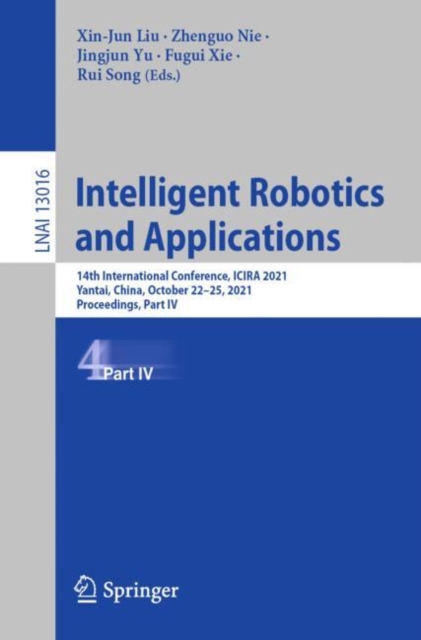
The 4-volume set LNAI 13013 - 13016 constitutes the proceedings of the 14th International Conference on Intelligent Robotics and Applications, ICIRA 2021, which took place in Yantai, China, during October 22-25, 2021.
This textbook provides a comprehensive introduction to the classical and modern calculus of variations, serving as a useful reference to advanced undergraduate and graduate students as well as researchers in the field.
This book focuses on developments in complex dynamical systems and geometric function theory over the past decade, showing strong links with other areas of mathematics and the natural sciences.
This book establishes bounds and asymptotics under almost minimal conditions on the varying weights, and applies them to universality limits and entropy integrals.
The 3-volume-set LNCS 12696 - 12698 constitutes the refereed proceedings of the 40th Annual International Conference on the Theory and Applications of Cryptographic Techniques, Eurocrypt 2021, which was held in Zagreb, Croatia, during October 17-21, 2021.
This book describes the Hamilton-Jacobi formalism of quantum mechanics, which allowscomputation of eigenvalues of quantum mechanical potential problems without solving for thewave function.
This book presents a broad overview of the important recent progress which led to the emergence of new ideas in Lipschitz geometry and singularities, and started to build bridges to several major areas of singularity theory.
This contributed volume provides readers with an overview of the most recent developments in the mathematical fields related to fractals, including both original research contributions, as well as surveys from many of the leading experts on modern fractal theory and applications.
The book collects the most relevant outcomes from the INdAM Workshop "e;Geometric Function Theory in Higher Dimension"e; held in Cortona on September 5-9, 2016.
This book presents a system that combines the expertise of four algorithms, namely Gradient Tree Boosting, Logistic Regression, Random Forest and Support Vector Classifier to trade with several cryptocurrencies.
This volume presents the revised papers of the 14th International Conference in Monte Carlo and Quasi-Monte Carlo Methods in Scientific Computing, MCQMC 2020, which took place online during August 10-14, 2020.
This volume offers an overview of the area of waves in fluids and the role they play in the mathematical analysis and numerical simulation of fluid flows.