Spaces of homogeneous type were introduced as a generalization to the Euclidean space and serve as a suffi cient setting in which one can generalize the classical isotropic Harmonic analysis and function space theory.
This book presents contemporary mathematical concepts and techniques including theories of summability, fixed point and non-absolute integration and applications, providing an overview of recent developments in the foundations of the field as well as its applications.
This monograph presents in a unified manner the use of the Morse index, and especially its connections to the maximum principle, in the study of nonlinear elliptic equations.
This book on functional analysis covers all the basics of the subject (normed, Banach and Hilbert spaces, Lebesgue integration and spaces, linear operators and functionals, compact and self-adjoint operators, small parameters, fixed point theory) with a strong focus on examples, exercises and practical problems, thus making it ideal as course material but also as a reference for self-study.
Intended for researchers, numerical analysts, and graduate students in various fields of applied mathematics, physics, mechanics, and engineering sciences, Applications of Lie Groups to Difference Equations is the first book to provide a systematic construction of invariant difference schemes for nonlinear differential equations.
Elliptic equations of critical Sobolev growth have been the target of investigation for decades because they have proved to be of great importance in analysis, geometry, and physics.
In recent years, the interaction between harmonic analysis and convex geometry has increased which has resulted in solutions to several long-standing problems.
Dieses 6-bändige Werk befasst sich mit den Anwendung von Differentialgleichungen in diversen Bereichen der Physik, Ingenieurwesen, Mathematik, Biologie und Soziologie.
The book is focused on physical interpretation and visualization of the obtained invariant solutions for nonlinear mathematical modeling of atmospheric and ocean waves.
Get ready for your AP Calculus AB exam with this straightforward, easy-to-follow study guide--updated to match the latest test changesThe wildly popular test prep guide updated and enhanced for smartphone users 5 Steps to a 5: AP Calculus AB 2017 provides a proven strategy to achieving high scores on this demanding Advanced Placement exam.
This proceedings volume gathers selected, peer-reviewed papers presented at the Dynamical Systems Theory and Applications International Conference - DSTA 2021, held virtually on December 6-9, 2021, organized by the Department of Automation, Biomechanics, and Mechatronics at Lodz University of Technology, Poland.
Spaces of homogeneous type were introduced as a generalization to the Euclidean space and serve as a suffi cient setting in which one can generalize the classical isotropic Harmonic analysis and function space theory.
This second extended edition of the classic reference on the extension problem of holomorphic functions in pluricomplex analysis contains a wealth of additional material, organized under the original chapter structure, and covers in a self-contained way all new and recent developments and theorems that appeared since the publication of the first edition about twenty years ago.
This monograph is devoted to the theory and approximation by finite volume methods of nonlinear hyperbolic systems of conservation laws in one or two space variables.
This is an indispensable reference for those mathematicians that conduct research activity in applications of fixed-point theory to boundary value problems for nonlinear difference equations.
This book on finite element-based computational methods for solving incompressible viscous fluid flow problems shows readers how to apply operator splitting techniques to decouple complicated computational fluid dynamics problems into a sequence of relatively simpler sub-problems at each time step, such as hemispherical cavity flow, cavity flow of an Oldroyd-B viscoelastic flow, and particle interaction in an Oldroyd-B type viscoelastic fluid.
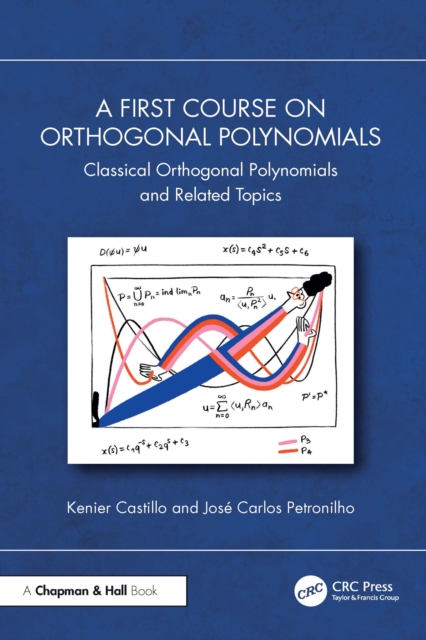
A First Course on Orthogonal Polynomials: Classical Orthogonal Polynomials and Related Topics provides an introduction to orthogonal polynomials and special functions aimed at graduate students studying these topics for the first time.
Nach einer Einführung in die holomorphen Funktionen von mehreren Veränderlichen wird die Welt der komplexen Mannigfaltigkeiten vorgestellt, insbesondere Untermannigfaltigkeiten, analytische Mengen und tangentiale Strukturen.
Introductory Differential Equations, Fourth Edition, offers both narrative explanations and robust sample problems for a first semester course in introductory ordinary differential equations (including Laplace transforms) and a second course in Fourier series and boundary value problems.
Nonlinear functional analysis is a central subject of mathematics with applications in many areas of geometry, analysis, fl uid and elastic mechanics, physics, chemistry, biology, control theory, optimization, game theory, economics etc.
An Essential Guide to Control Engineering FundamentalsUnderstand the day-to-day procedures of today's control engineer with the pragmatic insights and techniques contained in this unique resource.
This book gathers selected research articles presented in the "e;6th International Conference on Mathematical Modelling, Applied Analysis and Computation (ICMMAAC)"e;, held at JECRC University, Jaipur, during August 3-5, 2023.
In this book, ring-theoretical properties of skew Laurent series rings A((x; f)) over a ring A, where A is an associative ring with non-zero identity element are described.